组成图示
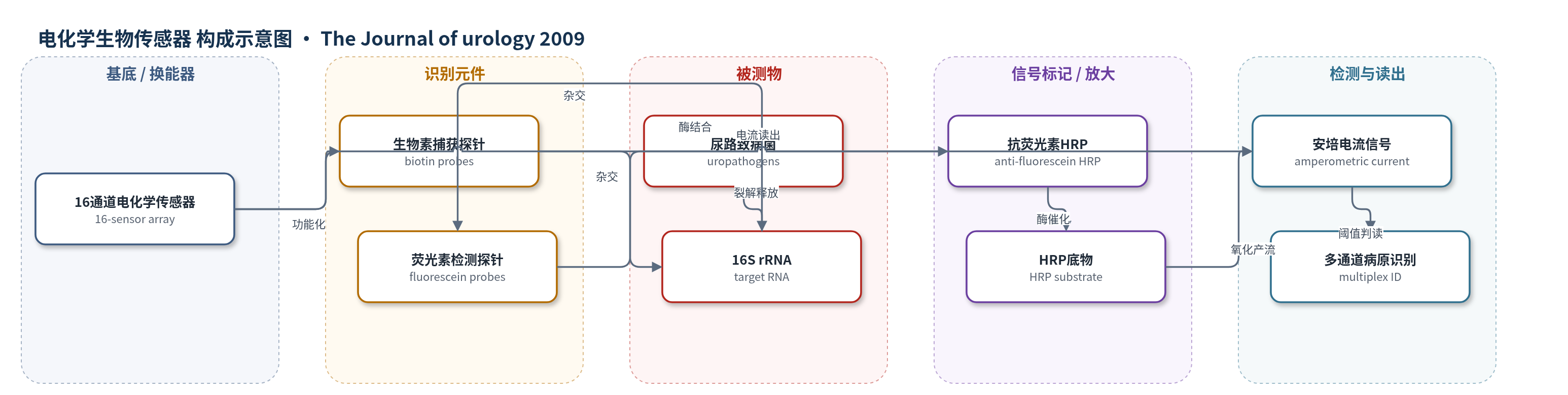
点击图片查看大图 · 依据论文自动绘制
传感器类型
电化学生物传感器
检测对象
尿路致病菌(uropathogens,包括大肠埃希菌 E. coli、铜绿假单胞菌 P. aeruginosa、肠球菌属 Enterococcus spp.、肺炎克雷伯菌 K. pneumoniae、奇异变形杆菌 P. mirabilis、鲍曼不动杆菌 A. baumannii 等)的16S rRNA;样品基质:尿液(urine,脊髓损伤患者新鲜尿沉渣)
检测原理
尿液沉渣经裂解释放细菌16S rRNA。传感器阵列各通道预先固定不同序列的生物素捕获探针,目标16S rRNA与捕获探针杂交;随后加入荧光素标记的检测探针,与目标RNA形成夹心杂交结构。抗荧光素辣根过氧化物酶(anti-fluorescein HRP)识别并结合荧光素标记的检测探针,使酶标定位到杂交复合物上。在固定电压下,HRP催化底物氧化,产生与酶量成正比的安培电流。由于每个病原菌释放的16S rRNA量与其浓度相关,且HRP具有可循环催化放大作用,各通道电流大小可反映对应病原菌浓度,从而实现无需核酸扩增的多重病原菌快速识别。
检测灵敏度
LOD: 10^4 cfu/ml(原文:overall limit of detection in the range of 10^4 cfu/ml in clinical samples);可检出低至: 2 × 10^4 cfu/ml(原文:pathogens at concentrations as low as 2 × 10^4 cfu/ml were detected);漏检浓度: ≤4 × 10^4 cfu/ml(原文:All pathogens that the biosensor missed were at 4 × 10^4 cfu/ml or less)
效应效果
该1小时多重电化学生物传感器在109份新鲜尿液样本中与标准培养比较,特异性和阳性预测值均为100%,总体敏感性89%,阴性预测值76%。ROC分析显示以高于阴性对照3个标准差为阈值时一致性最高(最大一致性0.917)。28份无生长样本全部判阴;81份培养阳性样本检出72份。漏检9份病原浓度均≤4×10^4 cfu/ml,复增至10^5 cfu/ml后可检出。多重感染样本中主要病原菌与培养一致,部分次要病原存在漏检或探针交叉反应,尤其KE探针可交叉识别克雷伯菌、肠杆菌及少数其他菌。相比需2–3天的培养法,该方法可在床旁时间窗内提供病原组成快照。
传感器的构成
- 基底/换能器电极:未修饰16通道电化学传感器阵列(16-sensor array,芯片式电极,具体电极材料未说明)
- 识别元件(捕获探针):5'-生物素标记DNA捕获探针(capture probes,如UNI782C、EB1172C、EC449C、KE434C、PM187C、PA102C、EF207C、AB456C),固定于传感器表面
- 识别元件(检测探针):3'-荧光素标记DNA检测探针(detector probes,如UNI751D、EB1137D、EC408D、KE399D、PM147D、PA74D、EF171D、AB421D),与目标16S rRNA杂交
- 信号标记物:抗荧光素辣根过氧化物酶(anti-fluorescein HRP)酶标,结合荧光素标记检测探针
- 电子供体/底物:HRP底物(HRP substrate,具体名称未说明),在固定电压下被HRP催化氧化产生电流
- 阴性对照/参考通道:AB探针通道(AB456C/AB421D,因临床样本无AB)作为NC背景阈值
中文摘要
本研究评估一种电化学DNA生物传感器阵列用于快速分子诊断尿路感染(UTI)的分析有效性。该阵列以针对常见尿路致病菌16S rRNA的DNA探针功能化,可在约1小时内直接检测尿液样本中的多种病原菌。前瞻性临床研究纳入脊髓损伤(SCI)神经源性膀胱患者,收集新鲜尿液并在采集后1–2小时内检测,结果与标准临床微生物培养比较。2007年7月至2008年12月共招募116例患者,获得109份可比较尿液样本;其中74%培养阳性,42%为多菌感染,共识别20种病原菌,以大肠埃希菌、铜绿假单胞菌和肠球菌属最常见。生物传感器特异性和阳性预测值均为100%,病原检测敏感性为89%,阴性预测值为76%。作者认为这是首个在床旁时间窗内成功识别病原菌的前瞻性电化学生物传感器临床研究,但仍需提高检出限并优化探针设计。
英文摘要
PURPOSE: Rapid diagnosis of urinary tract infection would have a significant beneficial impact on clinical management, particularly in patients with structural or functional urinary tract abnormalities who are highly susceptible to recurrent polymicrobial infections. We examined the analytical validity of an electrochemical biosensor array for rapid molecular diagnosis of urinary tract infection in a prospective clinical study in patients with neurogenic bladder.
MATERIALS AND METHODS: The electrochemical biosensor array was functionalized with DNA probes against 16S rRNA of the most common uropathogens. Spinal cord injured patients at a Veterans Affairs hospital were recruited into the study. Urine samples were generally tested on the biosensor within 1 to 2 hours of collection. Biosensor results were compared with those obtained using standard clinical microbiology laboratory methods.
RESULTS: We successfully developed a 1-hour biosensor assay for multiplex identification of pathogens. From July 2007 to December 2008 we recruited 116 patients, yielding a total of 109 urine samples suitable for analysis and comparison between biosensor assay and standard urine culture. Of the samples 74% were positive, of which 42% were polymicrobial. We identified 20 organisms, of which Escherichia coli, Pseudomonas aeruginosa and Enterococcus species were the most common. Biosensor assay specificity and positive predictive value were 100%. Pathogen detection sensitivity was 89%, yielding a 76% negative predictive value.
CONCLUSIONS: To our knowledge we report the first prospective clinical study to successfully identify pathogens within a point of care time frame using an electrochemical biosensor platform. Additional efforts to improve the limit of detection and probe design are needed to further enhance assay sensitivity.