组成图示
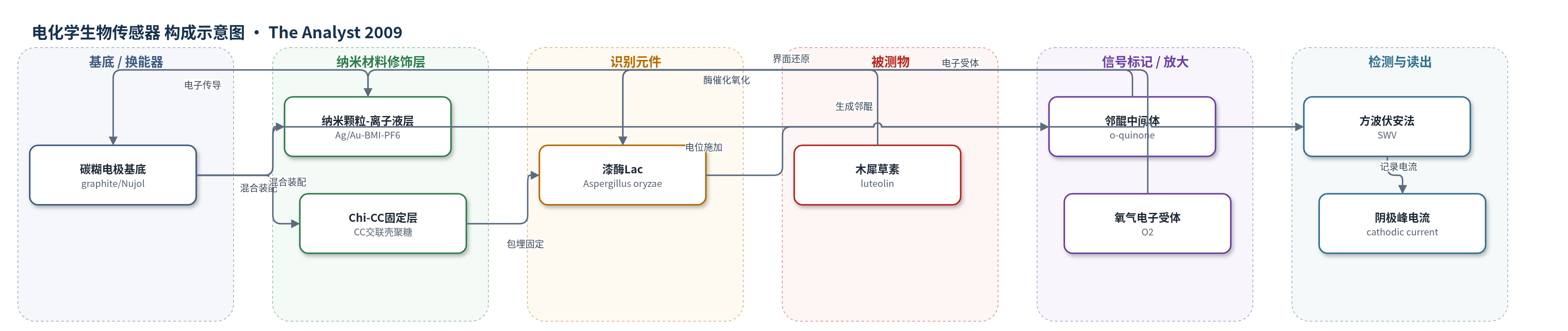
点击图片查看大图 · 依据论文自动绘制
传感器类型
电化学生物传感器
检测对象
木犀草素(luteolin);样品基质:洋甘菊茶浸提液、醋酸缓冲液标准溶液
检测原理
木犀草素扩散至固定于 Chi-CC 的漆酶(Lac)活性位点,被 Lac 催化氧化为邻醌(o-quinone),同时 O2 作为电子受体被四电子还原为水,维持酶催化循环。生成的邻醌在电极界面于 0.35 V(vs Ag/AgCl)发生电化学还原,重新生成木犀草素并释放电子。Ag 或 Au 纳米颗粒分散于 BMI-PF6 中形成高离子导电微环境,促进 Lac 与电极间的直接电子转移,降低界面阻抗;Chi-CC 交联壳聚糖稳定酶构象并提高负载量。方波伏安法(SWV)记录还原邻醌的阴极峰电流,该电流随木犀草素浓度增加而线性增大,从而实现定量检测。
检测灵敏度
LOD: 0.054 ± 0.004 mM(Ag-BMI-PF6);0.028 ± 0.002 mM(Au-BMI-PF6);线性范围: 0.099–5.825 mM;灵敏度斜率: 14.662 ± 0.103 mA/mM(Ag-BMI-PF6);16.550 ± 0.085 mA/mM(Au-BMI-PF6);R^2 = 0.9998(Ag-BMI-PF6);R^2 = 0.9999(Au-BMI-PF6)
效应效果
选择性良好:对芦丁、槲皮素、七叶内酯、咖啡酸、绿原酸相对响应为24.7%、19.3%、14.2%、9.6%、4.9%,对木犀草素无响应;±3%信号变化内可耐受芦丁9.6 mM、槲皮素15.4 mM、七叶内酯20.7 mM、咖啡酸39.8 mM、绿原酸64.5 mM。重复性RSD为2.05%(Ag)、1.32%(Au),重现性RSD为3.12%(Ag)、2.77%(Au),70天保持87%响应。茶样回收率91.8–104.8%(Ag)、92.9–103.6%(Au),测得含量8.58/4.97 mg/L(Ag)和9.15/5.75 mg/L(Au)。Au响应比Ag高13.7±0.1%,作者认为灵敏度优于文献纳米颗粒传感器,适用于茶样检测。
传感器的构成
- 工作电极基底:石墨粉(graphite powder)与 Nujol 构成碳糊电极,装入塑料注射器并以铜线(Cu wire)作外电接触
- 纳米导电修饰层:Ag-BMI-PF6 或 Au-BMI-PF6(银/金纳米颗粒分散于 1-丁基-3-甲基咪唑鎓六氟磷酸盐 BMI-PF6),提高离子导电性并促进电子转移
- 酶固定基质:氰尿酰氯(CC)化学交联壳聚糖(Chi-CC),通过氨基共价交联形成网络,包埋并稳定漆酶
- 识别/催化元件:米曲霉漆酶(Lac,Aspergillus oryzae),催化木犀草素(luteolin)氧化为邻醌(o-quinone)
- 信号中间体:邻醌(o-quinone),在 0.35 V vs Ag/AgCl 被电化学还原回木犀草素,产生阴极峰电流
- 工作介质与电子受体:0.1 M醋酸缓冲液(pH 4.0)及溶解 O2,O2 作为 Lac 电子受体被还原为水
中文摘要
本研究构建了基于分散于离子液体1-丁基-3-甲基咪唑鎓六氟磷酸盐(BMI-PF6)中的银或金纳米颗粒,以及固定于氰尿酰氯(CC)交联壳聚糖(Chi-CC)中的米曲霉漆酶(Lac)的电化学生物传感器。漆酶催化木犀草素(luteolin)氧化为邻醌,邻醌在0.35 V(vs Ag/AgCl)被电化学还原。方波伏安法用于测定木犀草素。最佳组成为石墨粉:Chi-CC:Nujol:Ag-BMI-PF6或Au-BMI-PF6=50:20:15:15(w/w/w/w,Lac 0.29 U/mL),在0.1 M醋酸缓冲液(pH 4.0)中,频率50 Hz、脉冲幅度100 mV、扫描增量5.0 mV。优化条件下,阴极电流在0.099–5.825 mM内线性增加,检出限为0.054±0.004 mM(Ag-BMI-PF6)和0.028±0.002 mM(Au-BMI-PF6)。传感器具有高灵敏度、良好重复性、重现性和长期稳定性(70天响应下降13%),洋甘菊茶加标回收率为91.8–104.8%。
英文摘要
Novel and effective biosensors based on Ag or Au nanoparticles dispersed in ionic liquid (IL) 1-butyl-3-methylimidazolium hexafluorophosphate (BMI.PF(6)) and laccase (Lac) from Aspergillus oryzae immobilized in chitosan (Chi) chemically cross-linked with cyanuric chloride (CC) were constructed. This enzyme catalyzes the oxidation of luteolin to the corresponding o-quinone, which is electrochemically reduced back to luteolin at 0.35 V vs. Ag/AgCl. Square-wave voltammetry was used for the electrochemical determination of luteolin at the Lac-nanoparticles-BMI.PF(6) biosensors. The best performance was obtained with 50:20:15:15% (w/w/w/w) as the graphite powder:Chi-CC:Nujol:Ag-BMI.PF(6) or Au-BMI.PF(6) composition (Lac 0.29 units mL(-1)) in 0.1 M acetate buffer solution (pH 4.0) with frequency, pulse amplitude and scan increment at 50 Hz, 100 mV, and 5.0 mV, respectively. Under optimized conditions, the cathodic currents increased linearly for the luteolin concentration range of 0.099-5.825 microM with detection limits of 0.054 +/- 0.004 microM (Ag-BMI.PF(6)) and 0.028 +/- 0.002 microM (Au-BMI.PF(6)). These biosensors demonstrated high sensitivity, good repeatability and reproducibility, and long-term stability (13% decrease in response over 70 days). The recovery study for luteolin in chamomile tea samples gave values of 91.8-104.8%. The influence of Lac immobilized in Chi-CC and nanoparticles-BMI.PF(6) contributes to the excellent performance of the biosensors.