组成图示
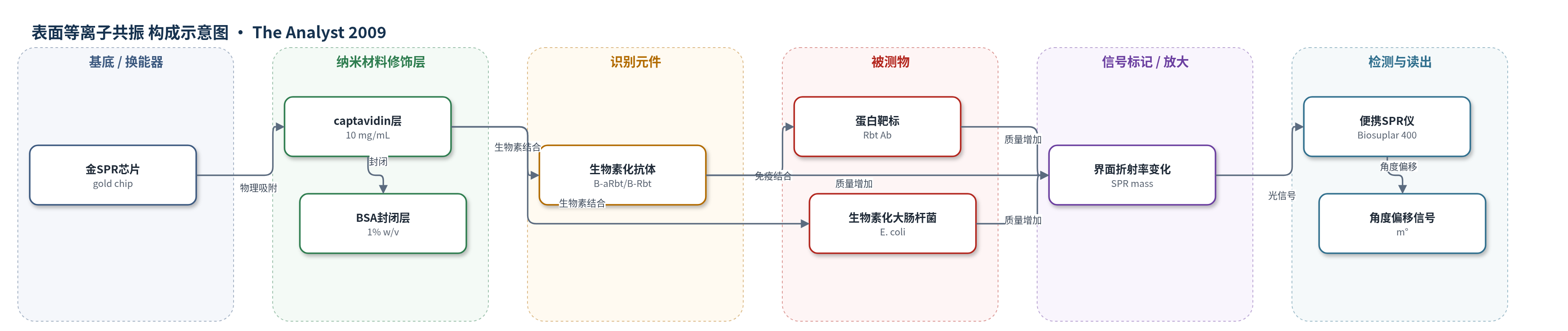
点击图片查看大图 · 依据论文自动绘制
传感器类型
表面等离子共振(SPR)生物传感器
检测对象
生物素化抗体(biotinylated antibody, B-aRbt/B-Rbt)、兔源抗体蛋白靶标(rabbit antibody, Rbt Ab)、生物素化大肠杆菌(biotinylated Escherichia coli);样品基质为PBS、碳酸氢盐缓冲液及LB培养后PBS重悬菌液
检测原理
金SPR芯片表面物理吸附captavidin,并用BSA封闭。生物素化抗体或生物素化大肠杆菌在pH 4.0或7.4下通过生物素-captavidin结合固定于界面,使表面质量/折射率增加,SPR共振角发生偏移;若固定的是生物素化抗体,未修饰兔抗体靶标再结合后进一步增加界面质量,产生更大角度偏移。pH 10.0碳酸氢盐使captavidin-生物素复合物解离,释放捕获组分,信号下降,实现表面再生。信号大小与结合到界面的生物质量相关,但便携SPR基线不稳定,且细菌尺寸导致仅近表面部分贡献信号。
检测灵敏度
原文未报告LOD、线性范围、灵敏度斜率或相关系数。
效应效果
非生物素化抗体负控信号低于11 m°,再生后无显著下降,说明捕获特异。生物素化大肠杆菌(10^7 CFU/mL)三次捕获信号为28、42、27 m°,再生后完全恢复;非生物素化菌(10^8 CFU/mL)仅4.6、12、9 m°。5 mg/mL生物素化抗体可完成9次捕获/再生,10 mg/mL可6次;中性pH第5次捕获保留85%首信号,酸性pH低于60%。蛋白靶标三次检测为44.1、32.9、26.9 m°,背景升至65.5、96.5、93.4 m°。avidin信号约为captavidin两倍,但pH 10再生失败。作者认为captavidin可用于传感器优化与可重复使用表面。
传感器的构成
- 基底/换能器:金SPR芯片(gold chip),提供表面等离子共振换能表面
- 捕获蛋白修饰层:captavidin(10 mg/mL,物理吸附),可逆结合生物素化生物组分
- 封闭层:BSA(1% w/v),阻断非特异吸附
- 识别元件:生物素化抗体B-aRbt或B-Rbt(biotinylated antibody),通过生物素-captavidin结合固定
- 靶标/全细胞层:未修饰兔抗体Rbt Ab(5 mg/mL)或生物素化大肠杆菌E. coli(10^7 CFU/mL),作为被测/捕获对象
- 读出层:Biosuplar 400便携SPR仪,监测共振角偏移(m°)
中文摘要
生物传感器传感表面的生物识别元件功能化对其性能至关重要。本文利用表面等离子共振(SPR)研究可再生生物素结合蛋白captavidin能否用于结合和释放生物素化生物组分,从而构建可再生生物传感器。实验表明,在captavidin功能化金表面上,生物素化抗体可经历最多九次连续捕获—释放循环;若随后加入蛋白靶标,则最多可完成三次连续捕获。生物素化大肠杆菌也能从金表面有效捕获和释放,提示captavidin可用于全细胞可再生生物传感器开发。结果表明,captavidin是一种有前景的可再生分子工具,可用于生物传感器优化与验证,经精细调控的captavidin修饰表面有望成为真正可重复使用的传感器。
英文摘要
Functionalisation of a biosensor's sensing surface with the appropriate biorecognition elements is essential for the correct performance of the biosensor. In this paper, we investigate by Surface Plasmon Resonance (SPR) if captavidin, a recently described biotin-binding regenerable protein, could be used to bind and release biotinylated biocomponents for the development of regenerable biosensors. In our experiments, biotinylated antibodies were successfully subjected to up to nine serial capture-release events from the captavidin-functionalised surface. Up to three consecutive captures were possible when a protein target had been subsequently added. On the other hand, biotinylated bacteria were also efficiently captured and released from the gold surface, suggesting also the suitability of captavidin for the development of whole-cell regenerable biosensors. Our results indicate that captavidin is a promising regenerable molecular tool that could be used during biosensor optimisation and validation, and that captavidin-modified surfaces could be fine-tuned into truly reusable sensors.