组成图示
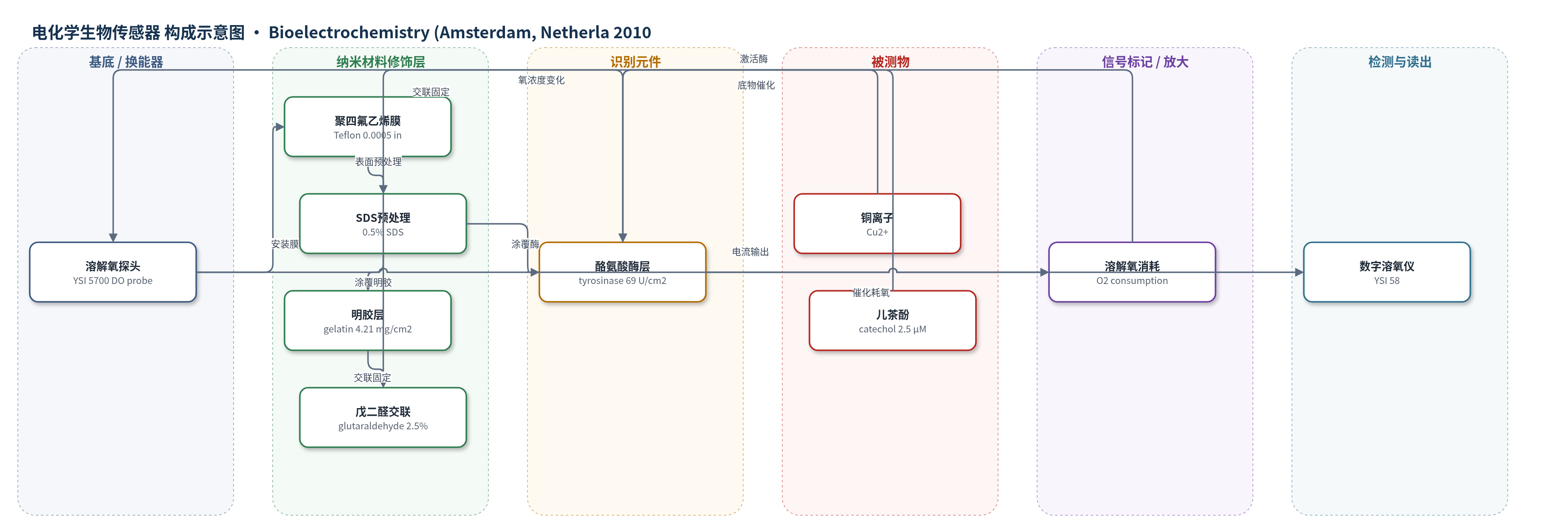
点击图片查看大图 · 依据论文自动绘制
传感器类型
电化学生物传感器
检测对象
铜离子(copper ion, Cu2+);样品基质:50 mM磷酸盐缓冲液(pH 7.0)反应介质
检测原理
该传感器以固定化酪氨酸酶为识别/催化元件,以Clark型溶解氧探头为换能器。测定时向含固定浓度儿茶酚的磷酸盐缓冲液中加入待测Cu2+。酪氨酸酶催化儿茶酚与O2反应生成邻醌和水,消耗溶解氧;Cu2+作为酪氨酸酶的激活剂,使酶活性增强,耗氧速率增加。探头记录无Cu2+时的溶解氧DO1与含Cu2+时的DO2,二者差值ΔDO随Cu2+浓度增大而增大,从而建立标准曲线。该法利用酶促耗氧差异间接定量Cu2+,无需外加电子供体或化学标记。
检测灵敏度
LOD: 0.95 μM;线性范围: 2.5–20.0 μM;响应时间: 1 min;标准曲线: y=0.0071x+0.0177;R^2 = 0.9911
效应效果
该传感器在10 μM Cu2+下重现性良好,n=10时平均9.95 μM,SD ±0.23 μM,CV 2.33%。最适pH为7.0,最适温度30 °C,pH稳定性在pH 7.0最佳。金属离子选择性方面,5和10 μM的Mn2+、Mg2+、NH4+、Zn2+、Fe3+均不激活酪氨酸酶;20 μM时Mn2+、Mg2+、Zn2+分别产生8%、13%、11%的激活,且与Cu2+共存时响应为105%–109%,表明Cu2+效应更显著。作者认为其制备简单、成本低、响应快,与文献中光纤、化学发光、微生物等铜传感器相比具有较宽线性范围和较低检出限。
传感器的构成
- 基底/换能器:Clark型溶解氧探头(YSI 5700 DO probe),将溶解氧浓度变化转换为电学信号。
- 气体选择性膜:高灵敏度聚四氟乙烯膜(Teflon membrane,0.0005 in),允许O2透过并保护酶层。
- 膜预处理:0.5% SDS磷酸盐缓冲液处理,降低膜表面张力,便于后续涂覆。
- 生物活性层:酪氨酸酶(tyrosinase,69 U/cm2)与明胶(gelatin,4.21 mg/cm2)混合涂覆,提供催化活性与固定基质。
- 交联固定层:戊二醛(glutaraldehyde,2.5%)交联酶-明胶,稳定生物活性层。
中文摘要
一些金属离子可作为酪氨酸酶活性的辅因子,铜离子即为其一。本研究开发了一种安培型生物传感器,用于研究铜离子对酪氨酸酶活性的影响。传感器构建中,采用基于明胶和双功能试剂戊二醛的化学共价固定化方法,将酪氨酸酶固定在覆盖有氧气敏感聚四氟乙烯膜的Clark型溶解氧探头上。测量原理基于测定酪氨酸酶催化反应中溶解氧水平的差异,即在无铜离子和有铜离子存在下比较溶解氧浓度变化;溶解氧浓度差与加入反应体系的铜离子浓度相关。该传感器响应在2.5–20.0 μM范围内与铜离子浓度呈线性关系,响应时间为1 min,检出限为0.95 μM。优化研究确定酪氨酸酶、明胶和戊二醛的最佳用量分别为69.0 U/cm2、4.21 mg/cm2和2.5%;工作条件为50 mM磷酸盐缓冲液(pH 7.0)和30 °C。此外还考察了重现性、热稳定性和pH稳定性等参数。
英文摘要
Some metal ions play a cofactor role for the activity of tyrosinase enzyme and one of them is copper ion. In this study an amperometric biosensor was developed in order to investigate the effect of the copper ions on the activity of tyrosinase enzyme. In the construction of the biosensor tyrosinase enzyme was immobilized on a Clark-type dissolved oxygen probe which was covered with a oxygen sensitive teflon membrane, by using a chemical covalent immobilization method based on gelatine and bifunctional reagent, glutaraldehyde. The principle of the measurement was based on the determination of the differentiation of dissolved oxygen level in the enzymatic reaction catalyzed by tyrosinase in the absence and the presence of copper ions. Differences between the dissolved oxygen concentrations were related to copper ion concentration which was added in to the reaction medium. The biosensor response depends linearly on copper ion concentration between 2.5-20.0microM with a response time 1min. The detection limit of the biosensor is 0.95microM. In the optimization studies of the biosensor, the most suitable amounts of tyrosinase, gelatin and glutaraldehyde ratio were determined to be 69.0U/cm(-2), 4.21mg/cm(-2), and 2.5%, respectively. In the optimization studies of the biosensor, phosphate buffer (pH 7.0 ,50mM) and 30 degrees C were detected to be working conditions. For the characterization of the biosensor some parameters such as reproducibility, thermal and pH stability were carried out.