组成图示
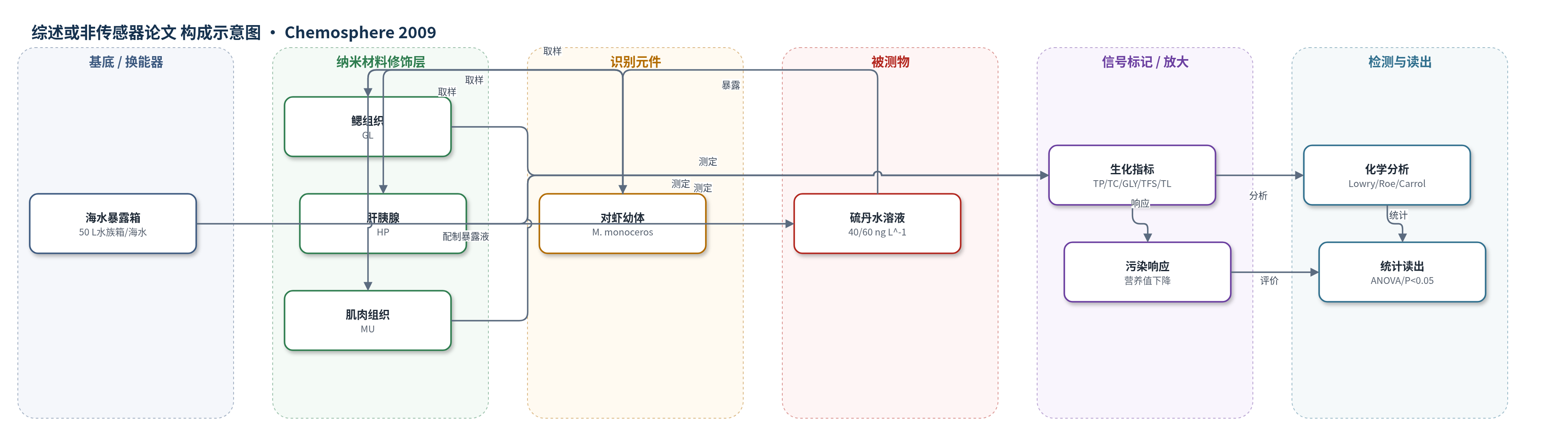
点击图片查看大图 · 依据论文自动绘制
传感器类型
综述或非传感器论文
检测对象
硫丹(endosulfan);样品基质:海水/养殖水样暴露体系,检测组织为对虾鳃(GL)、肝胰腺(HP)、肌肉(MU)
检测原理
本研究并非传统换能器式传感器,而是以活体对虾作为整体生物指示物。虾在含硫丹的海水中暴露后,农药经鳃等界面进入机体并造成毒性应激,导致能量代谢紊乱、蛋白分解增强、糖原分解加速和脂质动员增加。鳃、肝胰腺和肌肉中的TP、TC、GLY、TFS、TL浓度随暴露时间下降,形成可测生化响应。该响应不依赖电极或光学标记,而是通过组织取样和化学分析读出;暴露时间越长,相对对照下降越明显,但40与60 ng L^-1间差异不显著,说明在该范围内主要呈时间依赖而非剂量依赖。作者据此将组织生化组分变化作为污染早期预警指标。
检测灵敏度
原文未报告LOD、线性范围、灵敏度斜率或相关系数;96-h LC50: 199.3 ng L^-1(95% CI 182–221 ng L^-1)
效应效果
暴露23天内未观察到死亡,各处理组死亡率不超过5%;重复组织样本间生化分析无显著差异(P>0.05),表明取样和测定具有较好一致性。标准方法重复分析的变异系数为TP 5.0–17.5%、TC 4.0–16.5%、TL 6–17.6%。40和60 ng L^-1硫丹均显著降低TP、TC、GLY、TFS和TL(P<0.05),但两种剂量间多数指标无显著差异(P>0.05),提示该生物响应在亚致死范围内对时间更敏感。23天结束时肌肉蛋白下降最明显,导致营养价值降低。作者认为该虾对有机氯农药敏感,可作为沿海海洋和河口污染的潜在生物传感器,用于早期预警。
传感器的构成
- 生物指示物:Metapenaeus monoceros 幼虾,作为潜在整体生物传感器载体
- 暴露换能体系:50 L海水水族箱,含40或60 ng L^-1硫丹,提供污染暴露环境
- 响应组织层:鳃(GL)、肝胰腺(HP)、肌肉(MU),用于采集代谢响应信号
- 信号指标:总蛋白(TP)、总糖(TC)、糖原(GLY)、总游离糖(TFS)、总脂质(TL)
- 读出方法:Lowry蛋白法、Roe糖法、Carrol糖原法、Barnes-Blackstock脂质法
中文摘要
硫丹是一种广谱非内吸性有机氯农药,广泛用于农业、园艺和公共卫生害虫防治。本研究考察了印度对虾 Metapenaeus monoceros 暴露于两种亚致死剂量(40和60 ng L^-1)硫丹23天后,代谢活跃组织——鳃(GL)、肝胰腺(HP)和肌肉(MU)中生化组分的变化。结果显示,亚致死剂量硫丹显著(P<0.05)改变了试验虾总蛋白(TP)、总糖(TC)、糖原(GLY)、总游离糖(TFS)和总脂质(TL)水平;各生化组分浓度随暴露时间显著变化,但两种剂量间无显著差异(P>0.05)。所有生化组分相对对照的下降百分比随暴露时间延长而增加。23天结束时,TP、TC、GLY、TL和TFS在不同组织中的下降幅度顺序分别为MU>GL>HP、HP>GL>MU、MU>HP>GL、HP>MU>GL和MU>GL>HP。结果表明,亚致死剂量硫丹显著改变主要组织的基本生化组成,尤其降低肌肉蛋白水平,从而降低该经济虾类的营养价值。由于 M. monoceros 暴露后出现显著生化变化,该物种可能作为沿海海洋和河口有机氯污染的生物传感器。
英文摘要
Endosulfan, a broad-spectrum non-systemic organochlorine (OC) pesticide is extensively used to control a wide variety of pests in agriculture, horticulture and public health programmes. Biochemical changes occurring in the metabolically active tissues of gills (GL), hepatopancreas (HP) and muscle (MU) of the penaeid shrimp, Metapenaeus monoceros (Fabricius) on exposure to two sublethal doses (40 and 60 ng L(-1)) of endosulfan were studied for 23 days of exposure (DoE). Sublethal doses of endosulfan significantly (P<0.05) altered the levels of the total protein (TP), the total carbohydrates (TC), the glycogen (GLY), the total free sugars (TFS) and the total lipids (TL) in test shrimps. Concentrations of biochemical components significantly varied with the DoE but were dose-independent (P<0.05). Percent decrease in all biochemical components increased with the progress of the DoE irrespective of the exposure concentrations. The order of percent decrease in the concentrations of the TP, TC, GLY, TL and TFS in different tissues at the end of 23 DoE was found to be MU>GL>HP, HP>GL>MU, MU>HP>GL, HP>MU>GL and MU>GL>HP, respectively. The results of the study revealed that sublethal doses of endosulfan significantly alters the proximate composition of major tissues, particularly the TP levels in the MU tissues thereby reducing the nutritive value of this economically important penaeid shrimp. Since M. monoceros exhibits significant biochemical changes on exposure to endosulfan, this species could possibly be used as biosensor of coastal marine and estuarine pollution by OCs.