组成图示
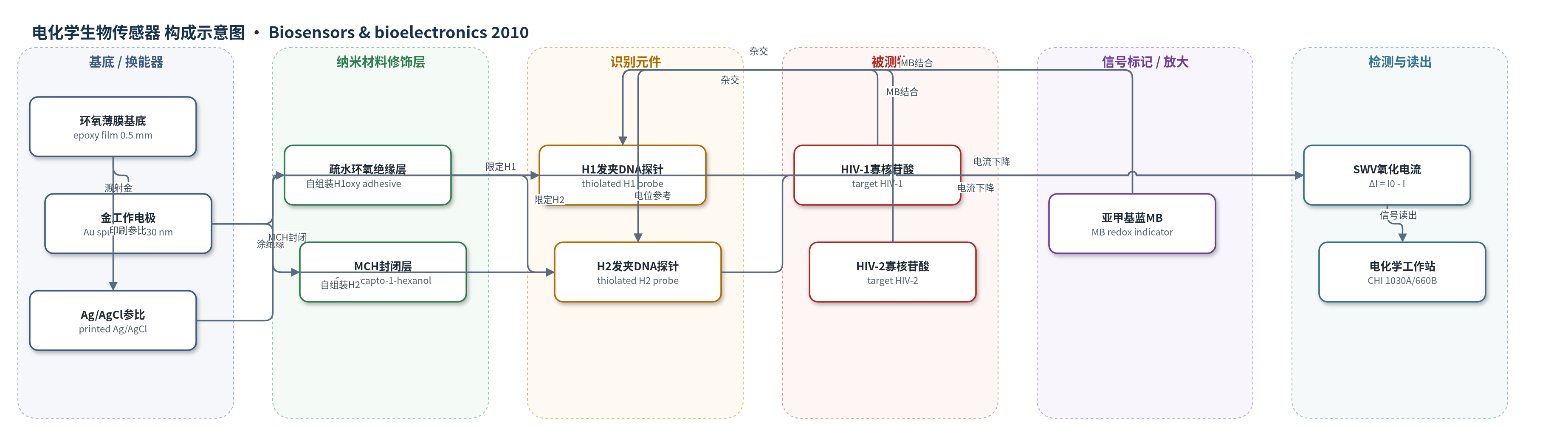
点击图片查看大图 · 依据论文自动绘制
传感器类型
电化学生物传感器
检测对象
HIV-1寡核苷酸(HIV-1 oligonucleotide)、HIV-2寡核苷酸(HIV-2 oligonucleotide);样品基质为寡核苷酸混合溶液/Tris-HCl-MgCl2或PBS-KCl缓冲液(微升级样品)。
检测原理
该传感器采用无标记杂交指示策略。巯基化发夹DNA探针H1和H2通过Au–S键自组装在金工作电极表面,MCH封闭裸露金表面以减少非特异吸附。亚甲基蓝(MB)作为氧化还原指示剂,优先嵌入或结合单链DNA,使SWV氧化电流较高。当加入HIV-1或HIV-2靶寡核苷酸后,其与对应探针杂交形成双链DNA,MB结合量减少,氧化电流下降。以ΔI=I0−I表示电流变化,ΔI随靶DNA浓度增加而增大,实现定量检测。阵列中H1通道响应HIV-1,H2通道响应HIV-2,因此可在同一芯片上同时检测两种靶标。该过程无需酶标或信号放大,信号变化主要来自杂交后MB结合状态改变。
检测灵敏度
LOD: 0.1 nM (S/N = 3);线性范围: 20–100 nM (HIV-1 and HIV-2);灵敏度斜率: -0.0045 μA/nM (HIV-1), -0.0036 μA/nM (HIV-2);R = 0.9974 (HIV-1), R = 0.9989 (HIV-2)
效应效果
该阵列表现出良好选择性与重现性。H1通道对HIV-1的ΔI/I0为83.3%,对单碱基突变HIV-1 M1为43.1%,对HIV-2和HIV-2 M2分别为21.7%和13.0%;H2通道对HIV-2为81.4%,对HIV-2 M2为51.4%,对HIV-1和HIV-1 M1分别为11.2%和5.9%,无明显交叉干扰。通道电流RSD为5.4%和4.2%,混合检测RSD均小于5%,交叉干扰RSD为2.0%–4.1%。SWV灵敏度高于FIS方法;与Jin等报道的p53单传感器(25–100 nM,LOD 0.2 nM)相当,并优于Henry等BRCA1阵列(6.5–50 nM,LOD 17.5 nM)。金膜在环氧基底上较玻璃/二氧化硅更稳定,循环扫描50次重现性好。未报告实际临床样品回收率,作者主张其可用作多重DNA序列临床检测模型。
传感器的构成
- 基底:环氧薄膜(epoxy film,0.5 mm),提供绝缘支撑与机械稳定性。
- 换能器电极:金工作电极与金辅助电极(Au,溅射约30 nm),负责电子转导;印刷Ag/AgCl参比电极(screen-printed Ag/AgCl)提供稳定电位参考。
- 绝缘隔离层:疏水环氧胶(hydrophobic epoxy adhesive),手工涂覆以限定小面积工作电极区域。
- 识别元件:巯基化发夹DNA探针H1与H2(thiolated hairpin-DNA probes),分别自组装于CH1–CH3和CH4–CH6,特异性识别HIV-1与HIV-2。
- 封闭剂:6-巯基-1-己醇(MCH),占据裸露金表面,减少非特异性吸附。
- 信号指示剂:亚甲基蓝(MB),作为杂交氧化还原指示剂,优先结合单链DNA并产生氧化电流。
- 电解液:50 mM PBS–100 mM KCl(pH 7.0)或20 mM Tris–HCl–100 mM MgCl2(pH 8.0),提供离子导电与杂交环境。
- 检测仪器:CHI 1030A/CHI 660B电化学工作站,采用方波伏安(SWV)读取MB氧化电流。
中文摘要
本研究开发了一种无标记电化学生物传感器阵列,作为利用微升级样品同时检测多重DNA的模型系统。新型多电极阵列由六个金工作电极和一个金辅助电极组成,采用金溅射技术制备;印刷Ag/AgCl参比电极采用丝网印刷技术制备。用于同时检测人类免疫缺陷病毒(HIV)寡核苷酸序列HIV-1和HIV-2的DNA生物传感器阵列,通过分别将两种巯基化发夹DNA探针自组装到相应三个工作电极表面而构建。杂交事件采用方波伏安法监测,以亚甲基蓝(MB)作为杂交氧化还原指示剂。由于MB对单链DNA的亲和力高于双链DNA,MB在阵列上的氧化电流随HIV浓度增加而下降。在优化条件下,HIV-1和HIV-2的峰电流在20–100 nM范围内线性,检出限均为0.1 nM(S/N=3)。该生物传感器阵列具有良好的特异性,无明显交叉干扰,并能区分单碱基突变寡核苷酸和随机寡核苷酸与互补靶DNA。该工作表明,不同发夹DNA探针可用于设计无标记电化学生物传感器阵列,以同时检测多重DNA序列,服务于多种临床应用。
英文摘要
A label-free electrochemical DNA biosensor array was developed as a model system for simultaneous detection of multiplexed DNAs using microlitres of sample. A novel multi-electrode array was comprised of six gold working electrodes and a gold auxiliary electrode, which were fabricated by gold sputtering technology, and a printed Ag/AgCl reference electrode was fabricated by screen-printing technology. The DNA biosensor array for simultaneous detection of the human immunodeficiency virus (HIV) oligonucleotide sequences, HIV-1 and HIV-2, was fabricated in sequence by self-assembling each of two kinds of thiolated hairpin-DNA probes onto the surfaces of the corresponding three working electrodes, respectively. The hybridization events were monitored by square wave voltammetry using methylene blue (MB) as a hybridization redox indicator. The oxidation currents of MB accumulated on the array decreased with increasing the concentration of HIVs due to higher affinity of MB for single strand rather than double strands of DNA. Under the optimized conditions, the peak currents were linear over ranges from 20 to 100 nM for HIV-1 and HIV-2, with the same detection limits of 0.1 nM (S/N=3), respectively. The biosensor array showed a good specificity without the obvious cross-interference. Furthermore, single-base mutation oligonucleotides and random oligonucleotides can be easily discriminated from complementary target DNAs. This work demonstrates that different hairpin-DNA probes can be used to design the label-free electrochemical biosensor array for simultaneous detection of multiplexed DNA sequences for various clinical applications.