组成图示
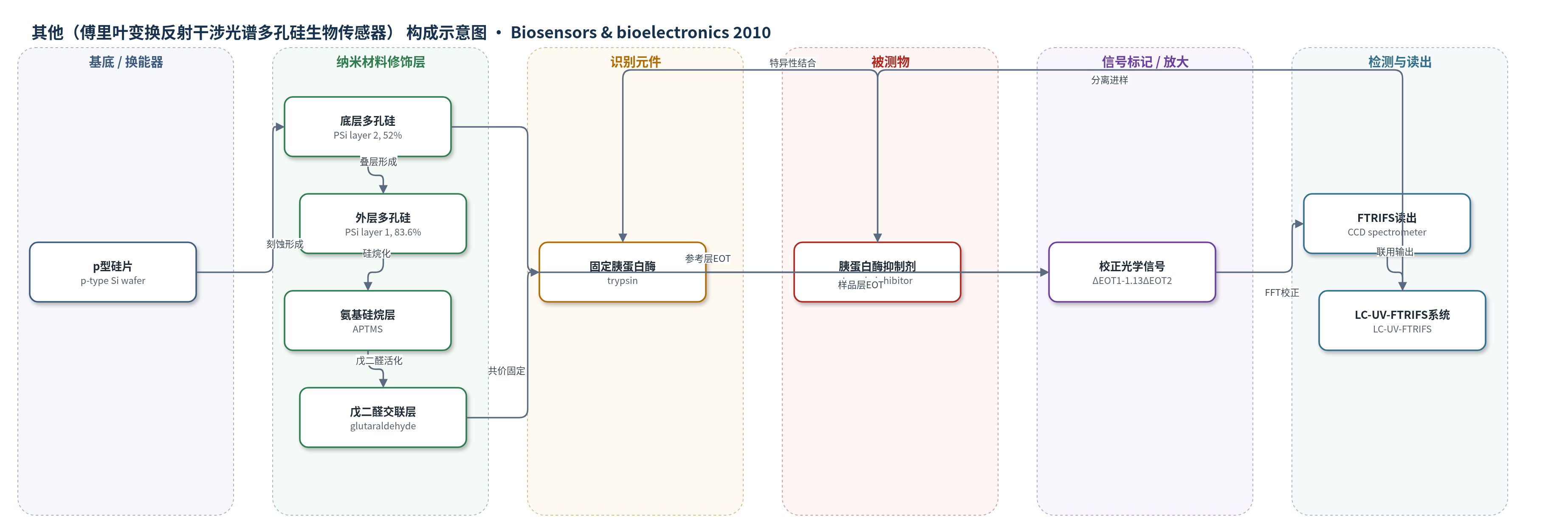
点击图片查看大图 · 依据论文自动绘制
传感器类型
其他(傅里叶变换反射干涉光谱多孔硅生物传感器)
检测对象
胰蛋白酶抑制剂(trypsin inhibitor);样品基质:PBS缓冲液、大豆提取物离子交换色谱分离馏分(复杂生物样品)
检测原理
该传感器为无标记光学亲和传感。外层高孔隙率多孔硅固定胰蛋白酶,底层低孔隙率多孔硅作为参考。当胰蛋白酶抑制剂进入流动池并与固定胰蛋白酶特异性结合时,靶标蛋白进入外层孔隙,改变孔隙填充物的平均折射率,使多孔硅上下界面反射白光形成的Fabry–Perot干涉峰发生位移。对反射光谱做快速傅里叶变换,峰位对应有效光学厚度2nL,其变化ΔEOT1反映靶标结合量。缓冲液、盐等小分子可同时进入两层,引起共同基线漂移;用底层信号ΔEOT2按ΔEOT1−1.13ΔEOT2校正,可消除基质和梯度洗脱影响。靶标浓度越高,外层特异性结合越多,校正后信号越大,呈线性。LC–UV–FTRIFS中,色谱馏分先经UV检测,再进入FTRIFS流动池,含抑制剂馏分产生台阶状信号且不回落,实现复杂样品中目标分子筛选。
检测灵敏度
LOD: 3.38 ng mL−1 (S/N = 3);线性范围: 10–200 ng mL−1(摘要)/0–200 ng mL−1(校正信号);灵敏度斜率: y = 1.77x;相关系数: 0.9936
效应效果
该传感器通过双层多孔硅参考层校正,显著抑制缓冲液/洗脱液折射率变化引起的基线漂移;用1×PBS(n=1.3347)与10×PBS(n=1.3485)交替5次确定权重因子1.13,校正式ΔEOT1−1.13ΔEOT2几乎消除基线波动。选择性方面,未固定胰蛋白酶芯片对200 ng/mL抑制剂校正信号约2.2 nm,仅为固定胰蛋白酶芯片信号的6.4%;1 mg/mL BSA仅引起2.8 nm EOT1变化且洗脱后回落,说明非特异吸附可区分。EOT测量噪声约0.2 nm。LC–UV–FTRIFS从大豆提取物离子交换色谱5个UV峰中仅第3峰出现台阶状FTRIFS信号,且活性测定确认该馏分含胰蛋白酶抑制剂,与UV/活性法一致。作者认为其可作为复杂生物样品药物筛选平台。
传感器的构成
- 基底/换能器:重掺杂p型硅片(p-type Si wafer,电阻率0.0019 Ω cm),背面铝条接触,作为多孔硅制备基底与光学反射界面
- 底层多孔硅:低孔隙率多孔硅(PSi layer 2,孔隙率52%,厚度约3.91 μm),作为参考通道并排除大分子
- 外层多孔硅:高孔隙率多孔硅(PSi layer 1,孔隙率83.6%,厚度约3.26 μm,孔径40–50 nm),作为样品通道并容纳胰蛋白酶/抑制剂
- 表面化学修饰层:热氧化多孔硅/多孔二氧化硅(thermally oxidized PSi/SiO2)+3-氨基丙基三甲氧基硅烷(APTMS)+2.5%戊二醛(glutaraldehyde),提供稳定表面、氨基与醛基共价偶联
- 识别元件:胰蛋白酶(trypsin,牛胰腺来源,MW 25.4 kDa),共价固定于外层,特异性结合胰蛋白酶抑制剂
- 封闭剂:甘氨酸(glycine),封闭残余醛基,降低非特异结合
- 流动池/光学读出:Plexiglass流动池、钨灯光源、光纤、CCD光谱仪(Ocean Optics USB4000),监测反射干涉光谱与有效光学厚度(EOT=2nL)
- LC-UV联用:Q-Sepharose FF离子交换柱、UV检测器(280 nm)、蠕动泵、自动馏分收集器,用于复杂样品分离与柱后检测
中文摘要
复杂样品中目标化合物的柱后鉴定是药物筛选与发现的重要任务。本文证明,附着亲和配体的双层多孔硅(PSi)可作为傅里叶变换反射干涉光谱(FTRIFS)柱后检测目标分子的传感元件,并以胰蛋白酶及其抑制剂作为模型探针–靶标体系。双层PSi通过电化学刻蚀制备,先以500 mA/cm2刻蚀20 s,再以167 mA/cm2刻蚀55 s。光学测量表明,胰蛋白酶可渗入外层(孔隙率83.6%),但被底层(孔隙率52%)排除。外层经氨基硅烷和戊二醛化学固定胰蛋白酶,可特异性结合胰蛋白酶抑制剂,作为样品通道;底层作为参考信号通道。通过监测多孔硅层有效光学厚度变化,FTRIFS可实时检测胰蛋白酶与抑制剂的结合事件。信号校正方法可有效消除样品基质变化引起的基线漂移。光学信号与胰蛋白酶抑制剂浓度在10–200 ng/mL范围内呈线性关系。基于双层PSi的FTRIFS生物传感器可与UV检测器联用,用于LC分离复杂组分混合物中目标分子的筛选。LC–UV–FTRIFS系统从大豆提取物样品中分离出含胰蛋白酶抑制剂的馏分并实现实时鉴定。
英文摘要
Post-column identification of target compounds in complex samples is one of the major tasks in drug screening and discovery. In this work, we demonstrated that double layer porous silicon (PSi) attached with affinity ligand could serve as a sensing element for post-column detection of target molecule by Fourier transformed reflectometric interference spectroscopy (FTRIFS), in which trypsin and its inhibitor were used as the model probe-target system. The double layer porous silicon was prepared by electrical etching with a current density of 500 mA/cm(2), followed by 167 mA/cm(2). Optical measurements indicated that trypsin could infiltrate into the outer porous layer (porosity 83.6%), but was excluded by the bottom layer (porosity 52%). The outer layer, attached with trypsin by standard amino-silane and glutaraldehyde chemistry, could specifically bind with the trypsin inhibitor, acting as a sample channel, while the bottom layer served as a reference signal channel. The binding event between the attached trypsin and trypsin inhibitor samples could be detected by FTRIFS in real-time through monitoring the optical thickness change of the porous silicon layer. The baseline drift caused by sample matrix variation could be effectively eliminated by a signal correction method. Optical signals had a linear relationship with the concentration of trypsin inhibitor in the range of 10-200 ng mL(-1). The FTRIFS biosensor based on double layer porous silicon could be combined with a UV detector for screening the target molecule from complex component mixtures separated by a LC column. Using an LC-UV-FTRIFS system, a fraction containing a trypsin inhibitor could be separated from a soybean extract sample and identified in real-time.