组成图示
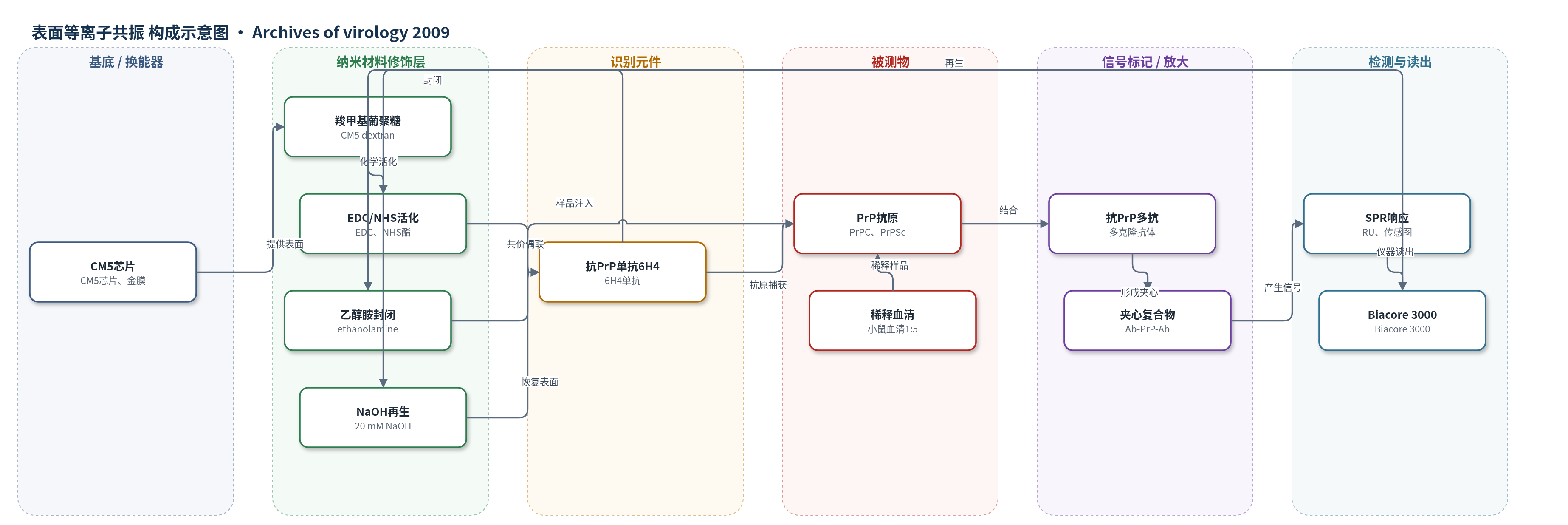
点击图片查看大图 · 依据论文自动绘制
传感器类型
表面等离子共振(SPR)生物传感器
检测对象
朊病毒蛋白(PrP,包括细胞型朊病毒蛋白 PrPC 与错误折叠朊病毒蛋白 PrPSc);样品基质为 HEPES-生理盐水/缓冲液、小鼠血清、scrapie 感染小鼠脑匀浆
检测原理
抗 PrP 单克隆抗体 6H4 通过 EDC/NHS 介导的酰胺键共价固定于 CM5 芯片羧甲基葡聚糖表面,乙醇胺封闭后形成传感界面。样品中 PrPC/PrPSc 流经表面时被 6H4 特异性捕获;随后注入抗 PrP 多克隆抗体,与已捕获的 PrP 结合形成夹心复合物。抗原-抗体结合使金膜附近局部折射率增加,激发表面等离子体共振条件改变,Biacore 3000 实时记录共振单位(RU)变化。PrP 浓度越高,表面结合质量越大,RU 响应越大;多克隆抗体夹心放大信号,提高灵敏度。PrPSc 可先用蛋白酶 K 消化去除 PrPC,保留蛋白酶 K 抗性核心,再经 SPR 检测。
检测灵敏度
LOD: 13.1 ng/ml (HBS-EP2, sandwich); 18.9 ng/ml (HBS-EP2, direct); 31.7 ng/ml (mouse serum, sandwich); 45.3 ng/ml (mouse serum, direct);线性范围: 20–500 ng/ml (HBS-EP2, sandwich); 50–500 ng/ml (mouse serum, primary response);灵敏度斜率: 0.9036 RU/(ng/ml) (HBS-EP2, sandwich); 0.4172 RU/(ng/ml) (HBS-EP2, direct); 0.5339 RU/(ng/ml) (mouse serum, sandwich); 0.2862 RU/(ng/ml) (mouse serum, direct);R^2 = 0.9998 (HBS-EP2, sandwich); R^2 = 0.9991 (HBS-EP2, direct); R^2 = 0.9997 (mouse serum, sandwich); R^2 = 0.9979 (mouse serum, direct)
效应效果
该方法在 HBS-EP2 缓冲液和小鼠血清中均呈良好线性,空白 RSD 分别为 0.96、3.87(缓冲液直接/夹心)和 4.63、4.06(血清直接/夹心)。PrPSc 加标小鼠血清回收率为 95.2%、96.4%、97.3%,平均 96.3%(n=9),CV 0.76–1.23%;蛋白酶 K 处理后 PrPC 无回收,PrPC+PrPSc 混合样回收 47.1%,显示对 PrPSc 的选择性。正常脑 PK 处理后无显著信号,感染脑有显著信号。单样本分析约 1 h,短于 ELISA 4–5 h 和 Western blot 6–8 h。作者认为其无标记、实时、可高通量,适用于食品与临床筛查。
传感器的构成
- 基底/换能器:CM5 传感器芯片(含金膜与羧甲基葡聚糖),提供 SPR 换能表面与羧基官能团
- 活化层:EDC/NHS 活化 CM5 羧甲基葡聚糖,生成 NHS 酯用于共价偶联抗体
- 识别元件:抗 PrP 单克隆抗体 6H4,通过酰胺键固定,特异性捕获 PrP
- 封闭剂:1 M 乙醇胺(pH 8.5),淬灭过量 NHS 酯,减少非特异结合
- 信号放大元件:抗 PrP 多克隆抗体(0.5 mg/mL),与捕获的 PrP 结合形成夹心复合物,增强 SPR 响应
- 运行/再生介质:HBS-EP2 缓冲液(10 mM HEPES、150 mM NaCl、3 mM EDTA)及 20 mM NaOH,用于样品输送、清洗与表面再生
中文摘要
本研究利用表面等离子共振(SPR)建立了一种快速、无标记且灵敏的免疫分析方法,用于检测朊病毒蛋白(PrP)。将抗 PrP 单克隆抗体固定于生物传感器表面,使其与不同浓度细胞型朊病毒蛋白(PrPC)结合,随后注入可溶性抗 PrP 多克隆抗体以增强信号,并实时监测抗原-抗体相互作用。该方法在 HEPES-生理盐水中检测 PrPC 的检出限为 13.1 ng/mL,在血清中为 31.7 ng/mL,单样本分析仅需约 1 h。研究还证明该方法可检测加标血清及 scrapie 感染小鼠脑组织中的错误折叠朊病毒蛋白(PrPSc)。结果表明,该 SPR 免疫分析具有快速、灵敏、可实时监测和潜在高通量筛查优势,有望发展为基于血清的可传播性海绵状脑病(TSE)检测平台。
英文摘要
Surface plasmon resonance was used to develop a rapid, label-free and sensitive immunoassay for detection of Prion protein (PrP). Anti-PrP monoclonal antibodies immobilized on the biosensor surface were allowed to bind various concentrations of cellular prion protein (PrP(C)), followed by a pulse with additional soluble anti-PrP polyclonal antibodies to intensify the signal. The interaction of antibody with antigen was monitored in real time. With this method, it was possible to detect PrP(C) with a limit of 31.7 ng/ml in serum and 13.1 ng/ml in HEPES-saline, requiring 1 h for a single sample measurement. The assay also detected misfolded prion protein (PrP(Sc)) in spiked serum and PrP(Sc) in scrapie-infected mouse brains. This is a rapid and sensitive assay for the detection of PrP in serum that could be developed into a platform for a serum-based TSE test.