组成图示
点击图片查看大图 · 依据论文自动绘制
传感器类型
综述或非传感器论文
检测对象
底物RNA(substrate RNA,6-FAM标记RNA);样品基质:体外缓冲液(含MgCl2/NaCl/Tris-HCl及中性共溶剂)
检测原理
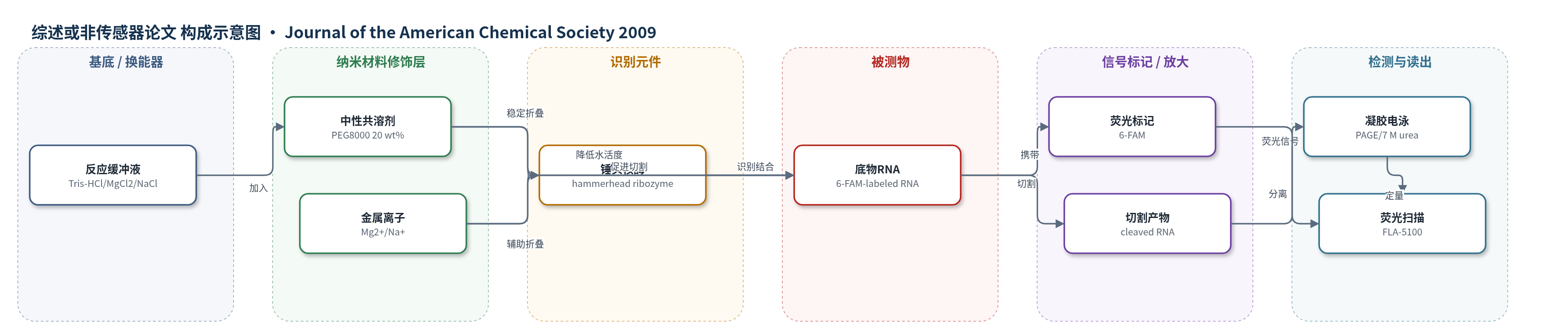
本文并非传统传感器,而是以荧光标记底物RNA的切割产物作为读出信号。锤头核酶与5′端6-FAM标记的底物RNA结合后,在Mg2+或高浓度Na+辅助下形成Y形活性构象,催化底物磷酸二酯键切割,产生较短的荧光RNA片段。反应经含尿素聚丙烯酰胺凝胶电泳分离后,用荧光扫描器检测6-FAM信号,产物条带强度反映切割程度。20 wt% PEG等中性共溶剂降低水活度,稳定RNA三级折叠所需的脱水过程,同时削弱Watson-Crick碱基对稳定性,使核酶更易形成活性构象、降低[Mg2+]1/2、加速切割产物释放,因此切割速率和产物量随共溶剂加入而增加。
检测灵敏度
原文未报告LOD、线性范围、灵敏度斜率或相关系数。
效应效果
10 mM MgCl2、37 °C下,20 wt% PEG等使核酶速率提高2.0–6.6倍;50 °C时PEG8000提高270倍。低离子下:3 mM Mg2+提高16倍,300 mM NaCl提高约100倍。PEG8000将[Mg2+]1/2从38 mM降至3.1 mM,Km从11 µM降至0.76 µM。体系只加速核酶催化,不加速非酶RNA-DNA嵌合体水解。0.5 mM MgCl2+100 mM NaCl中,PEG8000使1 h切割约50%。作者认为可用于基因调控与生物传感器。
传感器的构成
- 传感器构成:不适用,本文未报道具体传感器装置
- 识别/催化元件:锤头核酶(hammerhead ribozyme)与底物RNA,催化底物磷酸二酯键切割
- 反应介质:20 wt% PEG8000、PEG200、Dextran10/70、Ficoll70等中性共溶剂,模拟分子拥挤并改变水活度
- 信号读出:5′端6-FAM标记底物RNA,切割后经PAGE和FLA-5100荧光扫描定量
中文摘要
具有靶标RNA切割活性的短RNA序列在细胞基因调控和生物传感器研究中具有前景,但不同于水溶液的反应介质可能引起意想不到的分子相互作用和性质。本研究利用水溶性中性共溶剂,考察了由空间拥挤和溶剂性质改变引起的分子拥挤效应对锤头核酶活性的影响。在10 mM MgCl2下,20 wt%的聚乙二醇(PEG)及其他共溶剂使RNA水解速率提高2.0–6.6倍,在更低MgCl2浓度下提高更显著。值得注意的是,尽管共溶剂降低了核酶茎螺旋的稳定性,但核酶的热失活温度显著升高,使反应速率在50 °C下最高提高270倍。更重要的是,PEG降低了反应所需的金属离子浓度,即使在Mg2+或Na+受限条件下也能促进催化周转,并激活催化活性较低的核酶序列。这些观察结果与以下观点一致:共溶剂作为渗透调节物,稳定RNA三级折叠中的脱水反应,但削弱Watson-Crick碱基配对中的吸水反应。共溶剂对RNA二级和三级结构稳定性的相反作用,从根本上不同于蛋白质折叠,提示RNA如何在分子拥挤介质中稳定三级结构并增强催化活性。
英文摘要
Short RNA sequences exhibiting the activity of a target RNA cleavage are promising for cellular gene regulation and biosensor research, but the reaction media different from an aqueous solution may cause unanticipated molecular interactions and properties. In this study, we investigated the molecular crowding effects arising from steric crowding and altered solvent properties on the hammerhead ribozyme activity using water-soluble neutral cosolutes. Poly(ethylene glycol) (PEG) and other cosolutes at 20 wt % increased the RNA hydrolysis rate by a factor of 2.0-6.6 at 10 mM MgCl(2) and much more at lower MgCl(2) concentrations. Remarkably, although the cosolutes decreased the stability of the ribozyme stem helices, the thermal inactivation temperature of the ribozyme was significantly raised, resulting in a higher reaction rate, up to 270 times at 50 degrees C. More significantly, PEG decreased the metal ion concentration to perform the reaction even with a limiting Mg(2+) or Na(+) concentration, facilitated the catalytic turnover, and activated a catalytically less active ribozyme sequence. These observations agreed that the cosolutes acted as an osmolyte stabilizing the water-release reaction of the RNA tertiary folding but destabilizing the water-uptake reaction of Watson-Crick base pairing. The opposite cosolute effect on the stabilities of RNA secondary and tertiary structures, which is fundamentally different from a protein folding, suggests how RNA stabilizes a tertiary structure and enhances the catalytic activity in molecular crowding media.