组成图示
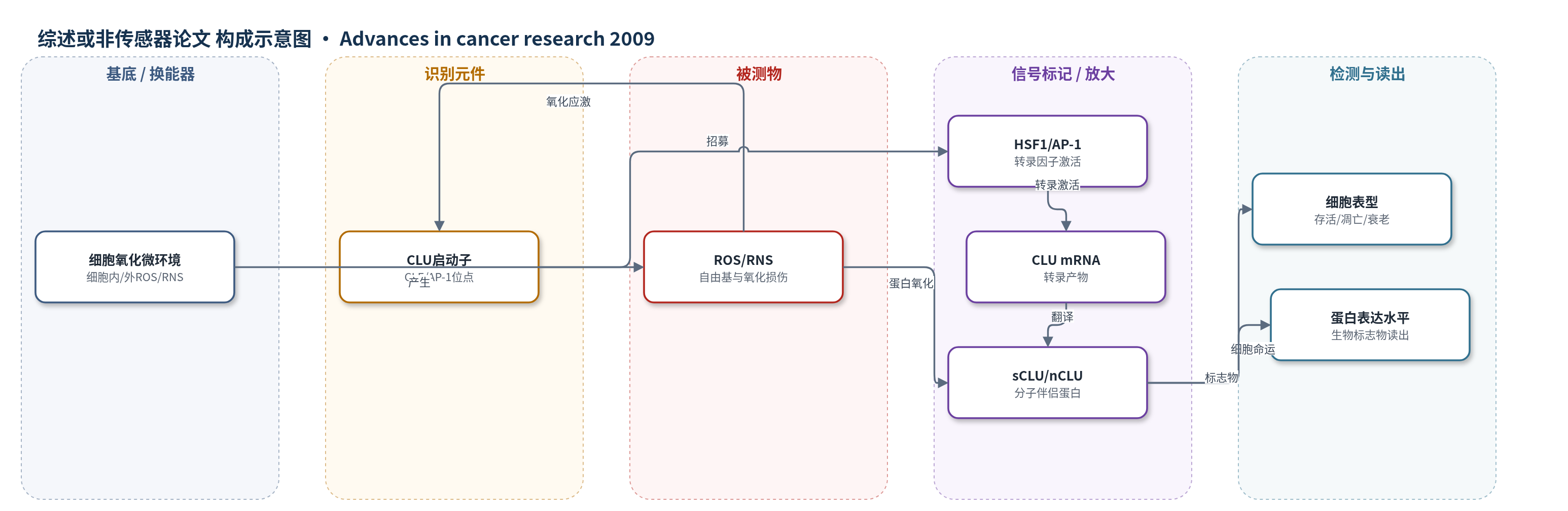
点击图片查看大图 · 依据论文自动绘制
传感器类型
综述或非传感器论文
检测对象
活性氧/活性氮物种(ROS/RNS,氧化应激);样品基质:细胞、血清、组织、动物模型
检测原理
本文所述并非人工传感装置,而是将CLU基因/蛋白视为细胞内氧化应激生物传感器。当细胞内ROS/RNS水平升高时,自由基及其衍生物造成DNA、蛋白和脂质氧化,并激活HSF1、AP-1等氧化敏感转录因子。HSF1结合CLU启动子中的CLE位点,AP-1结合相应元件,二者协同使CLU转录上调,产生sCLU和/或nCLU。sCLU以小热休克蛋白样分子伴侣方式结合部分去折叠或氧化蛋白,抑制聚集与沉淀,并通过Bax、Ku70、NF-κB、PI3K/Akt等通路调节细胞存活、凋亡与衰老。因此CLU表达水平随氧化负荷变化而改变,可作为氧化损伤的细胞内读出信号。
检测灵敏度
原文未报告LOD、线性范围、灵敏度斜率或R^2。
效应效果
本文未提供传感器选择性、抗干扰、稳定性、RSD、加标回收率或与ELISA/HPLC/qPCR的定量对比。作为生物学标志物,sCLU在多种氧化应激模型中上调:脓毒症患者血清中存活者较对照升高约26.5倍或15倍,非存活者升高约5.9至3.1倍;AD患者皮层和海马CLU浓度较对照高约40%。sCLU可保护细胞免受H2O2、辐射、化疗药和氧化剂诱导的损伤,但在肿瘤中作用复杂,既可能抑制早期损伤积累,也可能通过抗凋亡促进肿瘤进展。作者认为CLU可作为氧化应激和疾病进展的预后标志物及治疗靶点。
传感器的构成
- 识别元件:CLU基因启动子CLE/AP-1位点,响应氧化应激
- 信号放大:HSF1/HSF2与AP-1转录因子,驱动CLU转录
- 效应元件:sCLU/nCLU蛋白,结合氧化蛋白并调节细胞命运
- 不适用:未报道电极、纳米材料、封闭剂或外源标记物
中文摘要
聚簇蛋白/载脂蛋白J(CLU)基因在多数人体组织中表达,编码分泌型糖蛋白和截短核型两种亚型。CLU参与多种生理过程,并与衰老、糖尿病、动脉粥样硬化、退行性疾病和肿瘤发生相关。这些疾病的共同点是活性氧或活性氮物种产生与清除失衡导致氧化损伤增加。细胞因子、生长因子、热休克、辐射、氧化剂和化疗药物等刺激也可差异调控CLU基因并促进活性物种产生。低浓度活性物种参与正常细胞信号与稳态,过量时则促进基因组不稳定、慢性炎症、脂质氧化和靶蛋白聚集,使细胞易发生癌变或年龄相关疾病。CLU通过类似小热休克蛋白的分子伴侣活性抑制蛋白聚集和沉淀,从而介入氧化损伤过程。其启动子含有热休克转录因子1和激活蛋白1等调控元件,表明CLU基因是对细胞氧化负荷微小变化极为敏感的细胞生物传感器。本综述聚焦氧化损伤对CLU的调控。
英文摘要
Clusterin/Apolipoprotein J (CLU) gene is expressed in most human tissues and encodes for two protein isoforms; a conventional heterodimeric secreted glycoprotein and a truncated nuclear form. CLU has been functionally implicated in several physiological processes as well as in many pathological conditions including ageing, diabetes, atherosclerosis, degenerative diseases, and tumorigenesis. A major link of all these, otherwise unrelated, diseases is that they are characterized by increased oxidative injury due to impaired balance between production and disposal of reactive oxygen or nitrogen species. Besides the aforementioned diseases, CLU gene is differentially regulated by a wide variety of stimuli which may also promote the production of reactive species including cytokines, interleukins, growth factors, heat shock, radiation, oxidants, and chemotherapeutic drugs. Although at low concentration reactive species may contribute to normal cell signaling and homeostasis, at increased amounts they promote genomic instability, chronic inflammation, lipid oxidation, and amorphous aggregation of target proteins predisposing thus cells for carcinogenesis or other age-related disorders. CLU seems to intervene to these processes due to its small heat-shock protein-like chaperone activity being demonstrated by its property to inhibit protein aggregation and precipitation, a main feature of oxidant injury. The combined presence of many potential regulatory elements in the CLU gene promoter, including a Heat-Shock Transcription Factor-1 and an Activator Protein-1 element, indicates that CLU gene is an extremely sensitive cellular biosensor of even minute alterations in the cellular oxidative load. This review focuses on CLU regulation by oxidative injury that is the common molecular link of most, if not all, pathological conditions where CLU has been functionally implicated.