组成图示
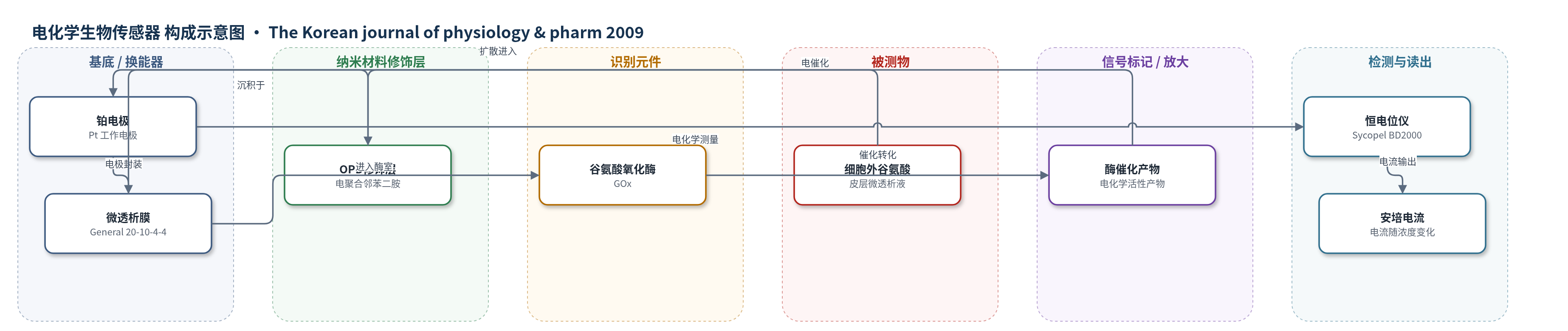
点击图片查看大图 · 依据论文自动绘制
传感器类型
电化学生物传感器
检测对象
谷氨酸(glutamate, Glu);样品基质:大鼠运动皮层细胞外液(微透析液)
检测原理
该传感器基于微透析-酶-电化学原理。大鼠运动皮层细胞外谷氨酸(Glu)经微透析膜扩散进入电极腔,与灌注液中的谷氨酸氧化酶(GOx)发生特异性催化反应,生成电化学活性产物。该产物在电聚合邻苯二胺(OPD)修饰的铂(Pt)电极表面发生电催化氧化,产生与谷氨酸浓度成正比的安培电流。恒电位仪在固定电位下记录电流,实现缺血前后皮层谷氨酸释放的实时监测。传感器在 50–450 μM 谷氨酸标准液中呈线性响应,灵敏度为 0.22 nA/μM,相关系数 R^2=0.998。该设计无需外源标记,依靠酶识别与 OPD 电催化完成信号转换。
检测灵敏度
线性范围: 50∼450 μM;灵敏度: 0.22 nA/μM;R^2 = 0.998
效应效果
传感器在 50–450 μM 谷氨酸标准液中线性良好,灵敏度 0.22 nA/μM,R^2=0.998,可实时监测 11 血管闭塞(11 VO)大鼠皮层谷氨酸释放。单次 10 min 闭塞组谷氨酸释放起始时间为 113.16±13.07 s,最大升高 125.01±3.74 μM,总释放量 38,390.44±2,252.86;重复 5 min 闭塞组总释放量为 20,710.62±18,277.71,较单次组降低 54%,第二次发作起始延迟至 132.74±3.03 s,最大升高 88.49±4.77 μM。论文未报告选择性、抗干扰、RSD 和实际样品回收率。作者认为多次短暂夹闭可诱导缺血耐受,减少谷氨酸释放,优于单次长时间闭塞。
传感器的构成
- 换能器电极:铂电极(Pt),作为安培检测工作电极
- 修饰层:电聚合邻苯二胺(OPD),在 Pt 电极上 0.65 V 电聚合 20 min,用于电化学信号转换
- 识别元件:谷氨酸氧化酶(GOx),特异性催化谷氨酸
- 灌注液:磷酸盐缓冲液(PBS),以 0.5 μl/min 携带 GOx 进入微透析电极
- 微透析膜:Sycopel General 20-10-4-4 微透析电极膜,允许脑组织液谷氨酸扩散进入
- 信号读出:Sycopel BD2000 恒电位仪,安培法记录电流
中文摘要
在神经外科手术中,外科医生常对颈动脉进行多次短暂夹闭,可能导致神经元损伤。通常认为脑缺血所致神经元损伤与兴奋性氨基酸细胞外浓度相关。本研究在 11 血管闭塞(VO)模型中测量细胞外谷氨酸释放动态,比较单次闭塞与短间隔内重复短暂闭塞。同时用激光多普勒血流仪监测脑血流变化,并用安培生物传感器测定皮层谷氨酸水平。实时监测显示,重复短暂闭塞组细胞外谷氨酸水平变化小于单次闭塞组;重复闭塞组第二次缺血发作的谷氨酸释放起始时间较第一次延迟,而第一次与单次 10 min 缺血发作相似。结果提示,与单次闭塞相比,重复短暂闭塞诱导神经元细胞释放的谷氨酸更少,谷氨酸释放起始延迟归因于内源性缺血耐受保护机制。
英文摘要
During operations, neurosurgeons usually perform multiple temporary occlusions of parental artery, possibly resulting in the neuronal damage. It is generally thought that neuronal damage by cerebral ischemia is associated with extracellular concentrations of the excitatory amino acids. In this study, we measured the dynamics of extracellular glutamate release in 11 vessel occlusion (VO) model to compare between single occlusion and repeated transient occlusions within short interval. Changes in cerebral blood flow were monitored by laser-Doppler flowmetry simultaneously with cortical glutamate level measured by amperometric biosensor. From real time monitoring of glutamate release in 11 VO model, the change of extracellular glutamate level in repeated transient occlusion group was smaller than that of single occlusion group, and the onset time of glutamate release in the second ischemic episode of repeated occlusion group was delayed compared to the first ischemic episode which was similar to that of single 10 min ischemic episode. These results suggested that repeated transient occlusion induces less glutamate release from neuronal cell than single occlusion, and the delayed onset time of glutamate release is attributed to endogeneous protective mechanism of ischemic tolerance.