组成图示
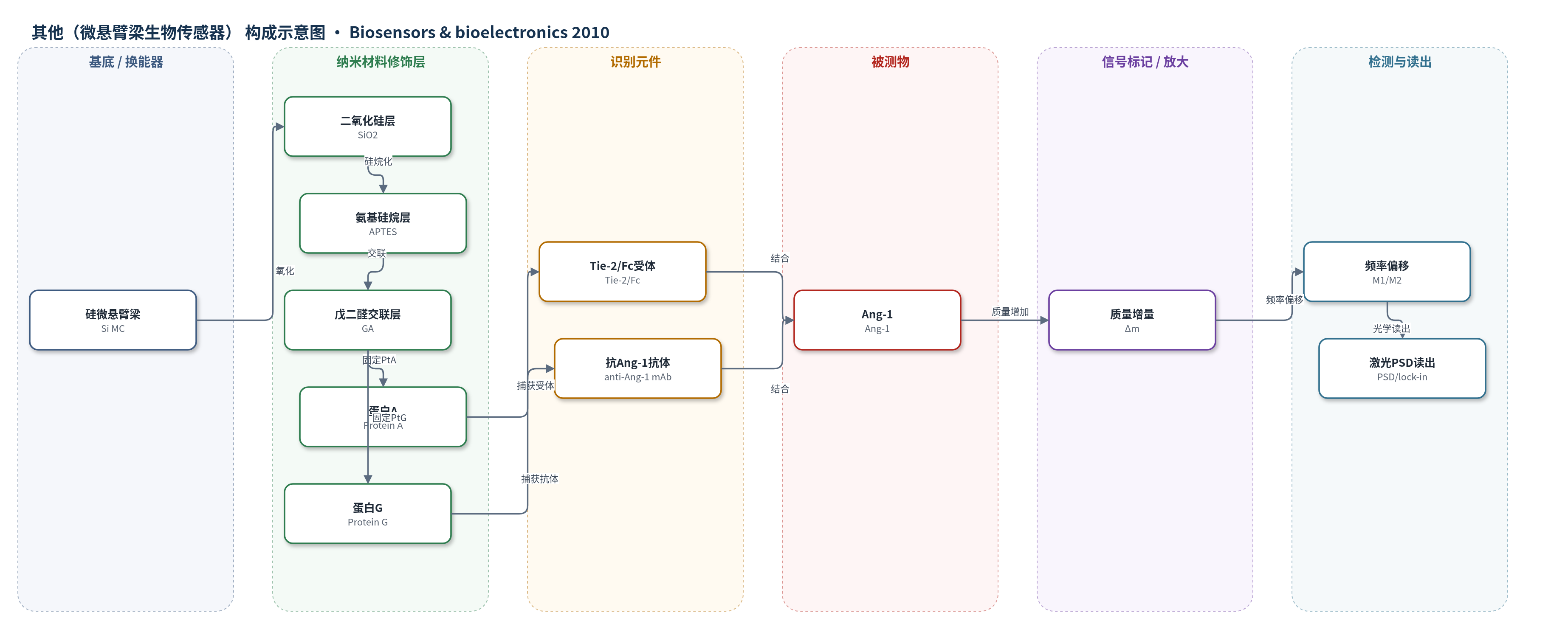
点击图片查看大图 · 依据论文自动绘制
传感器类型
其他(微悬臂梁生物传感器)
检测对象
Angiopoietin-1(Ang-1),PBS 蛋白溶液;特异性对照:VEGF-A165(PBS)
检测原理
该传感器采用动态微天平模式。硅微悬臂梁表面经 SiO2、APTES 和 GA 修饰后,通过 Protein A/G 固定 Tie-2/Fc 受体或抗 Ang-1 抗体作为识别元件。当 PBS 中的 Ang-1 与识别元件特异性结合时,悬臂梁表面质量增加,导致一阶和二阶弯曲模态谐振频率下降。频率偏移与质量增量满足 Δf/f0 = -1/2 Δm/m0,因此信号随 Ang-1 结合量增加而增大。作者将 M1 与 M2 的平均值 M12=(M1+M2)/2 用于定量,以降低测量不确定度并得到近似高斯分布。通过表面密度公式可换算每平方厘米分子数,从而分析 Ang-1 多聚化状态。无标记、无放大,非特异吸附和假抗原响应均低于特异性结合信号。
检测灵敏度
实验检测限(LOD): (Δf/f)_PBS = 1 × 10^-4;可检测 Ang-1 质量: 160 pg(不确定度 10 pg);相对不确定度: <0.5%
效应效果
系统重复性良好:49 次一/二阶模态测量中,σ_M1=2.7×10^-6、σ_M2=3.5×10^-6,组合 M12 的 σ=2.5×10^-6,且仅 M12 呈高斯分布。PBS 阴性对照相对频率偏移 (Δf/f)_PBS=1×10^-4,比 σ_M12 大约 50 倍,但比特异性结合低一个数量级。假抗原 VEGF-A165 响应 (Δf/f)_VEGF=(-1.1±0.8)×10^-5,低于实验检测限,比特异性结合低近两个数量级。抗体-抗原设计中 Ang-1 表面密度 (5.14±0.02)×10^12 molecules/cm2,相对不确定度<0.5%;抗原/抗体密度比 2.06±0.05,提示二聚结合。160 pg 检测质量与典型 ELISA 检出限相当;未报告实际样品回收率,作者认为可用于血管生成与癌症进展定量研究。
传感器的构成
- 基底/换能器:硅微悬臂梁(Si microcantilever, MC),表面/体微加工,长度400–800 μm、宽50–120 μm、厚2–3 μm,作为机械谐振质量换能器
- 表面氧化层:热氧化二氧化硅(SiO2)膜,1100 °C O2 中3 h,提供可硅烷化表面
- 硅烷化修饰层:3-氨基丙基三乙氧基硅烷(APTES),甲苯中60 °C 10 min,引入氨基
- 交联活化层:戊二醛(GA)硼酸盐缓冲液(pH 8.8)1 h,并用氰基硼氢化钠还原亚胺,形成稳定共价键
- 固定蛋白层:Protein A(PtA)或 Protein G(PtG),分别用于受体-配体或抗体-抗原设计,捕获 Fc 或抗体
- 识别元件:人重组 Tie-2/Fc 受体或抗 Ang-1 单克隆抗体(anti-Ang-1 mAb, A0604),特异性结合 Ang-1
- 信号标记物:无(无标记检测,Ang-1 结合产生质量增量 Δm)
- 读出系统:压电陶瓷圆盘激励、激光-位置敏感探测器(PSD)光学杠杆、锁相放大器,监测一/二阶弯曲模态频率偏移
中文摘要
微悬臂梁生物传感器近年来被提出作为高灵敏质量检测器,但关于其精度与特异性的研究较少。本文测量了作者悬臂梁系统的重复性与再现性,并提出将第一与第二振动模式的结果相结合以提高测量精度。随后,作者针对肿瘤进展潜在标志物血管生成素-1(Angiopoietin-1, Ang-1)优化了两种生物识别设计:基于受体的 Tie-2/Fc–Ang-1 体系和基于抗体的抗 Ang-1 单克隆抗体–Ang-1 体系。结果表明,该微悬臂梁系统可检测数百皮克量级的 Ang-1,相对不确定度低于 0.5%。通过计算蛋白表面密度(每平方厘米分子数),还可揭示目标蛋白的多聚化状态。作者还进行了阴性对照(PBS 无蛋白)和特异性测试(PBS 中加入假抗原 VEGF-A165),发现非特异性相互作用引起的频率偏移至少比特异性蛋白结合低一个数量级。凭借高精度与良好特异性,该系统可用作系统生物学研究中的定量工具,用于理解血管生成机制和癌症进展。
英文摘要
Microcantilever biosensors have been proposed in the last years as very sensitive mass detectors, but few works focused on the precision and specificity of such tools. We measured the repeatability and reproducibility of our cantilever-based system, proponing the combination of results coming from both the first and second mode of vibration. Then, we optimized two biodesigns (a receptor-based and an antibody-based) to the detection of Angiopoietin-1, a possible marker in tumor progression. The reported results show that our microcantilever-based system can detect Angiopoietin-1 masses of the order of few hundreds of picograms with less than 0.5% of relative uncertainty. We showed that the evaluation of the protein surface density (number of molecules per cm(2)) could reveal interesting features concerning the multimerization state of the targeted protein. We also performed negative controls (dipping the sample in PBS without proteins) and specificity tests (dipping the sample in PBS with a "false" antigen). The related frequency shifts coming from non-specific interactions were found to be at least one order of magnitude lower than typical variations due to specific protein binding. Thanks to its fine precision and optimal specificity, our microcantilever-based system can be successfully applied as a quantitative tool for systems biology studies such as the comprehension of angiogenic machinery and cancer progression.