组成图示
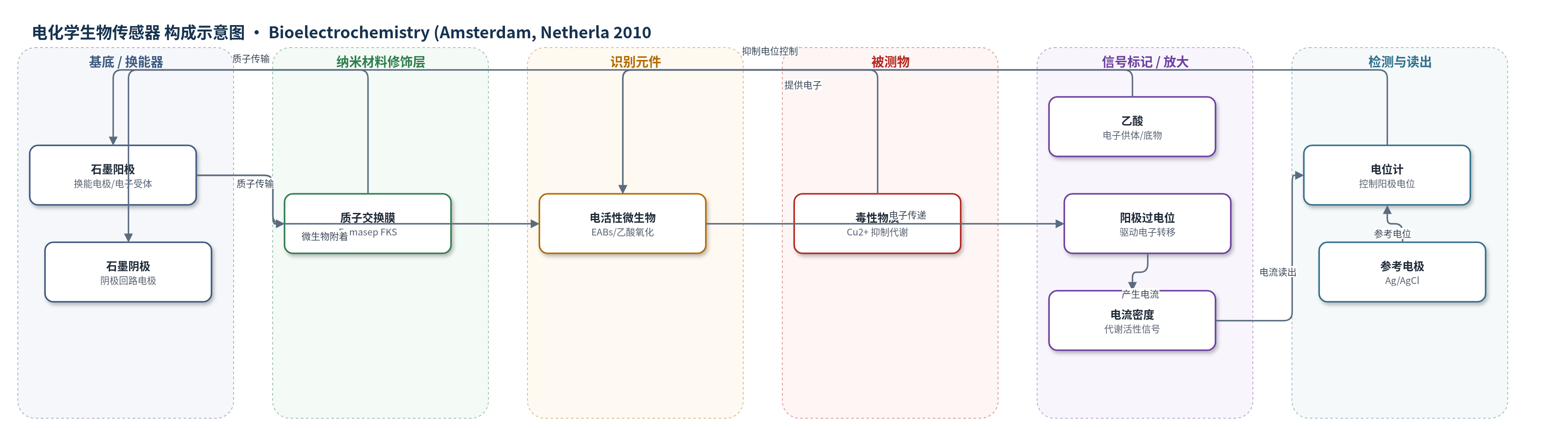
点击图片查看大图 · 依据论文自动绘制
传感器类型
电化学生物传感器
检测对象
毒性化合物(toxic compounds,实验以铜离子 Cu2+ 为代表);样品基质:水样(废水、饮用水或工艺水,阳极液)
检测原理
电活性微生物在阳极氧化乙酸:C2H3O2−+4H2O→2HCO3−+9H++8e−,电子经阳极进入外电路,质子通过质子交换膜到达阴极,铁氰化钾/亚铁氰化钾在阴极接受电子,形成电流。电流直接线性反映微生物代谢活性。毒性物质进入阳极液后抑制微生物代谢或电子传递,使电流下降。阳极过电位η=Ean−Eelectron donor决定微生物获得能量和反应速率;Eelectron donor由Nernst方程受pH、乙酸和碳酸氢盐浓度影响。因此需控制阳极电位、pH并使乙酸饱和,以稳定基线电流;毒性事件引起的电流下降与过电位扰动同量级,可通过电流变化在线报警。
检测灵敏度
灵敏度斜率: 10.18 Am−2V−1;阳极电位: 1.2%/mV;pH: 0.43%/mV;碳酸氢盐: 0.75%/mV;乙酸: 0.8%/mV
效应效果
传感器对铜剂量直接响应,初始铜浓度85 mg/L时,阳极电位−0.4 V、−0.35 V和−0.2 V下电流密度分别下降69.8%、44.4%和15.8%,洗脱后恢复基线,呈剂量–响应关系。极化曲线零电流电位−0.466 V,线性段斜率10.18 A m−2 V−1,最大电流密度1.367 A/m2(−0.273 V)。pH 6.9–7.6使电流密度由0.20增至0.24 A/m2(20%),0.35 pH单位引起10%下降。乙酸2–6 mM仅改变4%,碳酸氢盐3.3倍增加改变6%。作者主张控制阳极电位、pH并在底物饱和下运行,可稳定基线、减少误报,用于水样在线毒性监测。
传感器的构成
- 换能器阳极:石墨电极(graphite electrode),作为电子受体,接收微生物传递的电子并产生电流
- 阴极:石墨电极(graphite electrode),与阴极电子受体构成回路
- 隔膜:质子交换膜(Fumasep FKS),分隔阴阳极并允许质子传输
- 参考电极:Ag/AgCl,提供电位基准并辅助阳极电位控制
- 识别元件:电活性微生物(electrochemically active microorganisms, EABs),氧化乙酸并将电子传递至阳极
- 电子供体:乙酸(acetate),作为微生物代谢底物
- 阴极电子受体:铁氰化钾/亚铁氰化钾(K3Fe(CN)6/K4Fe(CN)6)与磷酸盐缓冲液(phosphate buffer),完成阴极还原反应
- 信号读出:电位计(potentiostat),控制阳极电位并测量电流密度
中文摘要
基于微生物燃料电池(MFC)的生物传感器可用作在线毒性传感器。电活性微生物的代谢活性可通过电流直接线性测量;微生物从阳极过电位获得能量,因此电流强烈依赖于阳极过电位。为检测毒性事件并避免误报,必须控制阳极过电位。阳极过电位及电流受阳极电位、pH、底物和碳酸氢盐浓度影响。按过电位计,各因素影响相当:阳极电位每变化1 mV使电流密度变化1.2%,pH为0.43%/mV,碳酸氢盐为0.75%/mV,乙酸为0.8%/mV。在乙酸饱和时达到最大乙酸转化速率,碳酸氢盐浓度保持恒定,因此乙酸和碳酸氢盐浓度控制可较阳极电位和pH宽松。阳极电位和pH变化引起的电流密度变化与毒性事件引起的变化同量级,故需在较小范围内严格控制pH和阳极电位。为在无毒性条件下获得稳定基线电流,MFC生物传感器应在受控阳极电位、受控pH和饱和底物浓度下运行。
英文摘要
A MFC-based biosensor can act as online toxicity sensor. Electrical current is a direct linear measure for metabolic activity of electrochemically active microorganisms. Microorganisms gain energy from anodic overpotential and current strongly depends on anodic overpotential. Therefore control of anodic overpotential is necessary to detect toxic events and prevent false positive alarms. Anodic overpotential and thus current is influenced by anode potential, pH, substrate and bicarbonate concentrations. In terms of overpotential all factor showed a comparable effect, anode potential 1.2% change in current density per mV, pH 0.43%/mV, bicarbonate 0.75%/mV and acetate 0.8%/mV. At acetate saturation the maximum acetate conversion rate is reached and with that a constant bicarbonate concentration. Control of acetate and bicarbonate concentration can be less strict than control of anode potential and pH. Current density changes due to changing anode potential and pH are in the same order of magnitude as changes due to toxicity. Strict control of pH and anode potential in a small range is required. The importance of anodic overpotential control for detection of toxic compounds is shown. To reach a stable baseline current under nontoxic conditions a MFC-based biosensor should be operated at controlled anode potential, controlled pH and saturated substrate concentrations.