组成图示
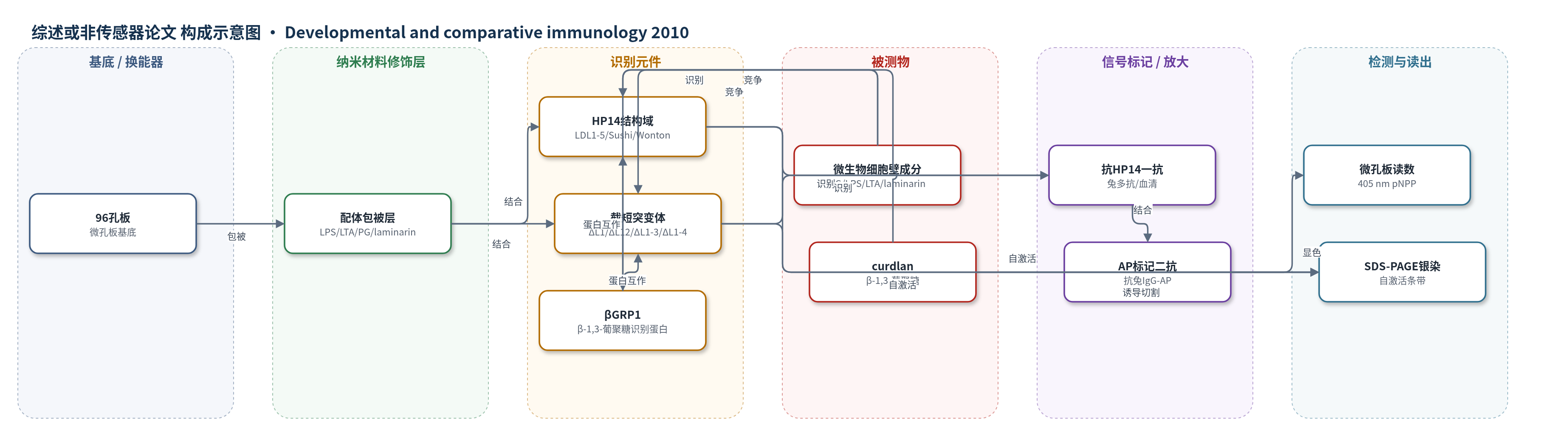
点击图片查看大图 · 依据论文自动绘制
传感器类型
综述或非传感器论文
检测对象
检测对象:Lys型肽聚糖(Lys-PG)、DAP型肽聚糖(DAP-PG)、脂多糖(LPS)、脂磷壁酸(LTA)、laminarin、curdlan(β-1,3-葡聚糖)、βGRP1;样品基质:重组蛋白溶液、昆虫血淋巴/血浆、包被微孔板。
检测原理
本文未构建独立传感器,而采用 ELISA 结合检测。将微生物细胞壁成分(Lys-PG、DAP-PG、LPS、LTA、laminarin)包被于 96 孔板并 BSA 封闭后,加入重组 HP14 结构域或截短突变体;若蛋白与配体发生特异性结合,则保留在孔内。竞争实验中,先以过量游离配体孵育蛋白,会占据结合位点,使孔内结合减少,405 nm 吸光度下降。随后加入抗 HP14 一抗和 AP 标记二抗,pNPP 显色,吸光度反映结合量。对于 βGRP1-curdlan-proHP14 体系,βGRP1 识别不溶 β-1,3-葡聚糖 curdlan 并与 proHP14 相互作用,诱导 proHP14 自切割为 45 kDa 和 30 kDa 片段,SDS-PAGE 银染或免疫印迹读出。
检测灵敏度
原文未报告 LOD、线性范围、灵敏度斜率或相关系数。
效应效果
作者以竞争结合实验验证特异性:LDL1–5、Sushi 和 Wonton 对 Lys-PG 的总结合显著高于过量游离配体竞争组(p<0.05,n=3,mean±SEM);LDL1–5 对 Lys-PG 的结合约为 LTA 的 10 倍。ΔL1 对 Lys-PG 的结合无显著差异(p=0.147),而 ΔL12 恢复对 Lys-PG 的特异性结合。表 2 将结合强度分为低(<5.0 mOD/min)和高(>20.0 mOD/min)水平。βGRP1 仅特异性识别 laminarin,并可与 Sushi 或 Wonton 结合;curdlan 与 βGRP1 共同存在时诱导 proHP14 自激活。未报告 RSD、稳定性、实际样品回收率或与 ELISA/HPLC/qPCR 的定量对比。
传感器的构成
- 非传感器体系:本文未报道传感器结构,仅采用 ELISA 结合检测。
- 表达/纯化平台:大肠杆菌 H6pQE60 表达 His 标签 LDL1–5、Sushi、Wonton、PD,Ni-NTA 亲和纯化并透析复性。
- 表达/纯化平台:杆状病毒-Sf21 表达 His 标签 ΔL1、ΔL12、ΔL1–3、ΔL1–4,经 ConA、离子交换和 Ni-NTA 纯化。
- 识别/结合元件:重组 HP14 结构域或截短突变体,用于结合微生物细胞壁多糖。
- 检测配体:laminarin、LPS、LTA、DAP-PG、Lys-PG 包被 96 孔板,curdlan 作为不溶 β-1,3-葡聚糖颗粒。
- 封闭剂:BSA/TBS 封闭非特异结合位点。
- 检测抗体:抗 HP14 区域特异性兔多抗、抗 proHP14 血清或抗 βGRP1 血清作为一抗。
- 信号标记:山羊抗兔 IgG-碱性磷酸酶(AP)结合一抗,pNPP 底物显色。
- 读出方式:微孔板 405 nm 吸光度或 SDS-PAGE/免疫印迹/银染检测结合与自激活。
中文摘要
病原识别与防御反应快速启动对宿主昆虫存活至关重要。在烟草天蛾(Manduca sexta)中,血淋巴蛋白酶14前体(proHP14)感知非己信号,触发分支丝氨酸蛋白酶级联,最终激活前酚氧化酶并导致入侵微生物周围黑色素形成。为解析 HP14 各结构域功能,作者表达了一系列 HP14 结构域及 N 端截短突变体,包括 LDL1–5、Sushi、Wonton、蛋白酶催化结构域(PD),以及缺失 1–4 个 LDL 重复的 proHP14(ΔLDL1、ΔLDL12、ΔLDL1–3、ΔLDL1–4)。结合实验显示,LDL1–5、Sushi 和 Wonton 均特异性识别赖氨酸型肽聚糖(Lys-PG),其中 Sushi 和 Wonton 还能结合 β-1,3-葡聚糖识别蛋白1(βGRP1);Wonton 还可结合脂多糖(LPS)、脂磷壁酸(LTA)和 DAP 型肽聚糖(DAP-PG)。四个 N 端截短 proHP14 进一步证实其与 LPS、LTA、DAP-PG、Lys-PG、laminarin 和 βGRP1 的特异性相互作用。结果表明 proHP14 在模式识别中具有较广特异性,其免疫调控作用可能受血浆因子和病原表面结构影响。
英文摘要
Pathogen recognition and rapid initiation of defense responses are essential for the survival of host insects. In Manduca sexta, hemolymph proteinase-14 precursor (proHP14) senses non-self presence and triggers a branched serine proteinase pathway which leads to prophenoloxidase activation and melanin formation around the invading organisms. To understand functions of individual domains in HP14, we have produced a series of HP14 domains and truncation mutants and studied their interactions with microbial polysaccharides and beta-1,3-glucan recognition protein-1 (betaGRP1)-a biosensor for fungal and bacterial infection. These include: the low-density lipoprotein receptor class A repeats 1-5 (LDL(1-5)), Sushi domain, Wonton domain, and proteinase catalytic domain of HP14, as well as proHP14 missing 1-4 LDL repeats (DeltaLDL(1), DeltaLDL(12), DeltaLDL(1-3) and DeltaLDL(1-4)). LDL(1-5), Sushi, and Wonton domains specifically recognized Lys-type PG, whereas the latter two also bound betaGRP1. Wonton in addition bound to lipopolysaccharide (LPS), lipoteichoic acid (LTA), and meso-diaminopimelic acid (DAP)-type peptidoglycan (PG). The four N-terminally truncated proHP14 (DeltaL(x)) further confirmed specific interactions with LPS, LTA, DAP-PG, Lys-PG, laminarin, and betaGRP1. These binding data suggest a broad specificity of proHP14 in pattern recognition. Its role in mediating immune responses is anticipated to be influenced by other plasma factors and surface structures of invading pathogens.