组成图示
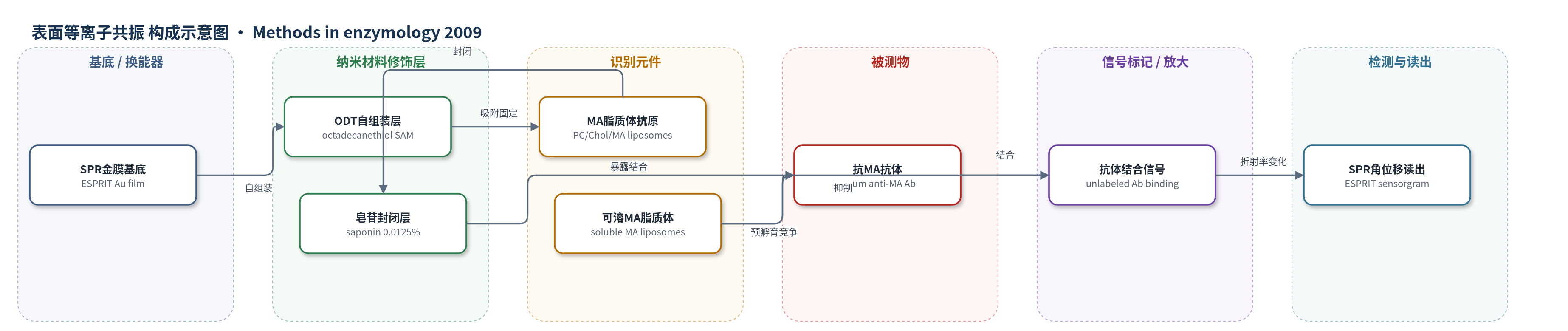
点击图片查看大图 · 依据论文自动绘制
传感器类型
表面等离子共振(SPR)生物传感器
检测对象
抗分枝菌酸抗体(anti-mycolic acid antibodies, anti-MA antibodies);样品基质:人血清(human serum)
检测原理
将纯化分枝菌酸(MA)与卵磷脂(PC)、胆固醇(Chol)制成脂质体,模拟 MA 在体内的脂质环境,并吸附固定在 ODT 疏水金膜表面。皂苷封闭脂质体疏水位点后,低稀释人血清中的抗 MA 抗体与固定 MA 结合,使金膜界面质量/折射率增加,ESPRIT SPR 共振角或反射率发生位移。随后用含 MA 脂质体或空 PC 脂质体预孵育血清:MA 脂质体竞争结合血清中的抗 MA 抗体,降低第二次结合信号,抑制率随抗体浓度升高而增大;空脂质体作为对照排除非特异结合。该抑制法(MARTI)减少抗胆固醇抗体交叉反应,无需酶或荧光标记放大。
检测灵敏度
线性范围: 血清稀释度 1/4000–1/500;R^2 = 0.9749
效应效果
在 IAsys 波导生物传感器上,MARTI 检测 61 份患者血清,总体特异性 48.4%(15/31)、灵敏度 86.7%(26/30);校正 HIV 感染者培养参考不足后特异性 76.9%,准确度 82%。但双通道基线匹配成功率约 30%。转移至 ESPRIT SPR 后,优化协议可在接收血清后 4 h 内出结果。与 ELISA 相比,P129 和 P96 在 ELISA 中假阴性(吸光比值 1.59、1.05,阈值 >2),MARTI 抑制率分别为 25.09% 和 29.53%(阈值 >20%);P94 真阴性(-0.23%)。皂苷 0.0125% 可稳定基线,ODT 表面可多次再生。
传感器的构成
- 基底/换能器:ESPRIT SPR 金膜传感器盘(glass slide + 50–100 nm Au film);原始 IAsys 波导消逝场传感器(HfO2 玻璃样表面,CPC/cetylpyridinium chloride 疏水化),通过棱镜/波导检测界面折射率变化。
- 修饰层:十八烷硫醇自组装单分子层(ODT, octadecanethiol, 10 mM in ethanol, 16 h),形成疏水界面并稳定固定脂质体。
- 识别元件:分枝菌酸脂质体(MA liposomes,egg phosphatidylcholine PC + cholesterol + purified mycobacterial MA),作为固定抗原呈递 MA。
- 封闭剂:皂苷(saponin, 0.0125% m/v in PBS/AE),封闭脂质体疏水位点,减少非特异结合。
- 信号产生层:无外源标记;人血清抗 MA 抗体(anti-MA antibodies)直接结合固定 MA,引起 SPR 信号。
- 抑制/竞争元件:可溶 MA 脂质体或空 PC 脂质体(soluble MA liposomes / empty PC liposomes),预孵育血清以竞争性抑制抗体结合。
- 缓冲/清洗介质:PBS/AE(含 EDTA 和 sodium azide),用于基线、洗涤;脂质体固定后使用非脱气 PBS/AE 避免脂质体破坏。
- 读出/再生:ESPRIT SPR 共振角/反射率变化(sensorgram, angle m°/reflectivity %);isopropanol + 50 mM NaOH (2:3, v/v) 与 99% ethanol 再生 ODT 金盘。
中文摘要
分枝菌酸(MA)是结核分枝杆菌细胞壁主要脂质,具有免疫调节作用,可在活动性结核(TB)患者中诱导特异性抗体。以抗 MA 抗体作为活动性 TB 的替代标志物时,传统 ELISA 将脂质抗原直接吸附于微孔板底部,灵敏度和特异性不足,部分原因是天然抗胆固醇抗体与 MA 存在交叉反应。本文报道利用脂质体包裹 MA,使其更接近体内生理环境,并优化脂质体作为传感器表面固定抗原载体和抑制试验中可溶性抗体结合抑制剂的条件。通过生物传感器抑制法(MARTI 检测)可降低抗胆固醇抗体干扰。文中描述了含或不含胆固醇稳定剂时脂质体的 MA 载量、用于生物传感器检测的最佳脂质体浓度与粒径,比较了波导消逝场生物传感器与表面等离子共振(SPR)生物传感器方法,并展示当两性霉素 B 结合脂质体中的 MA 时,生物传感器可证明 MA 的类固醇性质。
英文摘要
Antibodies to mycolic acid (MA) antigens can be detected as surrogate markers of active tuberculosis (TB) with evanescent field biosensors where the lipid antigens are encapsulated in liposomes. Standard immunoassay such as ELISA, where the lipid antigen is not encapsulated, but directly adsorbed to the well-bottoms of microtiter plates, does not yield the required sensitivity and specificity for accurate diagnosis of TB. One reason for this is the cross-reactivity of natural anticholesterol antibodies with MAs. MAs are the major cell wall lipids of mycobacteria. Mycobacterial MA has immunomodulatory properties and elicits specific antibodies in TB patients. Liposomes were optimized for their use as carriers both for the presentation of immobilized purified mycobacterial MA on sensor surfaces, and as a soluble inhibitor of antibody binding in inhibition assays. By using an inhibition assay in the biosensor, the interference by anticholesterol antibodies is reduced. Here, we describe the MA carrying capacity of liposomes with and without cholesterol as a stabilizing agent, optimized concentration and size of liposomes for use in the biosensor assay, comparison of the methods for wave-guide and surface plasmon resonance biosensors and how the cholesteroid nature of MA can be demonstrated by the biosensor when Amphotericin B is allowed to bind to MA in liposomes.