组成图示
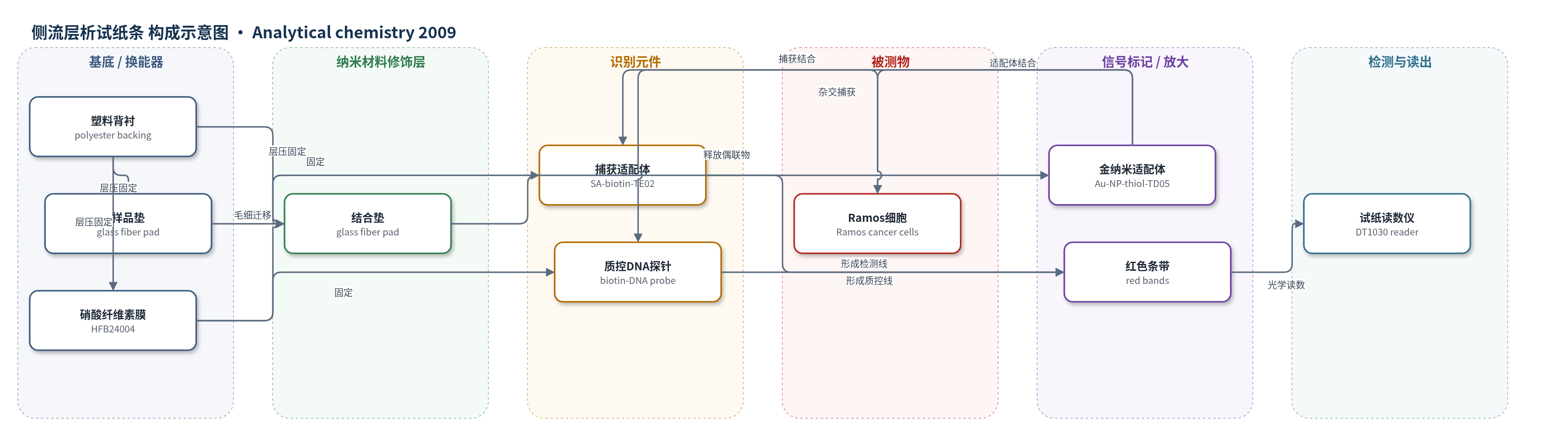
点击图片查看大图 · 依据论文自动绘制
传感器类型
侧流层析试纸条
检测对象
Ramos 细胞(Ramos cells,Burkitt 淋巴瘤 B 细胞系);样品基质:人全血(human whole blood)、PBSB 缓冲液
检测原理
ANSB 基于适配体与癌细胞表面的特异性识别及金纳米颗粒的光学信号。样品中的 Ramos 细胞随缓冲液毛细迁移,先与结合垫释放的 Au-NP-aptamer 偶联物中的 thiol-TD05 适配体结合,形成 Au-NP-aptamer-细胞复合物;随后复合物迁移至检测区,被固定于硝酸纤维素膜上的 biotin-TE02 捕获适配体二次结合,形成夹心结构。检测区聚集的 Au-NPs 因表面等离子体共振呈现红色条带,其峰面积随细胞数量增加而增大。未结合细胞的过量 Au-NP-aptamer 继续迁移至质控区,与互补 biotin-DNA 探针杂交形成质控线。该过程无需酶催化或核酸扩增,信号放大主要来自每个细胞表面多个适配体结合位点负载多个 Au-NPs。
检测灵敏度
LOD: 800 Ramos cells (based on S/N = 3);线性范围: 4 × 10^3 to 2 × 10^5 range(缓冲液);线性范围: 8 × 10^3 to 4 × 10^5 range(人全血);肉眼最低检测: 4000 Ramos cells
效应效果
ANSB 对 Ramos 细胞选择性较好:CCL 细胞单独存在时无检测线,与 Ramos 细胞混合时仅轻微干扰。人全血中,血样体积小于 5 µL 时无明显基质效应;10 µL 时信号显著下降,更多血液因红细胞非特异吸附掩盖信号。重现性方面,缓冲液中 2×10^4 个 Ramos 细胞 8 条试纸 RSD 为 6.3%,人全血中 RSD 为 7.3%。检测时间约 15 min,短于多数需 30 min 至数小时的报道方法。与作者前期荧光纳米颗粒、金纳米棒和微流控通道适配体检测相比,ANSB 更简单、快速、低成本,适合现场和即时检测;但灵敏度尚不足以检测实体瘤循环肿瘤细胞,作者提出可用荧光读数仪或染料掺杂聚苯乙烯/二氧化硅纳米颗粒标签提升。
传感器的构成
- 基底/支撑层:塑料背衬(polyester backing),用于层压固定样品垫、结合垫、硝酸纤维素膜和吸收垫
- 样品垫:玻璃纤维样品垫(glass fiber sample pad, CFSP001700),预载 pH 8.0 缓冲液(0.25% Triton X-100、0.05 M Tris-HCl、5% Tween-20、0.15 M NaCl),用于接收样品并促进细胞迁移
- 结合垫:玻璃纤维结合垫(glass fiber conjugate pad),点样 Au-NP-aptamer 偶联物(15±3.5 nm 金纳米颗粒 Au-NPs 偶联巯基适配体 thiol-TD05),储存于含 20 mM Na3PO4、5% BSA、2.5% Tween-20、10% sucrose 的洗脱缓冲液,用于释放检测探针
- 硝酸纤维素膜:nitrocellulose membrane(HFB24004),检测区固定链霉亲和素-生物素-适配体(streptavidin-biotin-TE02)捕获探针,质控区固定链霉亲和素-生物素-DNA探针(biotin-DNA),用于捕获 Au-NP-aptamer-细胞复合物和过量 Au-NP-aptamer
- 吸收垫:absorbent pad,用于吸收液体并维持毛细流动
- 识别元件:适配体 TE02 和 TD05,由 cell-SELEX 从活细胞筛选,特异性结合 Ramos 细胞
- 信号标记物:金纳米颗粒 Au-NPs(15±3.5 nm),提供红色条带和光学信号
- 封闭/稳定剂:BSA、Tween-20、sucrose,用于稳定 Au-NPs 并减少非特异吸附
中文摘要
本文报道了一种适配体-纳米颗粒试纸条生物传感器(ANSB),用于快速、特异、灵敏且低成本地检测循环癌细胞。作者首先通过细胞系统进化配体指数富集(cell-SELEX)从活细胞中筛选出高亲和力和高特异性的适配体,再将其与金纳米颗粒(Au-NPs)的独特光学性质相结合,在侧流层析装置上制备 ANSB。以 Ramos 细胞作为模型靶细胞进行原理验证。在优化条件下,ANSB 可在 15 min 内无需仪器通过肉眼检测最低 4000 个 Ramos 细胞,并借助便携式试纸读数仪检测 800 个 Ramos 细胞。更重要的是,ANSB 成功检测了人血中的 Ramos 细胞,为循环癌细胞的快速、灵敏、低成本定量检测提供了工具,具有现场使用和即时癌症诊断与治疗监测的应用前景。
英文摘要
We report an aptamer-nanoparticle strip biosensor (ANSB) for the rapid, specific, sensitive, and low-cost detection of circulating cancer cells. Known for their high specificity and affinity, aptamers were first selected from live cells by the cell-SELEX (systematic evolution of ligands by exponential enrichment) process. When next combined with the unique optical properties of gold nanoparticles (Au-NPs), ANSBs were prepared on a lateral flow device. Ramos cells were used as a model target cell to demonstrate proof of principle. Under optimal conditions, the ANSB was capable of detecting a minimum of 4000 Ramos cells without instrumentation (visual judgment) and 800 Ramos cells with a portable strip reader within 15 min. Importantly, ANSB has successfully detected Ramos cells in human blood, thus providing a rapid, sensitive, and low-cost quantitative tool for the detection of circulating cancer cells. ANSB therefore shows great promise for in-field and point-of-care cancer diagnosis and therapy.