组成图示
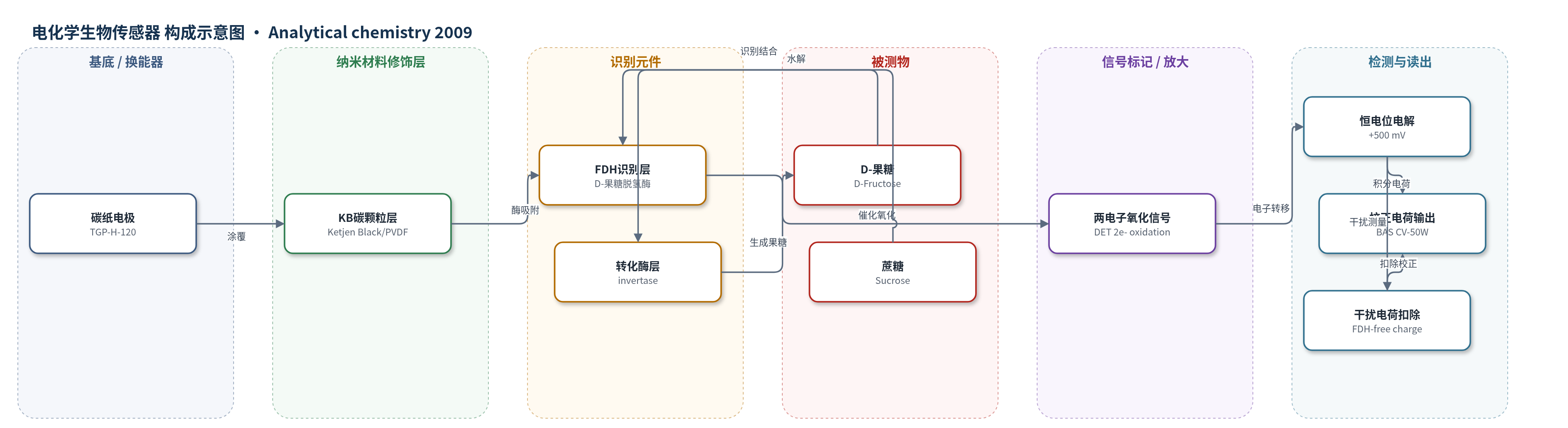
点击图片查看大图 · 依据论文自动绘制
传感器类型
电化学生物传感器
检测对象
D-果糖(D-Fructose)、蔗糖(Sucrose);样品基质为缓冲液及饮料(苹果汁、可乐、运动饮料)。
检测原理
FDH吸附于Ketjen Black(KB)多孔碳电极表面,其血红素c位点与电极直接电子转移(DET)。在+500 mV恒电位下,FDH催化D-果糖两电子氧化为5-酮-D-果糖,电子经KB碳层传递至碳纸电极,产生法拉第电流。库仑法对电流随时间积分至反应完全,总电荷Q=nFN(n=2),与D-果糖物质的量成正比,因此电荷量随浓度线性增加。KB的高比表面积和孔结构提高酶负载与电子转移电流密度。测定蔗糖时,转化酶先将蔗糖水解为D-果糖和葡萄糖,再经FDH氧化。对电活性干扰物,用无FDH电极测得干扰电荷并从总电荷中扣除。
检测灵敏度
线性范围: 1–100 mM(1 µL进样)
效应效果
传感器对D-果糖选择性高,FDH不受D-葡萄糖、D-甘露糖和D-果糖磷酸抑制。D-果糖库仑电解效率99 ± 3%(n=5),蔗糖100 ± 5%(n=5);含1 mM抗坏血酸时经无FDH电荷扣除后效率99 ± 4%(n=5)。电极4 °C保存5天稳定,连续进样响应恒定。饮料样品:苹果汁336 ± 9 mM(n=5)对F-kit 322 ± 13 mM(n=3);可乐267 ± 6 mM(n=3)对270 ± 0.3 mM(n=2);运动饮料180 ± 3 mM(n=6)对188 ± 9 mM(n=4)。线性范围1–100 mM,宽于F-kit约0.2–2.7 mM,操作更简单。
传感器的构成
- 基底/换能器电极:碳纸(CP,TGP-H-120,Toray)作为导电基底与电极支撑。
- 纳米材料修饰层:Ketjen Black(KB,EC 300J)碳纳米颗粒与PVDF粘结剂(2:8 w/w)涂覆,提供高比表面积多孔结构并增强DET电流密度。
- 识别元件:D-果糖脱氢酶(FDH,Gluconobacter frateurii)吸附于KB修饰电极,特异性催化D-果糖氧化。
- 辅助识别/水解元件:转化酶(invertase,Saccharomyces cerevisiae)与FDH共修饰,用于蔗糖水解为D-果糖和葡萄糖。
- 信号标记物:无(DET直接电子转移,无电子介体)。
- 电解液/反应介质:McIlvaine缓冲液(0.1 M柠檬酸/0.2 M Na2HPO4,pH 5)提供反应环境。
- 对电极:铂丝(Pt wire)用于完成电化学回路。
- 参比电极:Ag/AgCl电极用于控制+500 mV电位。
- 信号读出:BAS CV-50W电化学分析仪,恒电位电解并积分法拉第电流得到电荷量。
中文摘要
本文报道了一种基于D-果糖脱氢酶(FDH)直接电子转移(DET)反应的批量式库仑法D-果糖生物传感器。FDH吸附于多孔碳电极表面,无需电子介体即可催化D-果糖发生两电子电化学氧化生成5-酮-D-果糖。采用纳米结构碳颗粒修饰电极以提高催化电流密度。生物库仑测量获得的D-果糖氧化电荷量与1–100 mM、1 µL样品量对应的理论值良好一致。该方法结合特异性水解酶生成D-果糖,还可用于含D-果糖单元的寡糖/多糖检测;以FDH和转化酶修饰电极测定蔗糖为例。针对抗坏血酸等电活性干扰物,用无FDH电极测得的电荷量从FDH吸附电极总电荷中扣除,实现干扰校正。该方法成功测定多种饮料中D-果糖浓度。
英文摘要
This paper describes a batch-type coulometric d-fructose biosensor based on direct electron transfer reaction of d-fructose dehydrogenase (FDH) adsorbed on a porous carbon electrode surface. The adsorbed-FDH electrodes catalyzed the electrochemical two-electron oxidation of d-fructose to 5-keto-d-fructose without a mediator. Nanostructured carbon particle-modified electrodes were used for the coulometric d-fructose biosensor to enhance the catalytic current density. The electric charge for the d-fructose oxidation gained by the biocoulometric measurement was in good agreement with the theoretical value corresponding to d-fructose amount in the range from 1 to 100 mM with a sample volume of 1 muL. This method is also applicable to the determination of several oligo/polysaccharides containing the d-fructose unit, in combination with specific hydrolases to yield d-fructose. An example was demonstrated by sucrose determination in which the electrode modified with FDH and invertase was used as a working electrode. To address the problem of electroactive interferences such as ascorbate, the electric charge at the FDH-free electrode was subtracted from the total charge obtained at the FDH-adsorbed electrode. The d-fructose concentrations in several beverages were successfully determined with this method.