组成图示
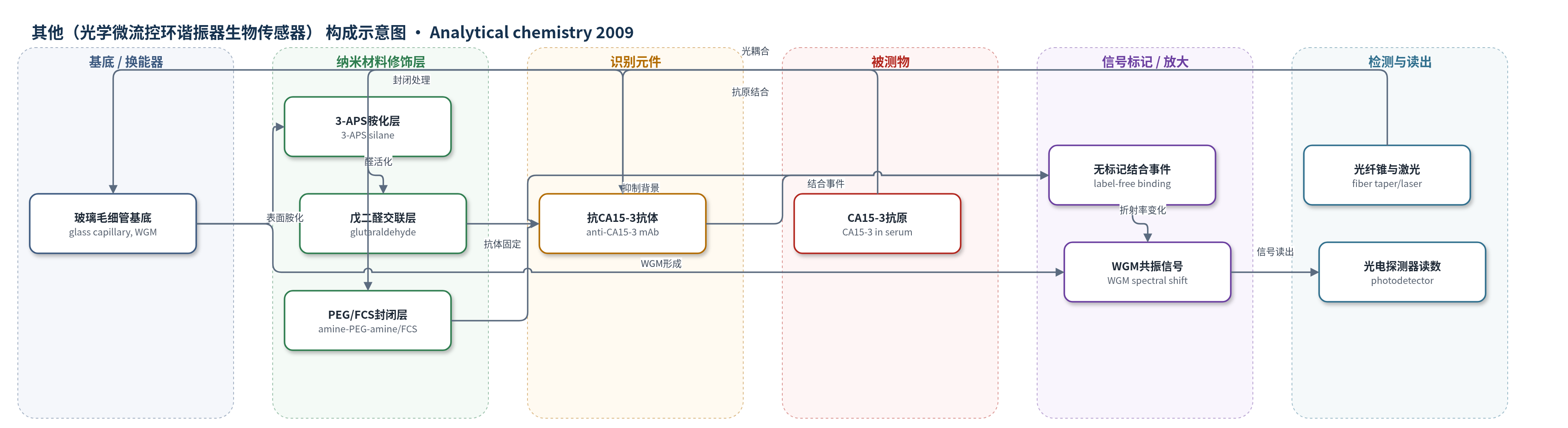
点击图片查看大图 · 依据论文自动绘制
传感器类型
其他(光学微流控环谐振器生物传感器)
检测对象
CA15-3(carbohydrate antigen 15-3);样品基质:临床人血清(稀释后),另在PBS缓冲液和胎牛血清(FCS)中验证。
检测原理
OFRR以玻璃毛细管为微流控通道和光学微腔,980 nm激光经光纤锥耦合形成耳语廊模式(WGMs),其倏逝场穿透薄壁进入毛细管内部。内表面经3-APS和戊二醛共价固定抗CA15-3单克隆抗体,并用amine-PEG-amine及FCS/Tween-20双重封闭抑制血清蛋白非特异吸附。当CA15-3与抗体结合后,传感界面局部折射率增加,WGM有效折射率改变,共振波长向长波方向漂移。漂移量经体折射率灵敏度归一化后可换算为表面密度,并随CA15-3浓度按Langmuir结合曲线增加,无需酶、荧光或放射性标记放大。
检测灵敏度
LOD: 约1 unit/mL(原文称可在PBS和稀释血清中检测约1 unit/mL CA15-3;21倍稀释对应未稀释血清约20 units/mL);线性范围: 1–200 units/mL(PBS);20–2500 units/mL(FCS加标,稀释后)
效应效果
传感器选择性良好:抗ER抗体表面不响应100 units/mL CA15-3,抗CA15-3抗体对100 units/mL CA12-5无交叉反应。双重封闭将3倍稀释FCS的非特异蛋白吸附降至约4.5×10^9/cm2(0.5 ng/cm2),6倍稀释降至2.7×10^9/cm2(0.3 ng/cm2),满足超低污损要求。临床IV期乳腺癌患者血清经21倍稀释后与ARUP标准检测相关性良好;6倍稀释结果偏高2–3倍,提示异嗜性抗体干扰。健康男性血清无可见信号。检测约20–30 min,显著快于约3 h的ELISA,作者认为其低成本、低样品量、操作简便,适合治疗监测和随访。
传感器的构成
- 基底/换能器:玻璃毛细管(glass capillary,直径约100 µm,壁厚<4 µm),形成光学环谐振器并作为微流控样品通道。
- 表面活化层:3-APS((3-aminopropyl)trimethoxysilane)胺化玻璃内表面,提供氨基反应位点。
- 交联活化层:5% glutaraldehyde(GA)在PBS中活化氨基,用于共价固定抗体。
- 识别元件:anti-CA15-3 monoclonal antibody(clone 2F16,50 µg/mL)固定于内表面,特异性捕获CA15-3。
- 封闭层:amine-PEG-amine(MW 1000,1 mg/mL)封闭剩余活性位点;血清检测时再用10% FCS-PBS/0.5% Tween-20二次封闭。
- 运行介质:3% FCS-PBS/0.5% Tween-20作为运行缓冲液,维持低非特异吸附基线。
- 信号标记物:无标记(label-free),不添加酶、荧光或放射性标记物。
- 光学读出:980 nm tunable diode laser、optical fiber taper(约3 µm)、photodetector与数据采集系统,读取WGM波长漂移。
中文摘要
乳腺癌生物标志物CA15-3在人血清中的灵敏、特异检测,是评估临床治疗效果和预测乳腺癌复发的重要环节。本研究开发了一种光流控环谐振器(OFRR)传感器及相应检测方案,用于无标记检测CA15-3,无需额外信号放大步骤。通过优化表面封闭方法,有效降低了血清蛋白的非特异性吸附。作者首先在磷酸盐缓冲液(PBS)和胎牛血清(FCS)中表征了传感器性能,随后将其用于临床人血清样品中CA15-3水平的测定,并与标准临床实验室检测结果进行比较。结果表明,OFRR可在约30 min内检测PBS和稀释血清中约1 unit/mL的CA15-3。该工作首次展示了光学环谐振器生物传感器在真实临床检测中的应用,具有成本低、操作简便、响应快速、样品用量少和特异性高等优点。
英文摘要
Sensitive and specific detection of breast cancer biomarker CA15-3 in human serum is an important step toward successful evaluation of clinical treatment and prediction of breast cancer recurrence. In this work, we developed an optofluidic ring resonator (OFRR) sensor and the corresponding sensing protocols for label-free CA15-3 detection without any additional signal amplification steps. Nonspecific serum protein adsorption was minimized with effective surface blocking methods. The sensor performance for CA15-3 detection was first characterized in phosphate-buffered saline (PBS) buffer and in fetal calf serum. Then the potential use of the OFRR as a simple clinical laboratory testing device for breast cancer diagnostics was tested by measuring the CA15-3 level in clinical human serum samples, and the results were compared with those of standard clinical lab tests. It was found that the OFRR was capable of detecting approximately 1 unit/mL CA15-3 in both PBS buffer and diluted serum within approximately 30 min. Our work marks the first demonstration of the optical ring resonator biosensor in real clinical applications that features low cost, simple detection procedures, rapid response time, low sample consumption, and high specificity.