组成图示
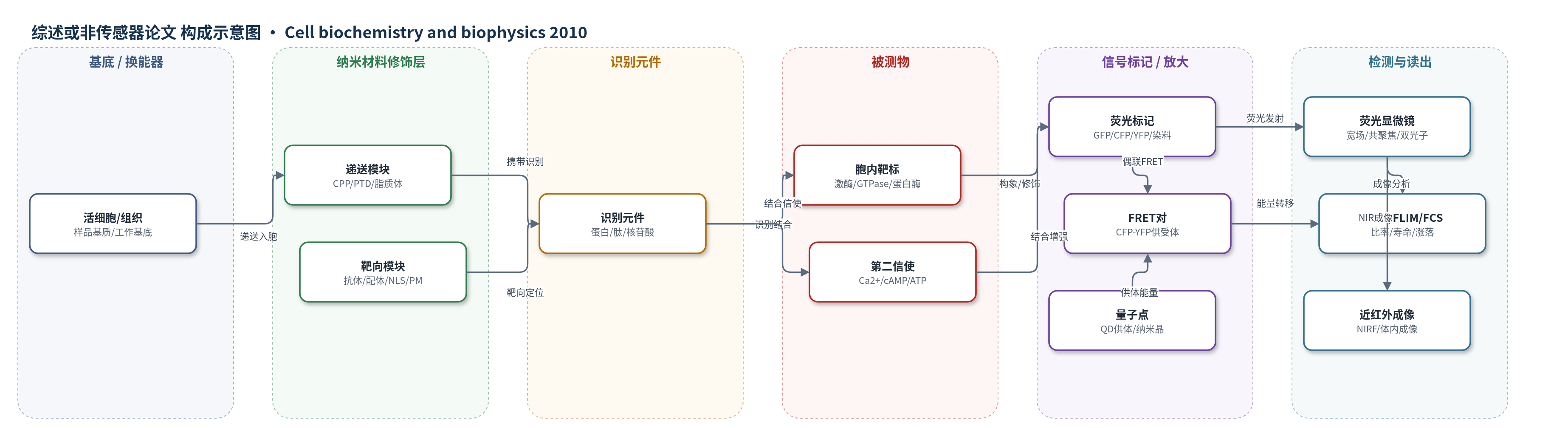
点击图片查看大图 · 依据论文自动绘制
传感器类型
综述或非传感器论文
检测对象
多种胞内靶标:蛋白激酶(protein kinases)、GTPase(Ras/Rho/Rac/Cdc42)、蛋白酶(proteases/caspases/cathepsins/MMPs)、第二信使(Ca2+、cAMP)、细胞周期调控蛋白(CDK/cyclin);样品基质:活细胞、组织、动物体内。
检测原理
荧光生物传感器通常由识别元件与荧光标记偶联构成。识别元件可为蛋白结构域、肽底物、核苷酸类似物或荧光蛋白融合模块,负责特异性结合胞内靶标或响应其催化事件。当靶标发生结合、磷酸化、甲基化、切割或构象变化时,会改变荧光团局部环境或供体-受体距离,从而改变荧光强度、比率、寿命或FRET效率。FRET 型传感器利用 CFP/YFP 等供体-受体对,在距离小于约 10 nm 时发生非辐射能量转移;FLIM 通过荧光寿命变化提供与探针浓度无关的定量信息;FCS 分析荧光涨落以获取动力学参数。环境敏感染料则随局部极性、疏水性或质子化状态变化而改变发射。淬灭和笼化策略可降低背景并实现时空可控激活。信号随靶标浓度或活性增强而增强或减弱。
检测灵敏度
原文未报告统一 LOD、线性范围、灵敏度斜率或 R^2。
效应效果
作为综述,该文未给出单一传感器的 RSD、加标回收率或统一 LOD,但强调荧光生物传感器可在活细胞、组织和动物体内以高时空分辨率、非破坏方式监测内源靶标。相比外源表达、基因敲除、siRNA 敲低、免疫荧光或 FACS 等间接方法,其可直接读出蛋白水平、活性、定位和相互作用,减少补偿效应。FRET/FLIM/FCS 提供比率、寿命或涨落信息,有助于降低浓度依赖误差;近红外探针降低组织损伤和光毒性。应用覆盖信号转导、细胞周期、癌症、凋亡、心血管、神经和病毒感染,并可用于药物筛选、分子诊断和治疗监测。
传感器的构成
- 工作基底:活细胞、组织或动物体内,作为荧光传感器工作的胞内/体内介质。
- 识别元件:蛋白、肽、多肽或核苷酸序列,负责结合靶标或响应磷酸化、切割、构象变化。
- 信号标记物:GFP 变体(CFP/YFP)、小分子荧光团、近红外荧光探针(NIRF)、量子点(QD),用于产生或传递荧光信号。
- 递送/靶向模块:细胞穿透肽(CPP)、蛋白转导结构域(PTD)、脂质体、碳纳米颗粒、抗体/配体、核定位序列(NLS)/质膜靶向域,用于进入细胞或定位亚细胞区室。
- 换能/读出模块:荧光显微镜、FRET、FLIM、FCS、近红外/双光子成像,将识别事件转换为可测荧光强度、比率、寿命或涨落信号。
中文摘要
随着药物发现项目增多,在健康与病理细胞中以高时空分辨率可视化和监测生物活动变得至关重要。为此,能够报告特定胞内靶标水平与活性的探针和传感器成为必需。绿色荧光蛋白(GFP)的发现、GFP 报告系统的发展、小分子荧光探针的合成进展以及荧光成像技术的快速进步,使生物传感器领域出现了大量可用于复杂生物样品、活细胞和组织的荧光报告系统,用于探测蛋白-蛋白相互作用、构象变化和翻译后修饰。本文综述荧光生物传感器技术的近期进展,介绍不同种类和类别的荧光生物传感器,并概述在细胞内和体内成像中常用的技术。文章还讨论合成荧光探针选择、标记、淬灭、笼化及胞内递送等问题与策略,最后给出遗传编码 FRET 报告系统、肽和蛋白生物传感器的实例,并描述其在多个领域的应用。
英文摘要
With the escalation of drug discovery programmes, it has become essential to visualize and monitor biological activities in healthy and pathological cells, with high spatial and temporal resolution. To this aim, the development of probes and sensors, which can report on the levels and activities of specific intracellular targets, has become essential. Together with the discovery of the Green Fluorescent Protein (GFP), and the development of GFP-based reporters, recent advances in the synthesis of small molecule fluorescent probes, and the explosion of fluorescence-based imaging technologies, the biosensor field has witnessed a dramatic expansion of fluorescence-based reporters which can be applied to complex biological samples, living cells and tissues to probe protein/protein interactions, conformational changes and posttranslational modifications. Here, we review recent developments in the field of fluorescent biosensor technology. We describe different varieties and categories of fluorescent biosensors together with an overview of the technologies commonly employed to image biosensors in cellulo and in vivo. We discuss issues and strategies related to the choice of synthetic fluorescent probes, labelling, quenching, caging and intracellular delivery of biosensors. Finally, we provide examples of some well-characterized genetically encoded FRET reporter systems, peptide and protein biosensors and describe biosensor applications in a wide variety of fields.