组成图示
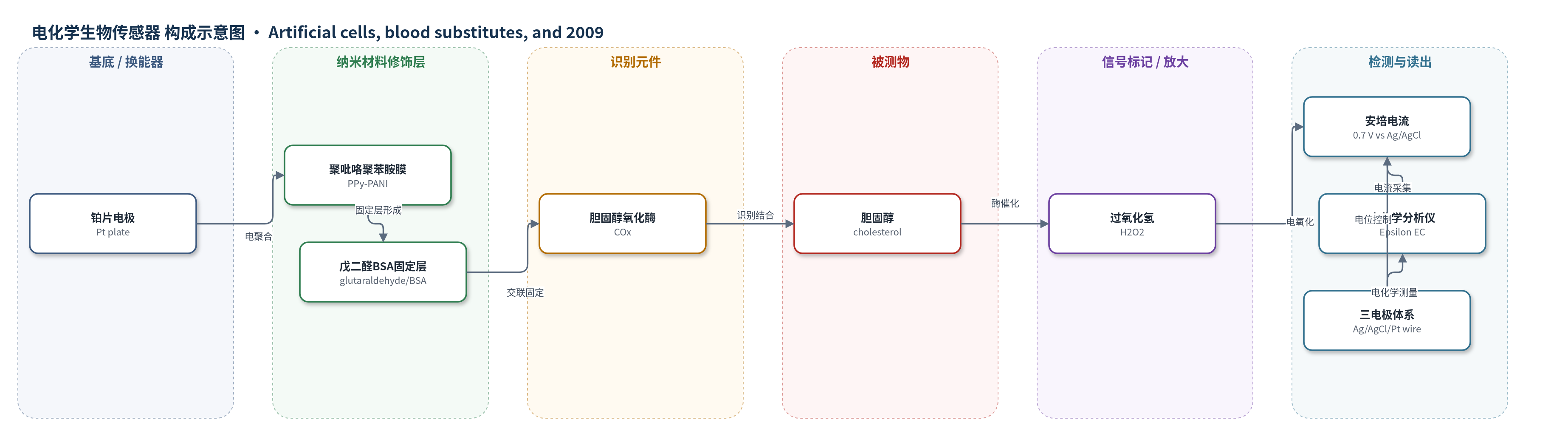
点击图片查看大图 · 依据论文自动绘制
传感器类型
电化学生物传感器
检测对象
胆固醇(cholesterol);样品基质:血清(serum)
检测原理
胆固醇氧化酶(COx)识别并催化胆固醇与氧气反应,生成胆甾-4-烯-3-酮和过氧化氢(H2O2)。生成的H2O2扩散至铂/聚吡咯-聚苯胺(Pt/PPy-PANI)电极表面,在0.7 V(vs. Ag/AgCl)下发生电氧化,释放电子并产生安培电流。电流大小与H2O2生成速率相关,从而随胆固醇浓度增加而增大。聚吡咯-聚苯胺复合膜提供导电通道和生物相容微环境,戊二醛与牛血清白蛋白(BSA)交联固定COx,有助于维持酶活性。该体系未使用额外信号放大策略,主要依靠酶催化产物H2O2的直接电氧化实现检测。
检测灵敏度
原文未报告LOD、线性范围、灵敏度斜率及R^2;报告响应时间: 300 s;Km: 3,3 mM;Imax: 5,26 mM/min;底物浓度考察范围: 0.01–0.3 mM
效应效果
该传感器在pH 7.0、25 °C下工作,响应时间300 s。操作稳定性方面,一天内连续30次测定后保留82%初始响应电流;4 °C磷酸盐缓冲液中储存23天后保留60%。在5个血清池样品中,电化学法/生物传感器测得胆固醇为160、110、105、78、76 mg/100 mL,比色法参考结果为218、157、153、119、112 mg/100 mL;原文未报告回收率、RSD和选择性数值。作者认为PPy-PANI可提供生物相容电化学微环境,传感器具有高灵敏度、良好选择性和优良稳定性,可用于实际血清样品胆固醇检测。
传感器的构成
- 基底电极:铂片电极(Pt plate,0.5 cm2),作为工作电极与导电基底,并提供H2O2电催化氧化位点
- 修饰层:聚吡咯-聚苯胺复合膜(PPy-PANI),由吡咯(pyrrole)和苯胺(aniline)在硫酸中循环伏安电聚合形成,提供导电微环境并承载酶
- 识别元件:胆固醇氧化酶(COx,EC 1.7.3.3),催化胆固醇氧化生成H2O2
- 交联固定剂:戊二醛(glutaraldehyde),与酶氨基交联以固定COx
- 稳定蛋白:牛血清白蛋白(BSA),与COx和戊二醛共同形成固定层
- 信号产物:过氧化氢(H2O2),酶反应产物,在0.7 V vs. Ag/AgCl氧化产生安培电流
- 电化学池电极:Ag/AgCl参比电极(3M KCl)与铂丝对电极,用于施加电位和电流检测
中文摘要
本文报道了一种新型安培法胆固醇生物传感器。该传感器以铂片电极为基底,在硫酸介质中通过循环伏安法电聚合吡咯和苯胺,制备聚吡咯-聚苯胺(PPy-PANI)复合膜,再用戊二醛交联法将胆固醇氧化酶(COx)固定于膜表面。检测基于COx催化胆固醇氧化生成过氧化氢(H2O2),随后在0.7 V(vs. Ag/AgCl)下对H2O2进行安培氧化,所得电流用于定量胆固醇。研究考察了pH、温度、底物浓度等条件,确定最佳工作条件为pH 7.0、25 °C。优化后的传感器具有线性工作范围和300 s的响应时间。稳定性测试表明,在一天内连续进行30次测定后仍保留82%的响应电流;4 °C储存23天后保留60%的响应电流。该传感器被用于血清中胆固醇的分析。
英文摘要
A new amperometric cholesterol biosensor was prepared by immobilizing cholesterol oxidase by a glutaraldehyde crosslinking procedure on polypyrrole-polyaniline (ppy-pani) composite film on the surface of a platinum electrode. In order to prepare a biosensor for the determination of cholesterol, electropolymerization of pyrrole and aniline on Pt surface was performed with an electrochemical cell containing pyrrole and aniline in sulphuric acid by cyclic voltammetry between 0.0 and 0,7 V (vs.Ag/AgCl) at a scan rate of 50 mV upon Pt electrode. The amperometric determination is based on the electrochemical detection of H(2)O(2), which is generated in enzymatic reaction of cholesterol. The cholesterol determined by the oxidation of enzymatically generated H(2)O(2) at 0.7 V vs. Ag/AgCl. The optimized cholesterol oxidase biosensor displayed linear working range and a response time of 300 s. The effects of pH and temperature were investigated and optimum parameters were found to be 7.0, 25 degrees C, respectively. In addition to this, the stability and reproducibility of biosensor were tried. Operational stability of the proposed cholesterol biosensor was obtained by periodical measurements of the biosensor response. Biosensor at optimum activity conditions was used in 30 activity assays in one day to determine the operational stability. The results show that 82% of the response current was retained after 30 activity assays. The electrode was stored in a refrigerator at 4 degrees C after the measurements. The storage stability of the biosensor was determined by performing activity assays within 23 days. The results demonstrate that 60% of the response current was retained after 23 days. Preparing biosensor is used for the analysis of cholesterol in serum.