组成图示
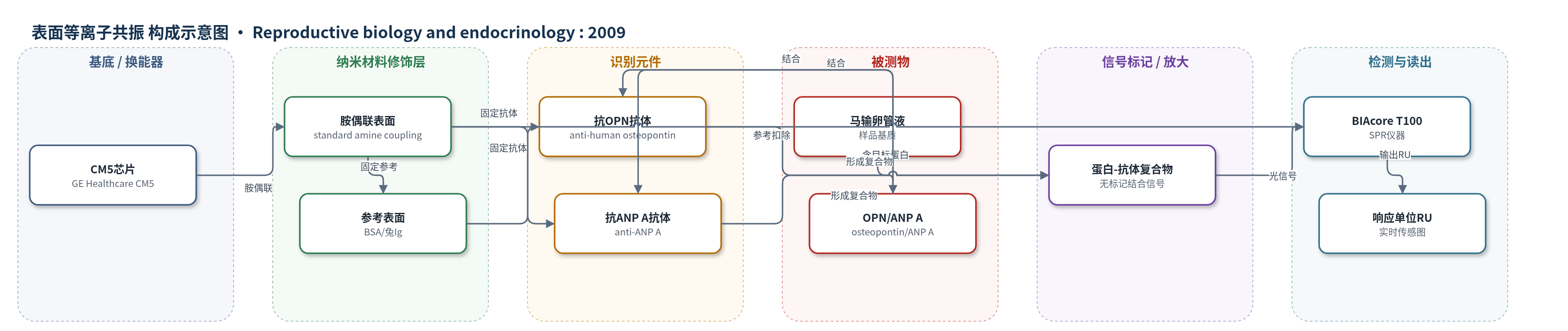
点击图片查看大图 · 依据论文自动绘制
传感器类型
表面等离子共振(SPR)生物传感器
检测对象
骨桥蛋白(osteopontin, OPN)、心房钠尿肽A(atrial natriuretic peptide A, ANP A);样品基质:马输卵管液(equine oviduct fluid)
检测原理
本方法将抗人骨桥蛋白抗体和抗人ANP A抗体通过标准胺偶联固定于CM5芯片,BSA与兔血清免疫球蛋白作为参考表面。离心后的马输卵管液用含Hepes、NaCl、Tween 20和BSA的运行缓冲液稀释后流过芯片。若液相中存在骨桥蛋白或ANP A,它们会与对应抗体特异性结合,使芯片界面质量/折射率增加,改变表面等离子体共振条件。BIAcore T100实时监测共振响应,结合相表现为响应单位(RU)上升,停止注射后解离相下降。目标蛋白浓度越高,结合量越大,RU响应越强;参考表面用于扣除非特异结合,100 mmol/L H3PO4用于再生。该方法无标记、实时,可定性或半定量分析复杂输卵管液中的蛋白。
检测灵敏度
原文未报告LOD、线性范围、灵敏度斜率或相关系数。
效应效果
SPR检测在BIAcore T100上进行,抗OPN和抗ANP A芯片表面固定水平分别为10500 RU和14000 RU,BSA与兔Ig作参考表面。稀释马输卵管液注射后,两种抗体表面均出现结合-解离传感图,证明马输卵管液中存在骨桥蛋白和ANP A。Western blot在发情周期三个阶段的马输卵管中分别检测到50–60 kDa的OPN和15–20 kDa的ANP A,且各阶段无明显差异。作者认为SPR可实时、无标记分析复杂输卵管液中的分子相互作用,是研究受精相关蛋白的敏感有力工具。原文未报告LOD、线性范围、RSD、回收率或与ELISA等方法的定量对比。
传感器的构成
- 换能器基底:CM5传感器芯片(GE Healthcare),提供表面等离子共振换能表面并用于抗体固定。
- 识别元件:抗人骨桥蛋白抗体(anti-human osteopontin, R&D Systems)和抗人ANP A抗体(anti-ANP A),经标准胺偶联固定于芯片,捕获输卵管液中的目标蛋白。
- 参考表面:牛血清白蛋白(BSA)和兔血清免疫球蛋白(rabbit serum immunoglobulins),以相近水平固定,用于扣除非特异结合。
- 流动相:运行缓冲液(10 mmol/L Hepes、150 mmol/L NaCl、0.05% Tween 20、1 g/L BSA),稀释离心马输卵管液并维持蛋白稳定。
- 信号标记物:无标记(label-free),目标蛋白直接结合抗体引起界面质量变化。
- 再生液:100 mmol/L磷酸(H3PO4),用于结合后再生芯片表面。
- 检测仪器:BIAcore T100(GE Healthcare),实时记录响应单位(RU)传感图。
中文摘要
输卵管上皮细胞(OEC)共培养可促进人、牛和猪的体外受精(IVF),但马的IVF率仍较低。本研究首先验证OEC对马IVF的有益作用,并鉴定参与受精的输卵管蛋白。实验将钙离子载体处理的新鲜马精子与体外成熟马卵母细胞在有无猪OEC条件下共孵育,结果显示OEC存在可提高IVF率。后续比较马与猪OEC、完整卵丘-卵母细胞复合体与去卵丘卵母细胞、经人绒毛膜促性腺激素(hCG)、黄体生成素(LH)和/或雌二醇刺激与未刺激OEC、体内与体外成熟卵母细胞,IVF率均无显著差异。基因组分析显示马存在骨桥蛋白(osteopontin)和心房钠尿肽A(ANP A)基因,而输卵管蛋白(oviductin)基因可能为假基因或注释不佳。表面等离子共振生物传感器和Western blot证实马输卵管中存在骨桥蛋白和ANP A,并在发情周期各阶段表达。外源骨桥蛋白或ANP A未显著改变马IVF率,但骨桥蛋白略提高IVF率。结果表明同源和异源输卵管细胞对马IVF有有益作用,但受精率仍低;SPR可用于分析受精过程中的分子相互作用。
英文摘要
BACKGROUND: Oviduct epithelial cells (OEC) co-culture promotes in vitro fertilization (IVF) in human, bovine and porcine species, but no data are available from equine species. Yet, despite numerous attempts, equine IVF rates remain low. Our first aim was to verify a beneficial effect of the OEC on equine IVF. In mammals, oviductal proteins have been shown to interact with gametes and play a role in fertilization. Thus, our second aim was to identify the proteins involved in fertilization in the horse.
METHODS & RESULTS: In the first experiment, we co-incubated fresh equine spermatozoa treated with calcium ionophore and in vitro matured equine oocytes with or without porcine OEC. We showed that the presence of OEC increases the IVF rates. In the subsequent experiments, we co-incubated equine gametes with OEC and we showed that the IVF rates were not significantly different between 1) gametes co-incubated with equine vs porcine OEC, 2) intact cumulus-oocyte complexes vs denuded oocytes, 3) OEC previously stimulated with human Chorionic Gonadotropin, Luteinizing Hormone and/or oestradiol vs non stimulated OEC, 4) in vivo vs in vitro matured oocytes. In order to identify the proteins responsible for the positive effect of OEC, we first searched for the presence of the genes encoding oviductin, osteopontin and atrial natriuretic peptide A (ANP A) in the equine genome. We showed that the genes coding for osteopontin and ANP A are present. But the one for oviductin either has become a pseudogene during evolution of horse genome or has been not well annotated in horse genome sequence. We then showed that osteopontin and ANP A proteins are present in the equine oviduct using a surface plasmon resonance biosensor, and we analyzed their expression during oestrus cycle by Western blot. Finally, we co-incubated equine gametes with or without purified osteopontin or synthesized ANP A. No significant effect of osteopontin or ANP A was observed, though osteopontin slightly increased the IVF rates.
CONCLUSION: Our study shows a beneficial effect of homologous and heterologous oviduct cells on equine IVF rates, though the rates remain low. Furthers studies are necessary to identify the proteins involved. We showed that the surface plasmon resonance technique is efficient and powerful to analyze molecular interactions during fertilization.