组成图示
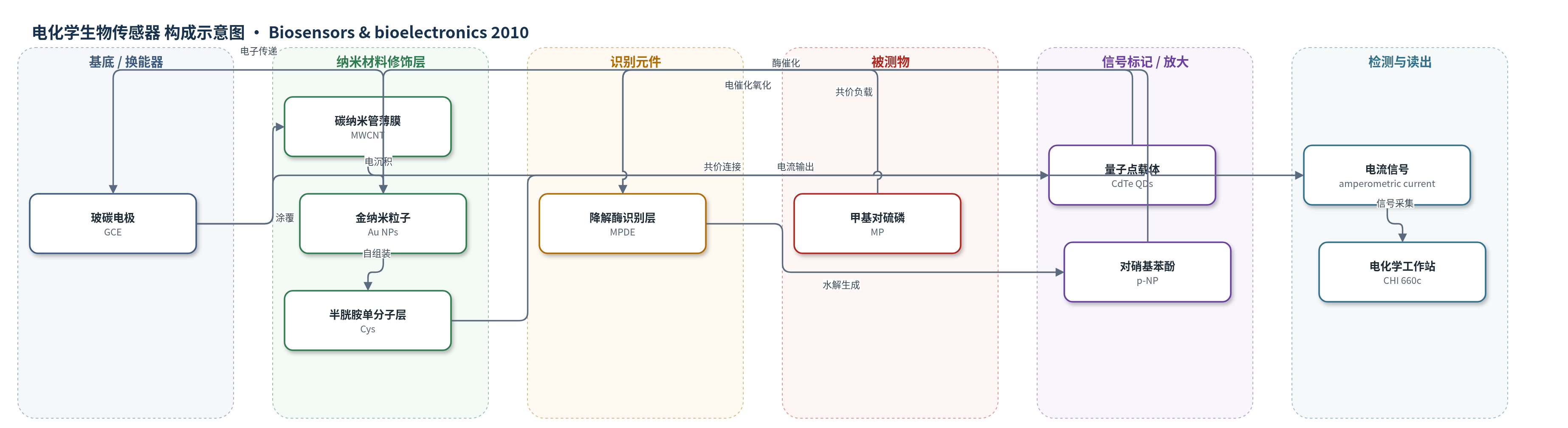
点击图片查看大图 · 依据论文自动绘制
传感器类型
电化学生物传感器
检测对象
甲基对硫磷(methyl parathion, MP);样品基质:PBS 缓冲液(pH 7.0)、大蒜样品(garlic samples)加标 PBS
检测原理
MPDE 催化水解含 P-S 键的甲基对硫磷(MP),生成等摩尔对硝基苯酚(p-NP)和磷酸二乙酯等低毒产物。p-NP 在工作电极固定电位下发生电化学氧化,产生与 MP 浓度成正比的安培电流。MWCNT 与 Au NPs 复合膜显著增大电极有效面积,并协同增强 p-NP 的电催化氧化;CdTe QDs 经 EDC/NHS 活化后共价结合 MPDE,作为载体在电极表面负载大量酶,实现酶量放大与界面电催化放大的双重增强。检测无需介质,MP 浓度越高,p-NP 生成越多,氧化电流越大。
检测灵敏度
LOD: 1.0 ng/mL;线性范围: 5.0 ng/mL–200 ng/mL 与 200 ng/mL–1000 ng/mL;R^2 = 0.994 与 0.996
效应效果
该传感器对 MP 具有高度选择性:在 100 ng/mL MP 存在下,100 ng/mL 西维因(carbaryl)、灭多威(dimethoate)、单甲磷(monocrotophos)、马拉硫磷(malathion)以及 0.1 M SO4^2-、NO3- 均不干扰。大蒜样品加标回收率为 96.0%–101.3%。批内 RSD 为 3.0%,批间 RSD 为 8.7%。4 ℃干燥保存 10 天内响应无明显下降,30 天后仍保持初始电流响应的 90%。与基于胆碱酯酶抑制的传感器相比,MPDE 不被有机磷农药抑制,可重复使用并适合连续监测,作者认为其可用于实际样品中 MP 的快速、灵敏、选择性检测。
传感器的构成
- 基底电极:玻碳电极(GCE),作为工作电极与电子转导基底。
- 碳纳米管修饰层:多壁碳纳米管(MWCNT)薄膜,预涂于 GCE,增大表面积并促进电子传递。
- 金纳米粒子修饰层:金纳米粒子(Au NPs),由 HAuCl4 多电位阶跃电沉积于 MWCNT 上,增大表面积并协同增强 p-NP 电催化氧化。
- 自组装连接层:半胱胺(Cys)单分子层,在 Au NPs 表面形成,提供氨基用于共价连接 CdTe QDs。
- 量子点载体层:羧基化 CdTe 量子点(CdTe QDs),经 EDC/NHS 活化后共价结合 MPDE,作为载体负载大量酶。
- 识别元件:甲基对硫磷降解酶(MPDE),催化水解 MP 生成对硝基苯酚(p-NP)。
- 信号产物:对硝基苯酚(p-NP),MP 水解产物,在固定电位下电化学氧化产生电流。
中文摘要
本文报道了一种基于双重信号放大策略的安培生物传感器,用于高选择性、高灵敏测定甲基对硫磷(MP)。传感器制备包括:先在玻碳电极(GCE)上预涂多壁碳纳米管(MWCNT)薄膜,再通过多电位阶跃法电沉积金纳米粒子(Au NPs);随后利用羧基化 CdTe 量子点(CdTe QDs)通过共价连接将甲基对硫磷降解酶(MPDE)固定于修饰电极表面。MWCNT 与 Au NPs 显著增大电极表面积,并对酶催化及产物对硝基苯酚的电化学氧化产生协同增强作用;CdTe QDs 作为载体负载大量 MPDE,提高电极表面酶量。该传感器无需介质即可对 MP 产生极灵敏、高选择且快速的响应,检出限为 1.0 ng/mL。由于 MPDE 可水解含 P-S 键的农药,对 MP 具有较高选择性,氨基甲酸酯类农药、其他有机磷农药及 SO4^2-、NO3- 等不干扰测定。传感器重现性和稳定性良好,且 MPDE 不被有机磷农药抑制,可重复使用并适用于连续监测。
英文摘要
An amperometric biosensor for highly selective and sensitive determination of methyl parathion (MP) was developed based on dual-signal amplification: (1) a large amount of introduced enzyme on the electrode surface and (2) synergistic effects of nanoparticles towards enzymatic catalysis. The fabrication process includes (1) electrochemical deposition of gold nanoparticles by a multi-potential step technique at multiwalled carbon nanotube (MWCNT) film pre-cast on a glassy carbon electrode and (2) immobilization of methyl parathion degrading enzyme (MPDE) onto a modified electrode through CdTe quantum dots (CdTe QDs) covalent attachment. The introduced MWCNT and gold nanoparticles significantly increased the surface area and exhibited synergistic effects towards enzymatic catalysis. CdTe QDs are further used as carriers to load a large amount of enzyme. As a result of these two important enhancement factors, the proposed biosensor exhibited extremely sensitive, perfectly selective, and rapid response to methyl parathion in the absence of a mediator. The detection limit was 1.0 ng/mL. Moreover, since MPDE hydrolyzes pesticides containing the P-S bond, it showed high selectivity for detecting MP and many interfering compounds, such as carbamate pesticides. Other organophosphorous pesticides and oxygen-containing inorganic ions (SO(4)(2-), NO(3)(-)) did not interfere with the determination. The proposed MPDE biosensor presents good reproducibility and stability, and the MPDE is not poisoned by organophosphate pesticides. Unlike cholinesterase-based biosensor, the MPDE biosensor can be potentially reused and is suitable for continuous monitoring.