组成图示
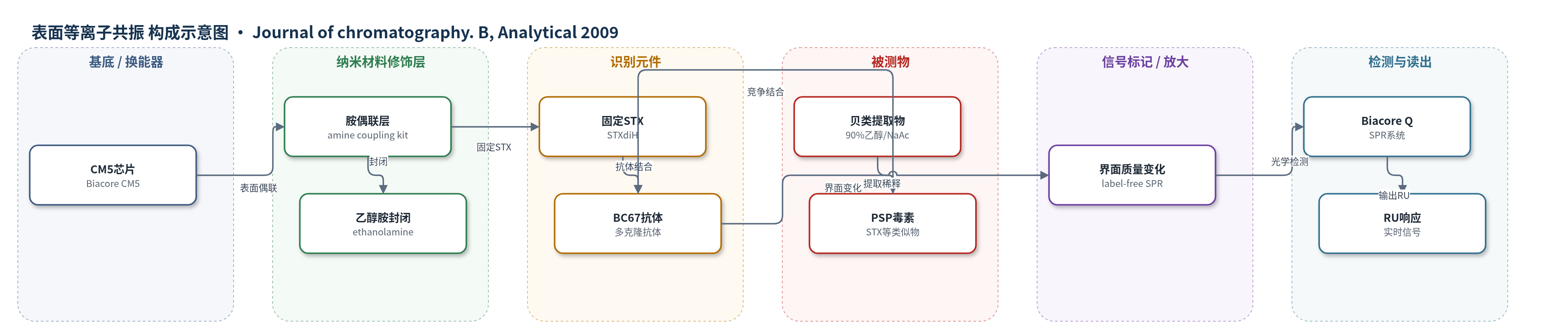
点击图片查看大图 · 依据论文自动绘制
传感器类型
表面等离子共振(SPR)生物传感器
检测对象
麻痹性贝类毒素(PSP toxins,含STX、NEO、GTX1/4、GTX2/3、GTX5、dcSTX、dcNEO、dcGTX2/3、C1/C2等);样品基质为贝类组织(贻贝、蛤、蛤蜊、牡蛎、扇贝)的90%乙醇或pH 5 NaAc缓冲液提取物。
检测原理
本方法采用竞争抑制式SPR检测。CM5芯片经胺偶联固定STXdiH作为表面抗原,BC67多克隆抗体与芯片表面STX结合。样品中的PSP毒素与BC67抗体结合后,竞争性地减少抗体与表面STX的结合。结合事件改变SPR芯片表面的质量/折射率,使表面等离子体共振条件发生偏移,Biacore Q通过反射光变化实时记录相对响应单位(RU)。被测毒素浓度越高,表面抗体结合越少,响应变化越大。该方法无酶标、无核酸或酶催化放大,灵敏度主要依赖BC67抗体的高亲和力和对多种PSP类似物的交叉反应。
检测灵敏度
LOD: 9.0 µg/100 g(90%乙醇提取,STXdiH);6.8 µg/100 g(NaAc提取,STXdiH);IC20法:8.0 µg/100 g(ELISA,90%乙醇)、22.5 µg/100 g(SPR,90%乙醇)、9.6 µg/100 g(ELISA,NaAc)、21.6 µg/100 g(SPR,NaAc)。动态范围(IC20–IC80):STXdiH ELISA 0.01–0.10 ng/mL;STXdiH SPR 0.9–3.3 ng/mL。
效应效果
54个贝类样品与AOAC HPLC、MBA结果总体一致。SPR对STXdiH交叉反应100%,dcSTX 120%、GTX5 75%、GTX2/3 39.1%、GTX1/4 0.6%;ELISA对STXdiH 100%,GTX5 26.2%、dcSTX 19.2%、GTX1/4<0.1%。NaAc提取基质干扰更低,SPR 20、40、80 µg/100 g回收率90.8、85.0、96.8%,CV 7.1、6.8、3.1%;ELISA 80 µg/100 g回收率97.7±11.0%。阈值:乙醇法ELISA/SPR 34.0/36.6,NaAc法51.8/70.2 µg/100 g。SPR 10样品约5 h,芯片稳定>2000次,可作MBA替代初筛。
传感器的构成
- 换能基底:Biacore CM5认证级芯片,提供SPR换能表面
- 偶联层:amine coupling kit(胺偶联试剂盒),用于芯片表面化学偶联
- 封闭层:ethanolamine(乙醇胺),用于表面封闭/减少非特异结合
- 识别元件:saxitoxin dihydrochloride(STXdiH),固定于芯片表面作为竞争抗原
- 检测识别元件:BC67多克隆抗石房蛤毒素抗体,与表面STX及样品毒素竞争结合
- 信号读出:Biacore Q SPR系统,实时记录相对响应单位(RU)
中文摘要
本研究开发并比较了酶联免疫吸附测定(ELISA)与表面等离子共振(SPR)生物传感器两种免疫学方法,用于检测贝类中的麻痹性贝类毒素(PSP toxins)。两种方法均采用新西兰白兔免疫石房蛤毒素–杰夫胺–牛血清白蛋白(STX–jeffamine–BSA)后制备的多克隆抗体BC67,并设计为竞争抑制格式。采用90%乙醇和pH 5醋酸钠缓冲液两种快速提取程序处理54个贝类样品,并与AOAC高效液相色谱法(HPLC)和小鼠生物测定法(MBA)进行比较。结果表明,两种免疫学方法的结果与HPLC和MBA总体一致,说明该抗体具有高灵敏度和较广的PSP毒素交叉反应谱,可应用于不同免疫检测平台。SPR生物传感器相比ELISA具有手工操作少、操作简便、样品前处理简单和实时半定量分析等优点,可适用于高通量贝类毒素监测。
英文摘要
An enzyme labeled immunosorbent assay (ELISA) and surface plasmon resonance (SPR) biosensor assay for the detection of paralytic shellfish poisoning (PSP) toxins were developed and a comparative evaluation was performed. A polyclonal antibody (BC67) used in both assay formats was raised to saxitoxin-jeffamine-BSA in New Zealand white rabbits. Each assay format was designed as an inhibition assay. Shellfish samples (n=54) were evaluated by each method using two simple rapid extraction procedures and compared to the AOAC high performance liquid chromatography (HPLC) and the mouse bioassay (MBA). The results of each assay format were comparable with the HPLC and MBA methods and demonstrate that an antibody with high sensitivity and broad specificity to PSP toxins can be applied to different immunological techniques. The method of choice will depend on the end-users needs. The reduced manual labor and simplicity of operation of the SPR biosensor compared to ELISA, ease of sample extraction and superior real time semi-quantitative analysis are key features that could make this technology applicable in a high-throughput monitoring unit.