组成图示
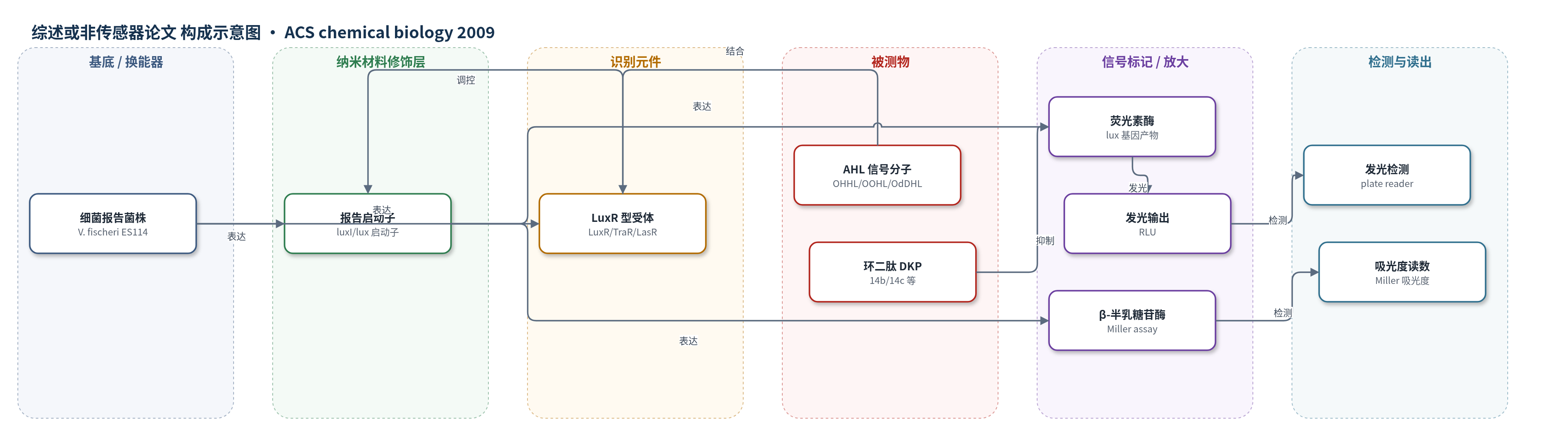
点击图片查看大图 · 依据论文自动绘制
传感器类型
综述或非传感器论文
检测对象
检测对象为 AHL(N-酰基-L-高丝氨酸内酯,AHLs,如 OHHL、OOHL、OdDHL)及 DKP(环二肽,cyclic dipeptides,如 14b、14c);样品基质为细菌培养液/报告菌株培养体系。
检测原理
该体系以细菌报告菌株为换能平台。AHL(如 OHHL)进入细胞后与 LuxR 型受体结合,LuxR-AHL 复合物结合 lux 启动子,诱导 lux 操纵子表达荧光素酶;荧光素酶催化长链醛(decanal)与 FMNH2 产生发光,RLU 随 AHL 浓度升高而增加。DKP 14c 在竞争剂量反应中降低 OHHL 的最大诱导发光但不改变 OHHL 的 EC50,提示其不直接竞争 LuxR 结合位点;突变体实验也排除 OmpU、ToxR、CheV、FlrC、YehT 的直接介导。进一步实验显示 14c 预培养可显著降低活性荧光素酶水平,并可直接抑制酶反应中的荧光素酶活性,因此发光下降主要源于对荧光素酶表达/活性的影响,而非 LuxR 介导的 QS 识别事件。
检测灵敏度
IC50: 208 μM (14b); IC50: 116 μM (14c);原文未报告 LOD、线性范围、灵敏度斜率或相关系数。
效应效果
在 E. coli JM109 (pSB401) 中,天然 DKP 5–10 未显示激动活性,5 和 9 仅抑制发光约 20%;非天然 DKP 14b 和 14c 在 V. fischeri ES114 (Δ-luxI) 中对 5 μM OHHL 诱导发光分别抑制 76% 和 95%(500 μM),IC50 为 208 μM 和 116 μM,比 AHL 衍生物 LuxR 抑制剂高 2–3 个数量级。竞争剂量反应显示 14c 降低最大发光但不改变 OHHL EC50,提示非竞争性;OmpU、ToxR、CheV、FlrC、YehT 缺失不影响 14c 抑制。14c 预培养使活性荧光素酶输出由 72.4±7.6 降至 13.2±4.4,直接加入酶反应降至 24.4±1.4。作者认为 DKP 不是 LuxR 介导的 QS 信号,并提醒过表达生物传感器数据需谨慎。
传感器的构成
- 换能/报告系统:Vibrio fischeri ES114 (Δ-luxI) 等细菌报告菌株,提供 LuxR 型受体与报告基因表达环境
- 识别元件:LuxR 型转录因子(LuxR、TraR、LasR),与 AHL 配体结合后调控下游启动子
- 报告基因/信号元件:lux 操纵子(luxCDABE)或 β-半乳糖苷酶报告基因,产生发光或吸光度信号
- 被测物/测试物:AHL(OHHL、OOHL、OdDHL)及 DKP(14b、14c 等),用于评估激动/拮抗活性
- 信号读出:发光(RLU)或 Miller 吸光度法检测 β-半乳糖苷酶活性
中文摘要
群体感应(QS)在革兰氏阴性菌中受 N-酰基-L-高丝氨酸内酯(AHLs)及其同源受体 LuxR 型蛋白调控,并介导宿主-细菌相互作用。某些环二肽(2,5-二酮哌嗪,DKPs)从细菌中分离,并被报道在 AHL 生物传感器菌株中激活或抑制 LuxR 型蛋白,但浓度显著高于天然内酯。这些报道促使人们提出 DKPs 可能是一类新的 QS 信号,甚至种间或界间信号;然而其机制和生理相关性仍不清楚。本文设计并合成非天然 DKP 库,用于确定 LuxR 型蛋白激活和抑制所需结构特征并探究机制。这些 DKP 与天然 DKP 一起在细菌报告基因实验中筛选。与以往报道相反,天然 DKP 未显示拮抗或激动活性。然而,非天然卤代 cyclo(L-Pro-L-Phe) 衍生物能够抑制 Vibrio fischeri 的发光。进一步实验表明,这些 DKP 并不通过与天然内酯信号 OHHL 竞争来抑制发光。数据表明 DKPs 不是本研究所检测细菌中的 QS 信号;尽管它们可影响 QS 调控结果,但并非通过直接与 LuxR 型蛋白相互作用实现。
英文摘要
Quorum sensing (QS) is under the control of N-acylated l-homoserine lactones (AHLs) and their cognate receptors (LuxR-type proteins) in Gram-negative bacteria and plays a major role in mediating host-bacteria interactions by these species. Certain cyclic dipeptides (2,5-diketopiperazines, DKPs) have been isolated from bacteria and reported to activate or inhibit LuxR-type proteins in AHL biosensor strains, albeit at significantly higher concentrations than native lactones. These reports have prompted the proposal that DKPs represent a new class of QS signals and potentially even interspecies or interkingdom signals; their mechanisms of action and physiological relevance, however, remain unknown. Here, we describe a library of synthetic DKPs that was designed to (1) determine the structural features necessary for LuxR-type protein activation and inhibition and (2) probe their mechanisms of action. These DKPs, along with several previously reported natural DKPs, were screened in bacterial reporter gene assays. In contrast to previous reports, the native DKPs failed to exhibit either antagonistic or agonistic activities in these assays. However, non-natural halogenated cyclo(l-Pro-l-Phe) derivatives were capable of inhibiting luminescence in Vibrio fischeri. Interestingly, additional experiments revealed that these DKPs do not compete with the natural lactone signal, OHHL, to inhibit luminescence. Together, these data suggest that DKPs are not QS signals in the bacteria examined in this study. Although these compounds can influence QS-regulated outcomes, we contend that they do not do so through direct interaction with LuxR-type proteins. This work serves to refine the lexicon of naturally occurring QS signals used by Gram-negative bacteria.