组成图示
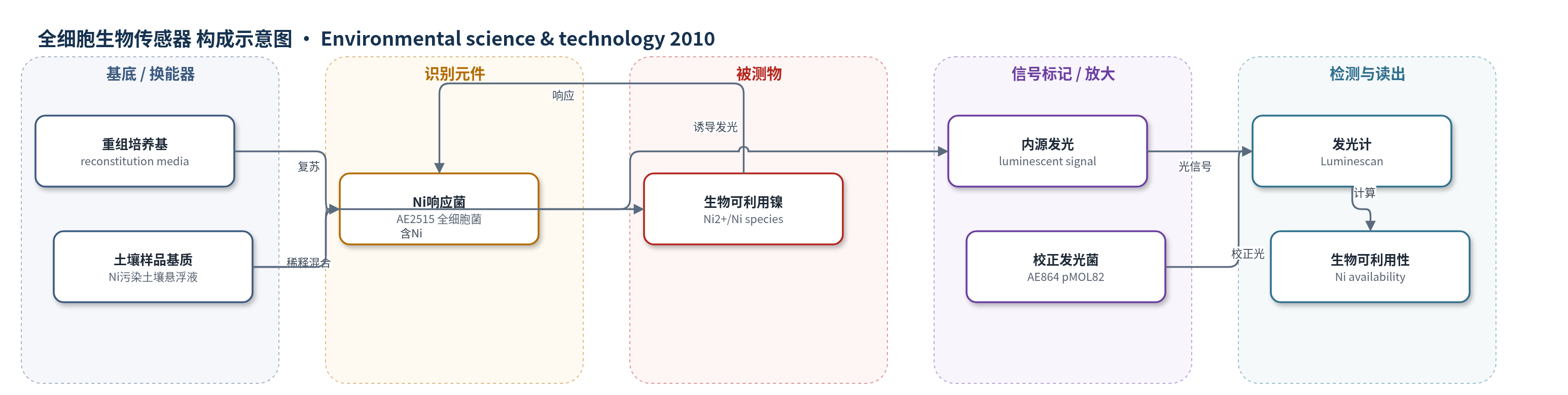
点击图片查看大图 · 依据论文自动绘制
传感器类型
全细胞生物传感器
检测对象
镍(Ni,Ni2+);样品基质:Ni 污染农业土壤悬浮液(Matapeake 粉壤土、Berryland 壤砂土)
检测原理
该检测采用全细胞细菌生物传感器。Ni 特异性菌株 Cupriavidus metallidurans AE2515 在存在生物可利用 Ni 时诱导产生发光信号;将 Ni 污染土壤悬浮液与复苏菌混合后,可溶/可被微生物利用的 Ni 进入细胞并激活发光通路,光强随生物可利用 Ni 浓度增加而增强。组成型发光株 AE864 (pMOL82) 同步发光,用于校正样品毒性、基质淬灭和细胞活力差异。Luminescan 发光计在 23 °C 下每 30 min 记录 12 h 光信号,当校正株信噪比在 0.8–1.2 时,AE2515 的发光数据有效,从而定量反映土壤中 Ni 的生物可利用性。
检测灵敏度
未报告
效应效果
该细菌生物传感器用于评估 Ni 污染土壤中的生物可利用性,未报告检出限或线性范围。结果显示,pH 6 时生物可利用 Ni 约为总 Ni 的 60%,pH 7.5 时约为 25%;由于 pH 7.5 总 Ni 负荷更高,绝对生物可利用量更大。Ni-Al 氢氧化物表面沉淀形成显著降低可解吸和生物可利用 Ni 比例。Berryland 土中吸附或有机络合 Ni 未明显增加生物可利用比例。生物可利用 Ni 浓度与 HNO3 溶解释放浓度相近,提示酸溶解抗性可间接反映生物可利用性。实验设金属标准双样、土壤三重复,并用组成型发光株 AE864 校正毒性与光淬灭,要求 S/N 0.8–1.2。
传感器的构成
- 识别元件:全细胞细菌 Cupriavidus metallidurans AE2515,Ni 特异性响应并产生发光信号
- 信号标记物:细菌内源发光系统(luminescent signal),光强反映生物可利用 Ni
- 校正元件:组成型发光菌株 C. metallidurans AE864 (pMOL82),校正样品毒性与光淬灭
- 样品基质:Ni 污染土壤悬浮液(Matapeake 粉壤土、Berryland 壤砂土,4:1–16:1 稀释)
- 读出装置:Luminescan 发光计(Thermo Scientific),23 °C 下每 30 min 监测 12 h
中文摘要
混合金属-铝氢氧化物表面沉淀的形成是环境体系中痕量金属(包括 Co、Ni 和 Zn)的重要吸收途径。本文研究混合 Ni-Al 氢氧化物沉淀形成与老化对实验室污染土壤中 Ni 溶解度和生物可利用性的影响。将两种特拉华州农业土壤与 3 mM Ni 溶液在高于和低于混合 Ni-Al 氢氧化物形成阈值的 pH 下反应 12 个月,并在 1、6 和 12 个月用 X 射线吸收光谱(XAS)测定 Ni 形态。通过 HNO3 和 EDTA 解吸实验考察沉淀溶解性,用 Ni 特异性细菌生物传感器评估金属生物可利用性。两种土壤中,Ni-Al 氢氧化物表面沉淀的形成均降低了可解吸和生物可利用 Ni 的比例。然而,与已发表的孤立土壤黏土组分研究相比,沉淀溶解度更大,尤其 EDTA 解吸时,且受老化过程影响较小。结果表明,真实环境中形成的混合 Ni-Al 氢氧化物相可能比预期更持久,且更易受配体促进溶解。
英文摘要
The formation of mixed metal-aluminum hydroxide surface precipitates is a potentially significant uptake route for trace metals (including Co, Ni, and Zn) in environmental systems. This paper investigates the effect of mixed Ni-Al hydroxide precipitate formation and aging on Ni solubility and bioavailability in laboratory contaminated soils. Two Delaware agricultural soils were reacted with a 3 mM Ni solution for 12 months at pH's above and below the threshold for mixed Ni-Al hydroxide formation. Ni speciation was determined at 1, 6, and 12 months using X-ray absorption spectroscopy (XAS). Precipitate solubility was examined through desorption experiments using HNO3 and EDTA as desorbing agents, whereas metal bioavailability was assessed using a Ni-specific bacterial biosensor. For both soils, the formation of Ni-Al hydroxide surface precipitates resulted in a reduction in the fraction of desorbed and bioavailable Ni. However, precipitate dissolution was greater, particularly with EDTA, than in published studies on isolated soil clay fractions, and less affected by aging processes. These results suggest that mixed Ni-Al hydroxide phases forming in real world environments may be both longer-lasting and more susceptible to ligand-promoted dissolution than previously expected.