组成图示
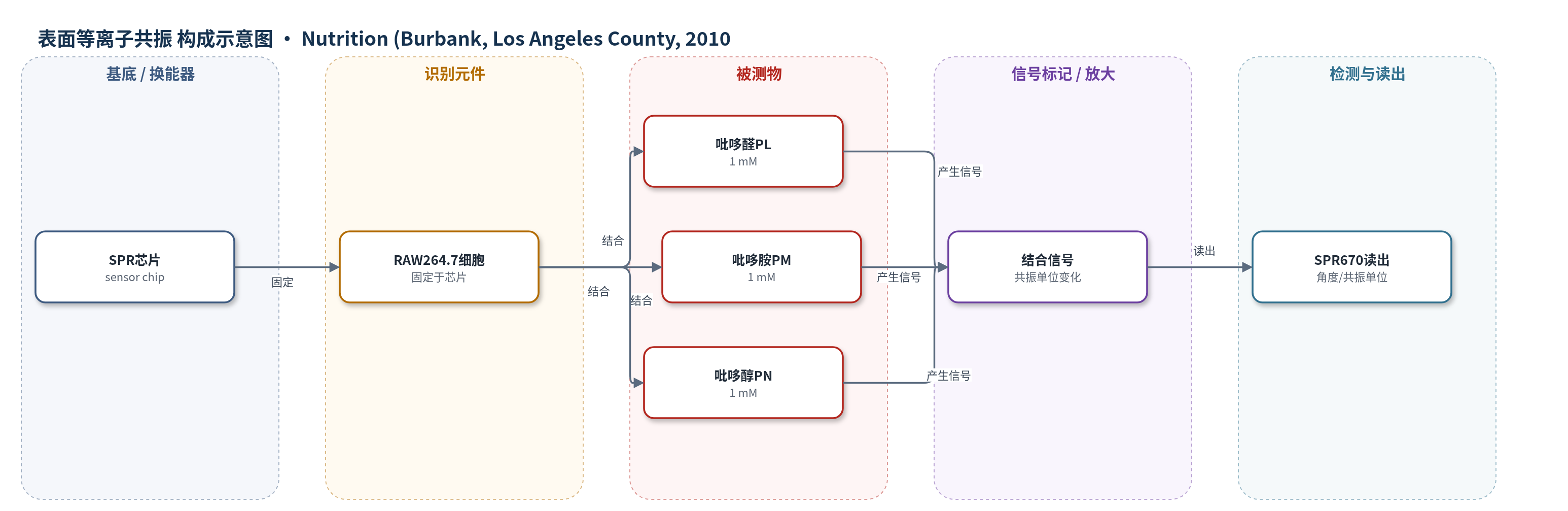
点击图片查看大图 · 依据论文自动绘制
传感器类型
表面等离子共振(SPR)生物传感器
检测对象
吡哆醛(pyridoxal, PL)、吡哆胺(pyridoxamine, PM)、吡哆醇(pyridoxine, PN);样品基质:PBS稀释液/RAW264.7细胞表面
检测原理
本研究将RAW264.7小鼠巨噬细胞固定于SPR传感器芯片表面,以PBS作为流动相。当PL、PM或PN随PBS注入时,若分子与细胞表面分子发生结合,芯片界面质量/折射率增加,改变表面等离子共振条件,使SPR670记录的共振单位或角度发生变化。结合阶段信号上升;随后改用PBS洗脱,PM和PN的结合信号回落至基线,表明其为可逆或弱结合;PL信号在170–240 s内维持,提示其与细胞表面存在持续相互作用。PL结合信号随浓度增加而增强,呈剂量依赖性。该检测无酶促或核酸放大,信号直接来源于分析物与细胞表面结合引起的界面光学变化。
检测灵敏度
原文未报告LOD、线性范围、灵敏度斜率或相关系数。
效应效果
SPR结果显示,1 mM下PM在样品加载期间结合最强,但PBS洗脱后共振单位回到基线;PN同样回基线,而PL信号在170–240 s维持,且PL结合呈剂量依赖,0.5与1.0 mM PL在PBS流动时共振单位几乎相同。COX-2 mRNA检测中,0.5 mM各B6均显著抑制LPS诱导表达,PL抑制最强;50 μM PL已显著抑制,7 d处理后20 μM PL也显著抑制。[3H]-PN摄取速度为68.5 pmol/min,PL、PN和PLP可抑制摄取,PM不抑制,PL抑制率最高。作者认为PL的细胞表面持续结合可能解释其强效抑制NF-κB激活和COX-2表达的作用。
传感器的构成
- 换能基底:SPR传感器芯片(sensor chip),固定细胞并产生表面等离子共振信号
- 识别元件:RAW264.7小鼠巨噬细胞,固定于芯片表面,提供细胞表面结合位点
- 分析物:吡哆醛(PL)、吡哆胺(PM)、吡哆醇(PN),以PBS稀释后注入
- 流动相:SPR running buffer(PBS),维持结合环境并在结合后洗脱
- 信号读出:SPR670生物传感器,通过共振单位/角度变化反映结合强度
中文摘要
维生素B6(B6)可抑制脂多糖(LPS)刺激的小鼠巨噬细胞RAW264.7中环氧合酶-2(COX-2)表达,其中吡哆醛(PL)的作用强于吡哆胺(PM)、吡哆醇(PN)和吡哆醛-5'-磷酸(PLP),但PL作用最强的机制尚不清楚。本研究比较PL、PM、PN和PLP在RAW264.7细胞中的摄取及细胞表面相互作用。采用实时荧光定量PCR检测COX-2 mRNA表达,高效液相色谱测定细胞内B6浓度,表面等离子共振(SPR)生物传感器分析B6与细胞表面的结合,并用[3H]-PN测定B6摄取速度。结果显示,在含PL、PM、PN或PLP的培养基中培养后,细胞内PLP水平未发生显著变化。SPR检测表明,只有PL能与细胞表面发生持续相互作用;PM和PN虽在样品加载期间与细胞表面结合,但改用磷酸盐缓冲液(PBS)洗脱后共振信号回到基线,而PL信号维持。[3H]-PN摄取可被未标记PN、PL或PLP抑制,但不被PM抑制,且PL抑制率高于PN和PLP。结论提示,PL抑制COX-2 mRNA表达可能与其细胞表面相互作用有关,而非细胞内PLP水平升高;PN和PL的摄取机制可能与PM不同。
英文摘要
OBJECTIVE: Vitamin B6 (B6) suppresses the expression of cyclooxygenase-2 stimulated by lipopolysaccharide in mouse macrophage RAW264.7 cells. The greatest effect is recognized for pyridoxal (PL) compared with pyridoxamine (PM), pyridoxine (PN), and pyridoxal 5'-phosphate (PLP). However, it has not been elucidated why PL has the strongest effect. We compared the uptakes and cell surface interactions among PL, PM, PN, and PLP in RAW264.7 cells.
METHODS: Cyclo-oxygenase-2 mRNA expression was evaluated by real-time polymerase chain reaction. Intracellular B6 concentrations were measured by high-performance liquid chromatography. Interactions of B6s with the cell surface were analyzed using a surface plasmon resonance biosensor. B6 uptake speeds were measured using [(3)H]-PN.
RESULTS: The intracellular PLP levels did not change significantly when cells were cultured in medium containing PL, PM, PN, or PLP. Only PL interacted with the cell surface. Although PM and PN were associated with the cell surface, their binding was only recognized during sample loading. After the change to phosphate buffered saline after sample loading, the binding resonances of PM and PN returned to baseline, whereas that of PL did not. Uptake of [(3)H]-PN was inhibited by non-labeled PN, PL, or PLP, but not PM, at 1 microM. The inhibition rate of PL was higher than those of PN and PLP.
CONCLUSION: The inhibition of cyclo-oxygenase-2 mRNA expression by PL may be related to the cell surface interaction of PL, rather than the intracellular PLP level. The uptake mechanism for PN and PL may differ from that for PM.