组成图示
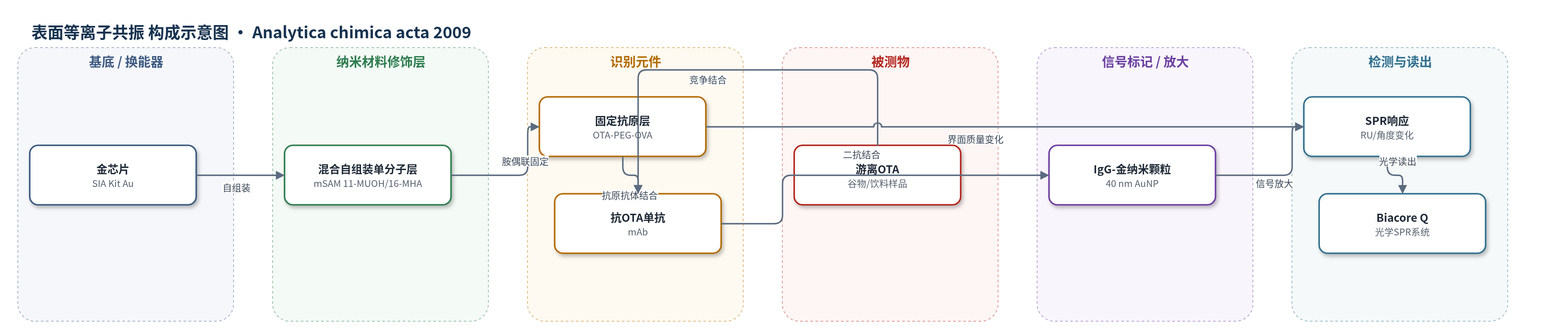
点击图片查看大图 · 依据论文自动绘制
传感器类型
表面等离子共振(SPR)生物传感器
检测对象
赭曲霉毒素A(Ochratoxin A, OTA);样品基质:谷物(燕麦、玉米)及饮料(葡萄酒、葡萄汁、苹果汁)
检测原理
传感器在金芯片的混合自组装单分子层(mSAM)上通过胺偶联固定OTA-PEG-OVA偶联物,形成竞争免疫SPR界面。样品中的游离OTA与抗OTA单克隆抗体(mAb)预先孵育,形成OTA-mAb复合物;随后注入传感器表面,mAb与固定OTA结合。游离OTA浓度越高,mAb被占据越多,表面结合的mAb越少。随后注入抗小鼠IgG-金纳米颗粒(40 nm)复合物,与表面mAb特异性结合。金纳米颗粒显著增加界面质量和局部折射率,使SPR响应增强。竞争曲线采用四参数logistic拟合,SPR响应随OTA浓度升高而降低。40 nm金纳米颗粒提供约17.2倍信号放大,从而降低检出限。
检测灵敏度
LOD: 0.042 ± 0.004 ng mL−1;LOD: 42.3 ± 4.3 pg mL−1;LOD (direct): 1.5 ± 0.3 ng mL−1;检测范围: 0–1 μg mL−1;LOD (oats): 0.33 ± 0.034 ng g−1;LOD (corn): 0.5 ± 0.022 ng g−1;LOD (grape juice): 0.058 ± 0.005 ng mL−1;LOD (apple juice): 0.084 ± 0.007 ng mL−1;LOD (white wine): 0.41 ± 0.043 ng mL−1;LOD (red wine): 0.33 ± 0.028 ng mL−1
效应效果
该传感器对OTA具有良好选择性,与黄曲霉毒素M1、脱氧雪腐镰刀菌烯醇和玉米赤霉烯酮的交叉反应均低于0.01%。OTA-PEG-OVA/mSAM表面可稳定完成600次以上结合/再生循环,优于OTA-BSA表面的250次。增强竞争分析的批间变异系数为8.1%,不同基质中CV为5.1%–14.4%。谷物用50%甲醇提取,饮料用3%或5% PVP处理并调pH,无需净化或预浓缩,提取后分析时间少于10 min。谷物和饮料中OTA检出限低于0.5 ng/mL(谷物以ng/g计),作者认为其速度、简便性和灵敏度可与ELISA/HPLC竞争,甚至优于部分现有生物传感器方法。
传感器的构成
- 基底/换能器:金芯片(SIA Kit Au),提供SPR光学换能表面
- 混合自组装单分子层:11-巯基十一醇(11-MUOH)与16-巯基十六酸(16-MHA)按9:1混合沉积,形成mSAM,提供羧基并降低非特异吸附
- 固定抗原层:OTA-PEG-OVA偶联物(OTA-PEG-CO2H与OVA经DCC/NHS偶联),通过胺偶联固定,约2500 RU,提供OTA表位并PEG间隔提高可及性
- 识别元件:抗OTA小鼠单克隆抗体(mAb),与样品中游离OTA竞争结合固定抗原
- 信号放大元件:抗小鼠IgG-金纳米颗粒复合物(IgG/nanogold,40 nm),结合mAb产生强SPR信号
- 抗非特异/基质处理组分:HBS-EP缓冲液、PEG-400、乙二醇、NaCl及PVP,抑制金颗粒聚集、非特异吸附和食品多酚干扰
中文摘要
赭曲霉毒素是真菌产生的次级代谢产物,可污染多种食品和饲料,具有致畸和致癌性。本文报道了一种基于混合自组装单分子层(mSAM)表面、利用金纳米颗粒增强信号的表面等离子共振(SPR)方法,用于快速高灵敏检测赭曲霉毒素A(OTA)。该竞争免疫分析通过聚乙二醇(PEG)间隔臂将OTA与卵白蛋白(OVA)偶联并固定于传感器表面。与无PEG间隔臂的商业BSA-OTA偶联物相比,OTA-PEG-OVA表面显著提高了抗体结合和再生性能。直接检测最低浓度为1.5 ng/mL;引入40 nm金纳米颗粒后,检出限降至0.042 ng/mL。谷物样品经50%甲醇提取,液体样品用3%或5%聚乙烯吡咯烷酮(PVP)处理,无需净化或预浓缩。燕麦和玉米中OTA检出限分别为0.3和0.5 ng/g,葡萄酒及其他饮料中为0.058–0.4 ng/mL。该表面可稳定完成600次以上结合/再生循环,为食品基质中OTA快速定量筛查提供了有力工具。
英文摘要
Ochratoxins are a group of mycotoxins produced as secondary metabolites by fungi which contaminate a large variety of food and feed commodities. Due to their teratogenic and carcinogenic properties, ochratoxins present a serious hazard to human and animal health. There is an increasing need to establish a simple sensitive method to detect these toxins. Here we report a rapid and highly sensitive surface plasmon resonance (SPR) assay of ochratoxin A (OTA) using Au nanoparticles for signal enhancement on a mixed self-assembled monolayer (mSAM) surface. A competitive immunoassay format was used for the development of the OTA immunoassay, which is based on the immobilization of target OTA through its ovalbumin (OVA) conjugate with a polyethylene glycol (PEG) linker. The new OTA conjugate (OTA-PEG-OVA) showed remarkably enhanced performance characteristics compared with those based on the immobilization of a commercial bovine serum albumin BSA-OTA conjugate without a PEG linker. Although OTA concentrations as low as 1.5 ng mL(-1) could be directly detected on this surface, the limit of detection (LOD) can be dramatically improved to 0.042 ng mL(-1) for OTA by applying large gold nanoparticles (40 nm) for signal enhancement. Various chemical conditions to minimize the influence of the food matrix on assay performance were also investigated. Grain samples were simply extracted with 50% methanol and liquid samples treated with poly(vinylpyrrolidone) (PVP) (3 or 5%), without any sample clean-up or pre-concentration step prior to analysis. The LODs for OTA in oats and corn were 0.3 and 0.5 ng g(-1), respectively, while in wine and other beverages, LODs ranged from 0.058 to 0.4 ng mL(-1). No cross-reactivity was observed with three other common mycotoxins. In addition, the mSAM/OTA-PEG-OVA surface exhibited high stability with over 600 binding/regeneration cycles. This approach with simple sample preparation provides a powerful tool for the rapid and sensitive quantitative determination of OTA in food matrices.