组成图示
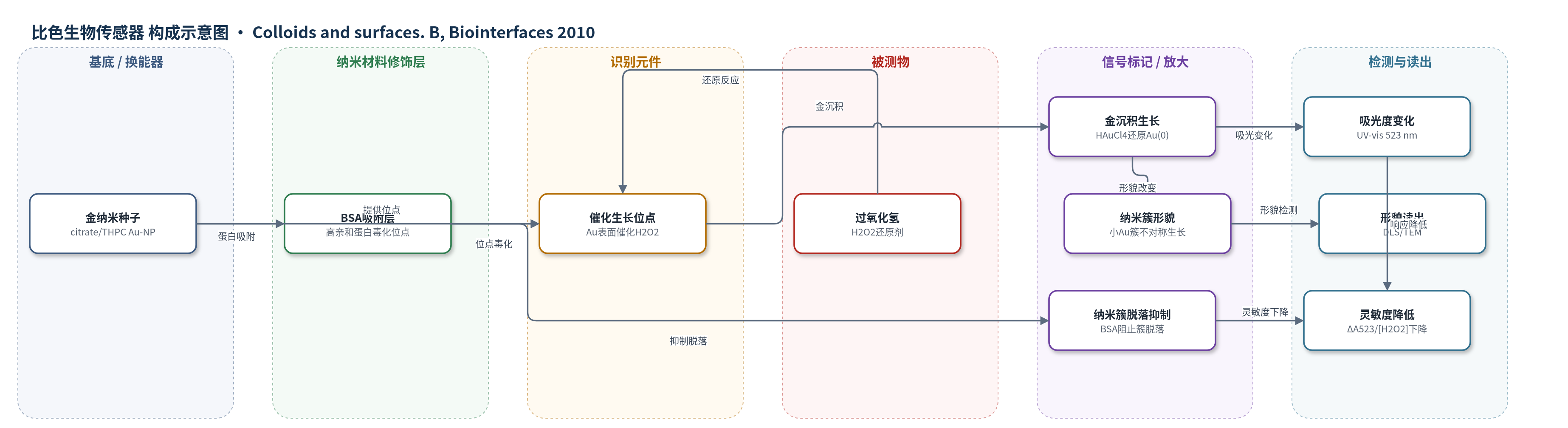
点击图片查看大图 · 依据论文自动绘制
传感器类型
比色生物传感器
检测对象
过氧化氢(H2O2);样品基质:磷酸盐缓冲液(PB)及含牛血清白蛋白(BSA)/葡萄糖氧化酶(GOx)的模拟蛋白溶液。
检测原理
该模型生物传感器以金纳米颗粒种子为催化基底,H2O2 作为被测还原剂。加入 H2O2 后,其在金种子表面催化还原 HAuCl4,使 Au(0) 沉积到种子表面,颗粒尺寸和形貌发生变化,导致局域表面等离子体共振吸收增强或红移,UV–vis 在 523 nm 的吸光度或峰面积随 H2O2 浓度增加而增大。BSA 因与金表面强结合而吸附在种子表面,占据催化位点,抑制均匀金沉积,并促使小尺寸金纳米簇不对称生长;同时 BSA 可减少纳米簇从种子表面脱落,使散射/吸收响应偏离正常生长曲线,整体降低灵敏度。GOx 与金表面亲和性较低,因此对催化生长影响有限。
检测灵敏度
灵敏度斜率:ΔA523 nm/[H2O2];THPC–gold 由 1.4 a.u./mM 降至 0.04 a.u./mM(BSA 0→200 µg/mL);Au-colloid 在 200 µg/mL BSA 时灵敏度约降低5倍;生长抑制起始约 25 µg/mL BSA(Au-colloid)和 75 µg/mL BSA(THPC–gold)。
效应效果
该文未报告实际样品加标回收率、RSD、稳定性或与 ELISA/HPLC/qPCR 的定量对比。主要性能表现为抗蛋白干扰差异:BSA 对两种金种子均产生显著抑制,Au-colloid 在约 25 µg/mL 开始抑制,THPC–gold 在约 75 µg/mL 开始抑制,200 µg/mL 为共同临界毒化浓度;BSA 200 µg/mL 使 Au-colloid 灵敏度约降低5倍,THPC–gold 灵敏度从 1.4 a.u./mM 降至 0.04 a.u./mM。GOx 即使达 600 µg/mL 也仅有限降低灵敏度,说明低亲和酶影响较小。DLS 和 TEM 支持 BSA 改变颗粒形貌、抑制纳米簇脱落。作者认为该结果对种子介导催化型生物传感器在含高亲和蛋白基质中的应用设计具有指导价值。
传感器的构成
- 催化种子/换能基底:柠檬酸稳定金纳米颗粒(citrate-stabilized Au-NP seeds,约20 nm)或 THPC 金纳米颗粒(THPC–gold,约6 nm),提供 H2O2 还原 HAuCl4 的催化位点。
- 表面蛋白修饰层:牛血清白蛋白(BSA)吸附层,高亲和结合金表面,毒化催化位点并改变生长形貌。
- 反应前驱体:氯金酸(HAuCl4),在 H2O2 存在下被还原为 Au(0) 并沉积到种子表面。
- 被测反应物:过氧化氢(H2O2),作为过氧化物酶产物/还原剂驱动金沉积。
- 对比酶:葡萄糖氧化酶(GOx),低亲和蛋白,用于比较其对催化生长的影响。
- 缓冲介质:磷酸盐缓冲液(PB,0.01 M,pH 7),维持反应 pH 和离子环境。
- 信号读出:紫外-可见吸收光谱(UV–vis),监测 523 nm 吸光度或峰面积随 H2O2 浓度变化。
中文摘要
本文以种子介导催化生长金纳米颗粒的模型生物传感器为对象,研究蛋白结合对金纳米颗粒催化剂毒化的作用。该传感器利用金纳米颗粒种子催化过氧化氢(H2O2)还原氯金酸(HAuCl4),使金沉积到种子表面,并通过紫外-可见吸收光谱监测颗粒生长引起的吸光度变化。作者重点考察牛血清白蛋白(BSA)和葡萄糖氧化酶(GOx)对传感器灵敏度的影响。结果表明,BSA 与金表面具有强相互作用,即使低浓度也会占据或毒化催化位点,抑制金纳米颗粒的均匀生长,促进小尺寸金纳米簇在种子表面的不对称生长,并降低模型传感器对 H2O2 的响应;而 GOx 对金表面亲和性较低,即使较高浓度也仅造成有限影响。该工作揭示了高亲和蛋白会显著降低种子介导催化型生物传感器灵敏度,为含蛋白复杂基质中纳米催化传感器设计提供了依据。
英文摘要
Seed mediated catalytic growth of gold nanoparticles is used in the design of biosensors for the products of peroxidase proteins, though the role of in situ proteins and the enzymes themselves on the sensitivity of these biosensors is yet to be addressed. This work specifically focuses on whether the presence of proteins with a strong attraction to the gold nanoparticle seeds, such as albumin proteins, inhibits the nanoparticle's catalytic properties. We have determined that the sensitivity of the biosensor design, defined as its response to the reducing agent hydrogen peroxide, is highly dependent on the presence of bovine serum albumin (BSA) and less dependent on the presence of the enzyme glucose oxidase. We suggest that the strong interaction between BSA and the gold surface leads to poisoning of the catalytic sites on the particle surface, which reduces the uniform growth of the nanoparticles and increases asymmetric growth of small gold nanoparticles onto the seed surface. The overall effect of the protein interaction is to lower the sensitivity of the model biosensor.