组成图示
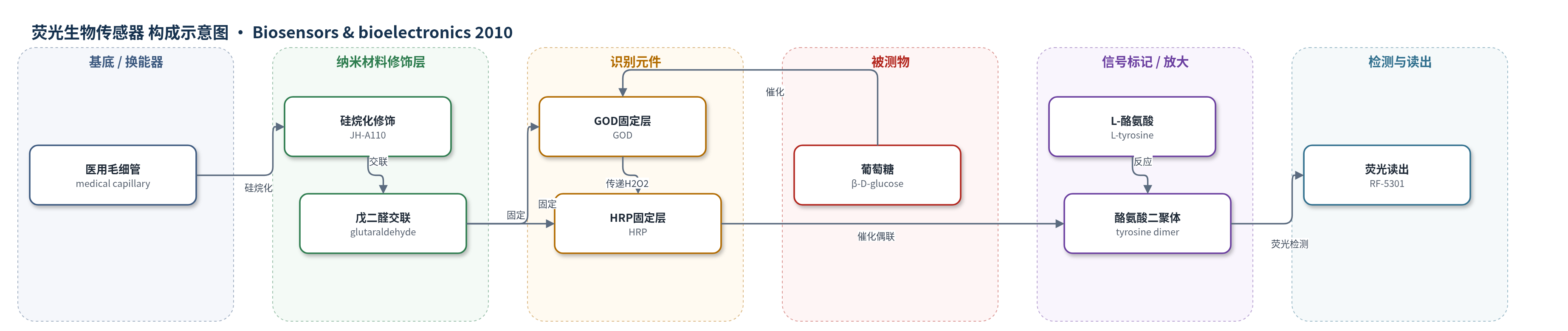
点击图片查看大图 · 依据论文自动绘制
传感器类型
荧光生物传感器
检测对象
葡萄糖(glucose,β-D-glucose);样品基质:血清(serum)及葡萄糖标准溶液
检测原理
该传感器将GOD和HRP共价固定于医用毛细管内壁。检测时,样品中的β-D-葡萄糖在GOD催化下与溶解氧反应,生成葡萄糖酸-γ-内酯和H2O2;随后H2O2在HRP催化下与L-酪氨酸发生氧化偶联,生成具有较强荧光的酪氨酸二聚体。酪氨酸二聚体在320 nm激发、410 nm发射处产生荧光,其荧光强度随葡萄糖浓度增加而增强,因此可通过ΔF=F2−F1间接定量葡萄糖。整个过程为双酶级联荧光反应,无额外信号放大,但毛细管微体积反应提高了灵敏度。
检测灵敏度
LOD: 0.62 μmol L−1;线性范围: 1–10 μmol L−1;线性方程: ΔFs = 10.61Cs −1.55(r = 0.9943);LOD计算方程: ΔFs = 14.0Cs −0.12(r = 0.9943)
效应效果
选择性方面,血清中抗坏血酸(28.4–79.5 μmol L−1)和尿酸(90–420 μmol L−1)有干扰,经100倍稀释后消除;Fe2+、Cu2+、Zn2+、Ca2+在考察范围内无干扰。稳定性良好,单支传感器一个月后相对活性仍>90%。重现性RSD为4.91%。血清加标回收率96–105%。与商品化葡萄糖试剂盒测定3份血清结果一致:本传感器为5.56、4.36、3.88 mmol L−1,试剂盒为5.40、4.22、3.64 mmol L−1。单次反应体积仅20 μL,约为传统荧光法1/400。
传感器的构成
- 基底/反应容器:医用毛细管(medical capillary,内径0.9 mm)作为酶固定化载体和微反应容器。
- 硅烷化修饰层:γ-氨基丙基三乙氧基硅烷(JH-A110)与毛细管内壁羟基共价结合,引入氨基。
- 交联层:戊二醛(glutaraldehyde)与氨基反应形成醛基,用于固定酶。
- 识别/催化元件:葡萄糖氧化酶(GOD)和辣根过氧化物酶(HRP)共价固定于内壁,催化葡萄糖氧化和酪氨酸偶联。
- 封闭层:Tris–HCl缓冲液封闭残余醛基。
- 信号标记物:L-酪氨酸(L-Tyr)作为荧光底物,在HRP/H2O2作用下生成酪氨酸二聚体荧光产物。
- 读出装置:自制毛细管支架与RF-5301荧光分光光度计,320 nm激发、410 nm发射检测。
中文摘要
基于固定化酶技术和荧光毛细管分析方法,作者开发了一种高灵敏度荧光反应体系和新型固定化多酶葡萄糖荧光毛细管生物传感器,用于测定葡萄糖含量。反应原理为:固定于医用毛细管内壁的葡萄糖氧化酶(GOD)和辣根过氧化物酶(HRP)催化下,β-D-葡萄糖与溶解氧反应生成葡萄糖酸-γ-内酯和过氧化氢;随后过氧化氢与L-酪氨酸反应生成酪氨酸二聚体,其最大激发和发射波长分别为320 nm和410 nm。二聚体荧光强度与β-D-葡萄糖浓度成正比。优化条件为:磷酸盐缓冲液0.15 mol L−1、L-酪氨酸1.0 μmol L−1,GOD和HRP固定化活性浓度分别为8.0和15.0 kU L−1;单次测定样品和试剂消耗分别为5.0 μL和15 μL。传感器葡萄糖定量范围为1–10 μmol L−1,相对标准偏差小于4.9%,检出限为0.62 μmol L−1,回收率为96–105%。用该传感器和商品化葡萄糖试剂盒测定若干血清的结果吻合良好,因此可用于糖尿病诊断中血清葡萄糖含量测定。
英文摘要
Based on the immobilization enzyme technology and the fluorescence capillary analysis method, the authors have developed a highly sensitive fluorescence reaction system and a novel immobilization multienzyme glucose fluorescence capillary biosensor for determining glucose contents. Reaction principle of the system is that under the catalysis of glucose oxidase (GOD) and horseradish peroxidase (HRP) immobilized on inner surface of a medical capillary, beta-D-glucose reacts with dissolved oxygen to form gluconic acid-delta-lactone and hydrogen peroxide, and then the latter reacts with l-tyrosine to produce a tyrosine dimer, which has maximal excitation and emission wavelengths at 320 nm and 410 nm, respectively. Fluorescence of the dimer is proportional to the concentration of the beta-D-glucose. Optimization conditions suitable for the reaction system and the biosensor were as follows. Concentration of the L-tyrosine used as fluorescence reagent was 0.15 mol L(-1), the active concentrations of the GOD and the HRP for the immobilization were 15 kU L(-1) and 8 kU L(-1), respectively. Consumptions of the sample and reagents in one determination were 5.0 microL and 15 microL, respectively. Quantitative range of the biosensor for the glucose was in the range 1-10 micromol L(-1), its relative standard deviation was less than 4.9%, and its detection limit was 0.62 micromol L(-1). The biosensor's recovery was in the range 96-105%. Results of some serum determined with the biosensor and with a commercial glucose-kit were well coincident to each other. Accordingly, the biosensor can be applied to the determination of serum glucose contents in the diagnosis of diabetes.