组成图示
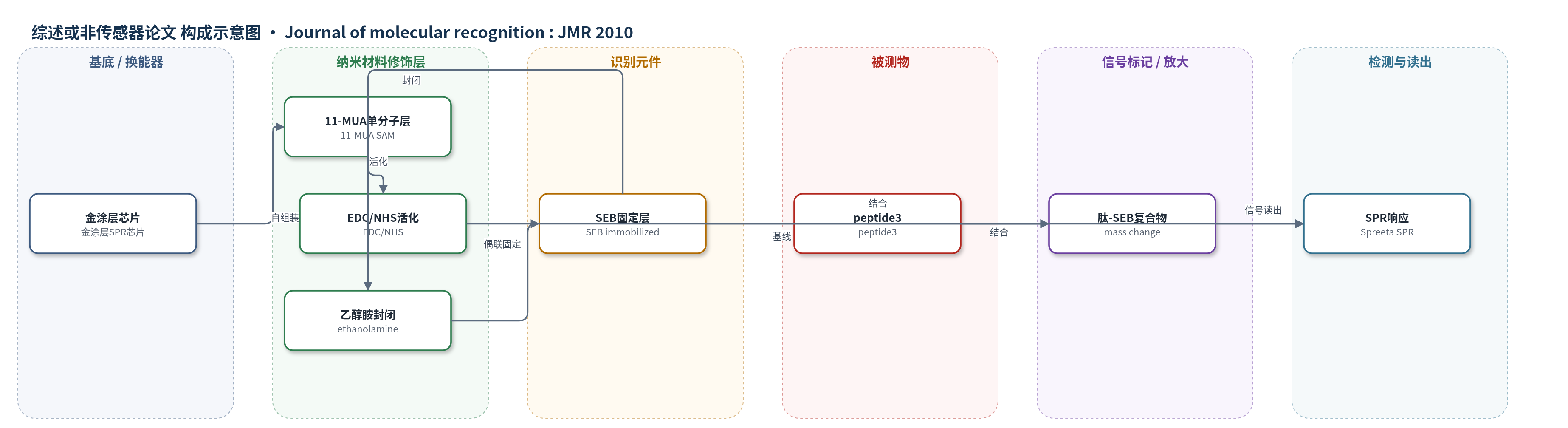
点击图片查看大图 · 依据论文自动绘制
传感器类型
综述或非传感器论文
检测对象
SEB 结合肽(SEB-binding peptide,peptide3;ITC 中包括 peptide1–5),样品基质:50 mM PBS(pH 7.5);SEB 作为固定捕获分子。
检测原理
SPR 检测中,金芯片表面先形成 11-MUA 自组装单分子层,经 EDC/NHS 活化后共价固定 SEB,并用乙醇胺封闭。将不同浓度的 peptide3 注入流动相,肽与固定 SEB 特异性结合,使传感器界面质量与折射率增加,SPR 响应随浓度升高而增大。结合过程用非均一表面模型拟合,得到快、慢两个吸附位点的 ka、kd 和亲和力。ITC 则直接测量结合热,显示结合为熵驱动、疏水作用主导;CD 和 MD 进一步说明结合后肽由随机卷曲转为更有序构象。
检测灵敏度
未报告 LOD、线性范围、灵敏度斜率或相关系数。
效应效果
选择性方面,ITC 显示 peptide3 和 peptide5 与 BSA 无显著结合,而 peptide1 与 BSA 的 Ka 为 1.0×10^4 M^-1,peptide2 为 7.0×10^3 M^-1,说明部分肽存在交叉结合。SPR 中 peptide3 与固定 SEB 呈两阶段结合,快位点 ka1=3.8 M^-1 s^-1、kd1=0.014 s^-1,慢位点 ka2=0.03 M^-1 s^-1、kd2=2×10^-6 s^-1,对应亲和力 2.6×10^2 和 1.6×10^4 M^-1。CD 显示结合后随机卷曲下降、有序结构增加;MD 显示 peptide3 构象稳定。作者认为该肽适配体可用于 SEB 生物传感器。
传感器的构成
- 基底/换能器:金涂层 SPR 传感器芯片(gold-coated sensor surface),提供表面等离子共振换能
- 修饰层:11-巯基十一酸(11-MUA)自组装单分子层(SAM),提供羧基用于偶联
- 活化偶联层:EDC/NHS 活化羧基,使 SEB 共价固定
- 识别/捕获元件:金黄色葡萄球菌肠毒素 B(SEB)固定于表面,用于捕获溶液中的 SEB 结合肽
- 封闭剂:0.5 M 乙醇胺(ethanolamine)封闭非特异结合位点
- 信号标记物:无外源标记,SPR 直接监测界面质量/折射率变化
- 样品/流动相:50 mM PBS(pH 7.5),注入 peptide3 等浓度 0.35–1.40 mM
中文摘要
金黄色葡萄球菌肠毒素B(SEB)是引起食物中毒的重要外毒素。本研究通过噬菌体展示肽库筛选SEB结合肽,并用等温滴定量热法(ITC)测定其结合热力学参数。在5个候选肽中,3个与SEB具有亲和力,其中peptide3亲和力最高,结合常数约10^5 M^-1。ITC结果表明,肽与SEB的结合主要由熵驱动,疏水相互作用占主导。圆二色光谱(CD)显示,自由肽在溶液中主要呈随机卷曲结构;与SEB结合后,随机卷曲含量下降,β-折叠和β-转角等有序结构增加,表明复合物形成使肽构象更加有序。分子动力学(MD)模拟进一步证实,高亲和力肽在结合后具有较稳定的构象。该研究为设计高亲和、高选择性肽适配体用于SEB生物传感器提供了结构-活性关系依据。
英文摘要
Staphylococcal enterotoxin B (SEB) is an exotoxin produced by Staphylococcus aureus and commonly associated with food poisoning. In this study, SEB-binding peptides were identified by screening a phage displayed peptide library. The binding of peptides to SEB was tested with isothermal titration calorimetry (ITC) and of the five selected peptides, three showed affinity to SEB, with one measured to have the highest affinity constant (10(5) M(-1)). ITC revealed that the interaction of peptide ligands with SEB was driven entropically and the binding was dominated by hydrophobic interactions. Circular dichroism (CD) measurements and molecular dynamics (MD) simulations, together, give a structural insight into the interaction of peptides with SEB. While SEB binding peptides showed random coil structure before binding, after complex formation they had more ordered structures. The peptide with highest affinity to SEB showed stable conformation during MD simulation. Taken together, our approach about thermodynamic and structural characterization of peptide ligands can be used to develop aptamers, with high affinity and selectivity, for biosensor applications.