组成图示
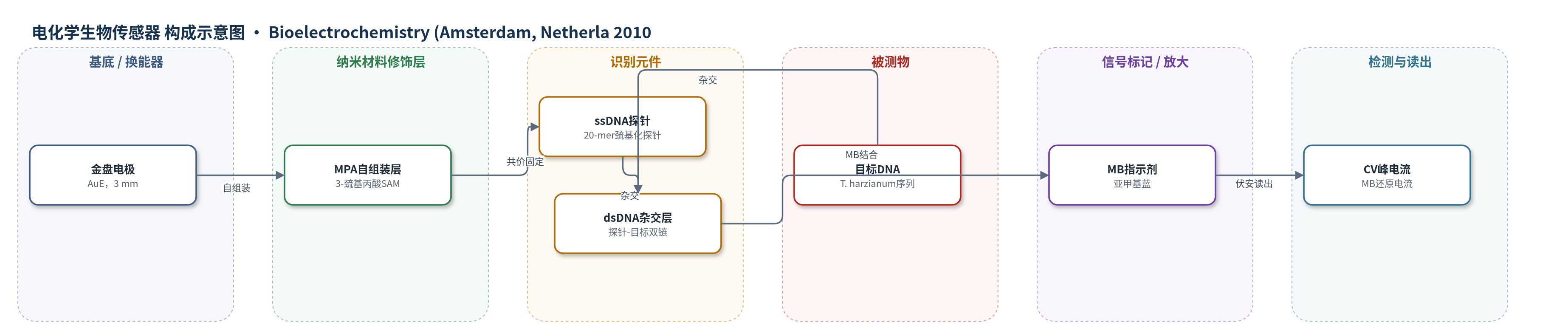
点击图片查看大图 · 依据论文自动绘制
传感器类型
电化学生物传感器
检测对象
哈茨木霉特异性基因序列(Trichoderma harzianum specific gene sequence/ITS1 region gene)、哈茨木霉粗DNA(crude DNA);样品基质:真菌培养物粗DNA提取物、PCR扩增产物、合成寡核苷酸溶液。
检测原理
传感器以金电极为换能器,MPA自组装单分子层提供稳定界面,巯基化ssDNA探针共价固定于表面。当样品中存在T. harzianum特异性目标DNA时,目标链与探针互补杂交,在电极界面形成dsDNA。随后亚甲基蓝(MB)作为氧化还原指示剂与双链DNA结合,主要通过嵌入双链碱基对及与鸟嘌呤碱基相互作用富集于电极表面。杂交程度越高,表面dsDNA越多,可结合的MB越多,MB在电极上的电子转移还原峰电流越大。该过程无需PCR等核酸扩增,信号随目标DNA浓度增加而增强,在1–20 ppm范围内与还原电流呈线性关系。
检测灵敏度
线性范围: 1–20 ppm;灵敏度斜率: 1.0031(线性回归 y=1.0031x+32.7);R^2 = 0.9664
效应效果
该传感器对互补目标DNA、单链探针、非互补DNA和非哈茨木霉DNA的MB峰电流依次降低,显示良好序列特异性。粗DNA测试中,T. harzianum信号最高,T. inhamatum次之,T. aureoviride、T. virens、T. longibrachiatum和T. koningii依次降低,可区分T. harzianum与非T. harzianum物种。优化杂交条件为30 ℃、60 min;目标DNA在1–20 ppm内线性响应,线性回归y=1.0031x+32.7,R^2=0.9664。作者认为该方法快速、灵敏、可重复且无需核酸扩增,适用于物种水平微生物检测。
传感器的构成
- 基底/换能器电极:金盘电极(AuE,3 mm),经抛光和化学清洗,作为电子转导基底。
- 自组装修饰层:3-巯基丙酸(MPA)自组装单分子层(SAM),在AuE表面形成稳定界面并提供羧基用于连接探针。
- 识别元件:5′-巯基己基修饰的20碱基单链DNA探针(ssDNA probe,5′ HS-(CH2)6-ACT CCC AAA CCC AAT GTG AA′3),通过硫醇-金键/共价连接固定,特异性识别T. harzianum目标序列。
- 信号标记物:亚甲基蓝(MB,10 µM),作为氧化还原指示剂/嵌入剂,结合dsDNA后产生可测伏安峰电流。
- 杂交/清洗介质:2×SSC(0.3 M NaCl、30 mM sodium citrate,pH 7.0)用于杂交;50 mM Tris-HCl+20 mM NaCl(pH 7.2)用于清洗和伏安测量。
- 信号读出:循环伏安(CV)扫描(−1.50至+1.50 V,100 mV/s),读取MB还原峰电流。
中文摘要
本文报道了一种用于检测哈茨木霉(Trichoderma harzianum)相关基因序列的电化学生物传感器。该传感器以金盘电极为基底,通过3-巯基丙酸(MPA)自组装单分子层(SAM)共价固定一条与T. harzianum特异性基因互补的20碱基巯基化单链DNA探针。目标DNA与表面探针杂交形成双链DNA后,加入亚甲基蓝(MB)作为氧化还原指示剂;由于MB与双链DNA及鸟嘌呤碱基的结合/嵌入作用,其循环伏安还原峰电流随杂交程度增加而增大。通过优化探针固定、杂交温度与时间以及MB结合条件,传感器可在不进行核酸扩增的情况下区分T. harzianum与非T. harzianum序列,并对目标寡核苷酸在1–20 ppm范围内呈线性响应,为快速、简便、可重复的物种水平微生物检测提供了新方法。
英文摘要
A new electrochemical biosensor is described for voltammetric detection of gene sequence related to Trichoderma harzianum. The sensor involves immobilization of a 20 base single-stranded probe (ssDNA), which is complementary to a specific gene sequence related to T. harzianum on a gold electrode through specific adsorption. The DNA probe was used to determine the amount of target gene in solution using methylene blue (MB) as the electrochemical indicator. The covalently immobilized probe could selectively hybridize with the target DNA to form a hybrid on the surface despite the bases being attached to the electrode. The changes in the peak currents of methylene blue (MB), an electroactive label, were observed upon hybridization of probe with the target. Peak currents were found to increase in the following order: hybrid-modified AuE and the probe-modified AuE which localized to the affinity of MB. Control experiments with the non-complementary oligonucleotides were performed to assess whether the DNA biosensor responds selectively, via hybridization, to the target. DNA biosensor also able to detect microorganism at the species levels without nucleic acid amplification. The redox current was linearly related to the concentration of target oligonucleotide DNA, ranged from 1-20 ppm. Numerous factors, affecting the probe immobilization, target hybridization and indicator binding reactions are optimized to maximize the sensitivity and reduce the assay time.