组成图示
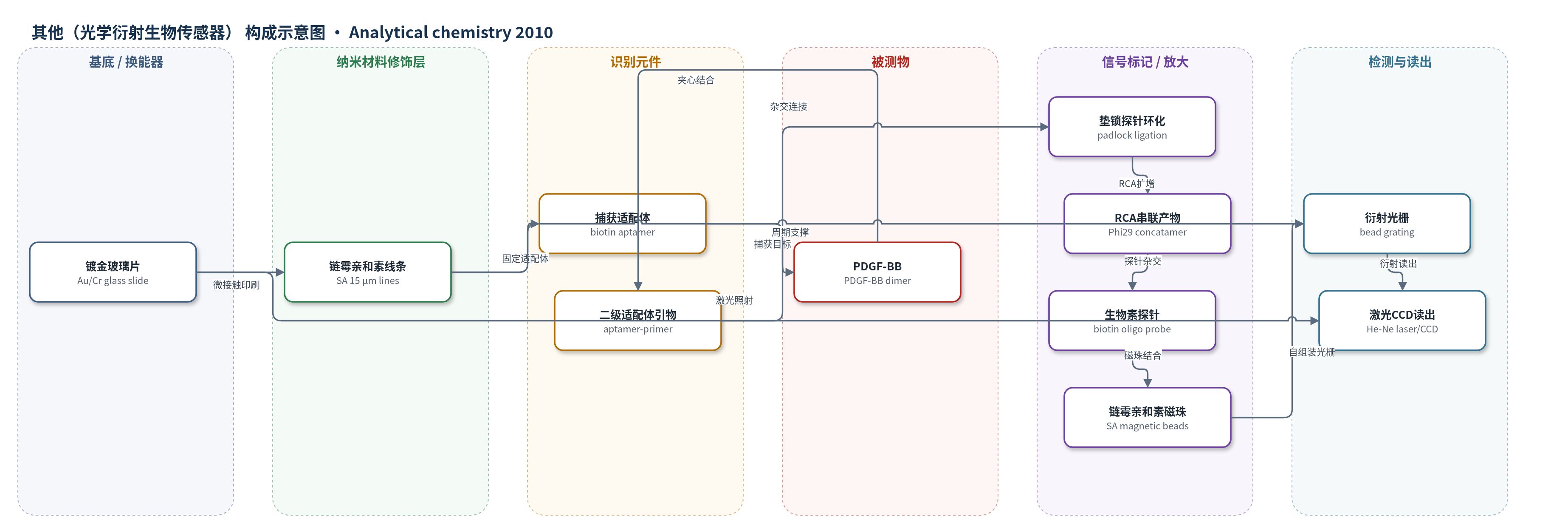
点击图片查看大图 · 依据论文自动绘制
传感器类型
其他(光学衍射生物传感器)
检测对象
血小板衍生生长因子B链(PDGF-BB, platelet-derived growth factor B-chain),样品基质为PBSM缓冲液标准品;对照包括PDGF-AA、PDGF-AB。
检测原理
生物素化捕获适配体固定在微接触印刷的链霉亲和素周期线条上,PDGF-BB二聚体被捕获后,二级适配体-引物复合物结合形成夹心结构。垫锁探针两端与二级适配体3′端引物序列杂交,经E. coli DNA连接酶环化,形成RCA模板;Phi29 DNA聚合酶以3′端为引物等温扩增,生成长串联重复DNA。生物素化寡核苷酸探针杂交到串联产物,链霉亲和素磁性微珠结合生物素探针,在15 μm周期线条上自组装成衍射光栅。PDGF-BB浓度越高,捕获事件越多,RCA产物和微珠密度越高,光栅有效高度/折射率调制越强,He-Ne激光反射的一级衍射模强度I1相对零级I0增大。RCA将单个蛋白识别事件放大为数千核苷酸重复和多个微珠,实现无标记光学衍射检测。
检测灵敏度
LOD: 10 pM;检测范围: 10 pM–100 nM;Kd: 0.8 nM
效应效果
该传感器对PDGF-BB选择性良好:10 nM PDGF-AA和阴性对照几乎无微珠,PDGF-AB仅少量结合,显著低于PDGF-BB;无RCA时1 nM PDGF-BB微珠数比RCA低4–5倍且无明显衍射模,证明RCA放大关键。检测限10 pM,优于早期荧光方案0.4 nM、适配体量子点方案0.4 nM及硫醇化适配体电化学传感器1–40 nM,低1–2个数量级;但高于商品化适配体引物聚合酶扩增电化学免疫传感器0.6 pM。未报告实际样品回收率或RSD,仅说明多区域测量有标准差,单点重复三次可显著降低波动,波动可能来自印章缺陷或表面失活。平台无需荧光/放射性标记,可明场观察并低成本构建,作者认为适用于血液/血清疾病标志物检测。
传感器的构成
- 基底/换能器:镀金玻璃片(50 nm Au/5 nm Cr, Asylum Research),提供反射面与微接触印刷表面
- 周期性图案:PDMS印章微接触印刷链霉亲和素(streptavidin, SA)15 μm交替线条,固定生物素化适配体并形成衍射周期
- 封闭剂:BSA 1 mg/mL封闭未印刷条纹,减少非特异结合
- 识别元件:3′-生物素化抗PDGF-BB捕获适配体(capture aptamer)固定于SA线条;二级适配体-引物复合物(aptamer-primer complex)结合PDGF-BB并作为RCA引物
- 信号放大元件:垫锁探针(padlock probe)杂交后由E. coli DNA连接酶环化,Phi29 DNA聚合酶和dNTP进行RCA,生成长串联重复DNA(concatamer)
- 信号标记物:5′-生物素化寡核苷酸探针(biotinylated oligonucleotide probe)杂交RCA产物;链霉亲和素标记磁性微珠(streptavidin-labeled magnetic beads, 750 nm)结合生物素探针,自组装成衍射光栅
- 读出:He-Ne激光(633 nm)照射,CCD相机记录零级/一级衍射模强度(I0/I1)
中文摘要
本文报道一种无需荧光或放射性标记的自组装光学衍射生物传感器,利用滚环扩增(RCA)和磁性微珠实现信号放大。在镀金玻璃片上用PDMS印章微接触印刷15 μm宽交替链霉亲和素线条,固定生物素化捕获适配体,特异性捕获血小板衍生生长因子B链(PDGF-BB)。二级适配体-引物复合物结合目标蛋白后,垫锁探针杂交并经DNA连接酶环化,形成RCA模板;Phi29 DNA聚合酶等温扩增产生长串联重复产物。生物素化寡核苷酸探针与RCA产物杂交,链霉亲和素标记磁珠结合探针,在周期性图案上自组装形成衍射光栅。He-Ne激光照射下,衍射模强度及微珠密度随PDGF-BB浓度变化。检测范围为10 pM–100 nM,最低可检测浓度10 pM,Langmuir拟合解离常数0.8 nM。与PDGF-AA/AB及无RCA对照相比具有良好特异性,证明RCA对衍射信号放大至关重要,平台无需荧光显微镜,可用于明场观察和衍射检测。
英文摘要
We present a robust, sensitive, fluorescent- or radiolabel-free self-assembled optical diffraction biosensor that utilizes rolling circle amplification (RCA) and magnetic microbeads as a signal enhancement method. An aptamer-based sandwich assay was performed on microcontact-printed streptavidin arranged in 15 microm wide alternating lines and could specifically capture and detect platelet-derived growth factor B-chain (PDGF-BB). An aptamer served as a template for the ligation of a padlock probe, and the circularized probe could in turn be used as a template for RCA. The concatameric RCA product hybridized to biotinylated oligonuclotides which then captured streptavidin-labeled magnetic beads. In consequence, the signal from the captured PDGF-BB was amplified via the concatameric RCA product, and the diffraction gratings on the printed areas produced varying intensities of diffraction modes. The detected diffraction intensity and the density of the microbeads on the surface varied as a function of PDGF-BB concentration. Our results demonstrate a robust biosensing platform that is easy to construct and use and devoid of fluorescence microscopy. The self-assembled bead patterns allow both a visual analysis of the molecular binding events under an ordinary bright-field microscope and serve as a diffraction grating biosensor.