组成图示
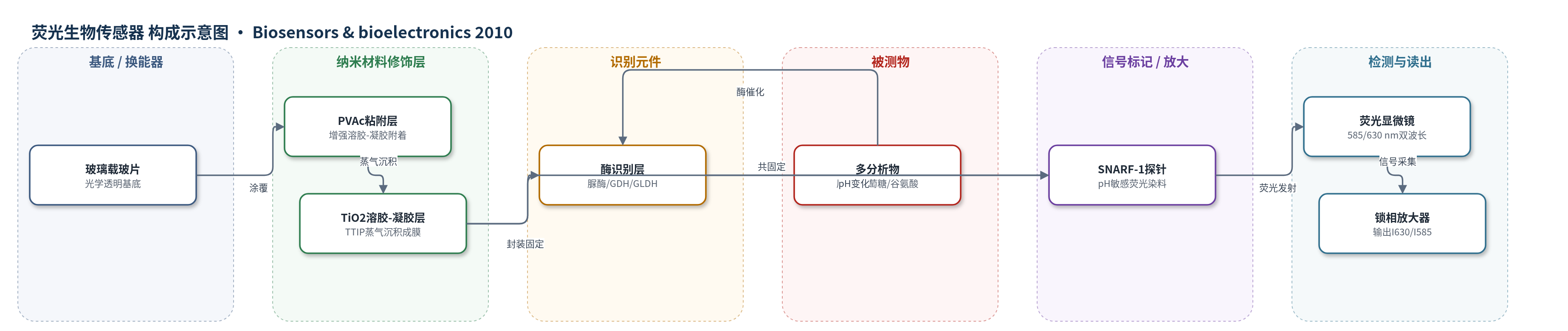
点击图片查看大图 · 依据论文自动绘制
传感器类型
荧光生物传感器
检测对象
尿素(urea)、葡萄糖(glucose)、谷氨酸(glutamate);样品基质:水样/缓冲液、人血清(加标)
检测原理
传感器以TiO2溶胶-凝胶阵列包埋脲酶、GDH和GLDH及SNARF-1-葡聚糖。加入样品后,脲酶水解尿素生成NH4+和HCO3-,使局部pH升高;GDH和GLDH分别氧化葡萄糖和谷氨酸并释放质子,使局部pH降低。SNARF-1-葡聚糖在488 nm激发下具有酸型585 nm和碱型630 nm两个发射峰,其强度比I630/I585随pH变化而改变,从而把酶促反应转化为光学信号。TiO2溶胶-凝胶基质保持酶活性并隔离各孔,荧光显微镜双波长测量并以比值内标校正,减少光源波动和光漂白影响。信号随底物浓度呈S形响应,符合Michaelis–Menten动力学。
检测灵敏度
水样:尿素 LOD: 2.4 μM;线性范围: 10–8000 μM;葡萄糖 LOD: 5.5 μM;线性范围: 40–10,000 μM;谷氨酸 LOD: 4.8 μM;线性范围: 10–10,000 μM。血清:尿素 LOD: 3.1 μM;线性范围: 2–300 μM;R^2 = 0.988;葡萄糖 LOD: 5.4 μM;线性范围: 20–10,000 μM;谷氨酸 LOD: 7.8 μM;线性范围: 40–8,000 μM;R^2 = 0.994。原文未报告灵敏度斜率。
效应效果
多分析物混合检测与单分析物结果无显著差异(t检验p<0.05),脲酶孔在10–100 μM混合样中比值仅降低1.5–3.7%,低于RSD=2.8%。水样RSD为2.8%、1.6%、4.3%(n=3),血清RSD为2.4–6.1%(n=45)。连续5周制备GDH阵列回收率为102±7%(n=5),4°C保存5周相对灵敏度>90%。人血清加标中,尿素线性范围2–300 μM、R^2=0.988,葡萄糖20–10,000 μM,谷氨酸40–8,000 μM、R^2=0.994,LOD分别为3.1、5.4、7.8 μM,可覆盖血清正常范围并优于或可比于现有硅基/电化学阵列。
传感器的构成
- 基底:玻璃载玻片(glass microscope slides),经K2Cr2O7/H2SO4清洗,提供光学透明支撑
- 粘附层:聚醋酸乙烯酯(PVAc)涂层,增强溶胶-凝胶膜与玻璃基底附着
- 阵列腔室:50孔盖玻片(50-well chambered cover-slip),形成独立检测孔位
- 溶胶-凝胶修饰层:钛酸四异丙酯(TTIP, Ti(OC3H7)4)蒸气沉积水解生成TiO2溶胶-凝胶薄膜,封装生物分子
- 识别元件:脲酶(urease)、葡萄糖脱氢酶(GDH)、谷氨酸脱氢酶(GLDH),分别催化尿素、葡萄糖、谷氨酸反应
- 信号标记物:羧基SNARF-1-葡聚糖(carboxy SNARF-1-dextran),pH敏感荧光探针,提供585/630 nm双发射
- 成膜助剂:聚乙烯醇(PVA)与甘油(glycerol),辅助酶/染料点成膜并稳定溶胶-凝胶结构
- 稳定缓冲层:5 mM BTP缓冲液,固定后稳定TiO2阵列并维持酶活性
中文摘要
本文报道了一种基于二氧化钛(TiO2)溶胶-凝胶阵列的新型光学生物传感器,用于血清中葡萄糖、尿素和谷氨酸的同时比值检测。采用简单蒸气沉积法,将脲酶、葡萄糖脱氢酶(GDH)和谷氨酸脱氢酶(GLDH)分别与羧基SNARF-1-葡聚糖(SNARF-1-dextran)共固定于TiO2溶胶-凝胶基质中。SNARF-1-dextran为pH敏感单分子荧光探针,其585 nm与630 nm发射强度比可反映局部pH变化。原子力显微镜和扫描电镜显示,TiO2溶胶-凝胶膜无裂纹、稳定且能有效包埋酶和染料,固定大分子后表面形貌显著改变。该阵列传感器可同时检测多个样品中的多种分析物,无明显交叉干扰。水样中三种分析物分析范围为0.01–10 mM,检出限为2.4–5.5 μM;血清中动态范围达2–3个数量级,检出限为3.1–7.8 μM。结果首次将溶胶-凝胶TiO2阵列与SNARF-1-dextran用于多分析物比值检测,为现有硅基光学阵列生物传感器提供了可行替代。
英文摘要
A novel optical array-based titanium dioxide (TiO(2)) biosensor combining with simple vapor deposition method was developed to simultaneously determine multianlaytes including glucose, urea and glutamate in serum samples. Carboxy seminaphthorhodamine-1-dextran (SNARF-1-dextran), serving as a single-molecule fluorescent probe, was co-immobilized with different enzymes including urease, glucose dehydrogenase (GDH), and glutamate dehydrogenase (GLDH) for determination of urea, glucose and glutamate simultaneously. The SNARF-1-dextran was a useful pH sensitive dye and the fluorescence ratio at 585 and 630 nm was used to characterize the change in solution pH. Atomic force microscopic (AFM) and scanning electron microscopy (SEM) images showed that TiO(2) is a crack-free stable sol-gel material, which can effectively trap enzymes in the sol-gel-derived matrices prepared by vapor deposition method. The surface morphology of the sol-gel-derived TiO(2) films changed significantly after the immobilization of macromolecules and enzymes. The array-based TiO(2) biosensors show good analytical performance on the simultaneous determination of multiple samples for multianalytes without obvious cross-interference. The analytical ranges of the three analytes in water samples were between 0.01 and 10 mM and limit of detections (LODs) were in the range 2.4-5.5 microM. In addition, satisfactory dynamic ranges of 2-3 orders of magnitude with LODs of 3.1-7.8 microM in serum samples were obtained. These results demonstrate the first report of combining a sol-gel-derived TiO(2) array biosensor with SNARF-1-dextran for ratiometric determination of multianalytes simultaneously and provide a viable alternative to current silica technology for the fabrication of array-based optical biosensors.