组成图示
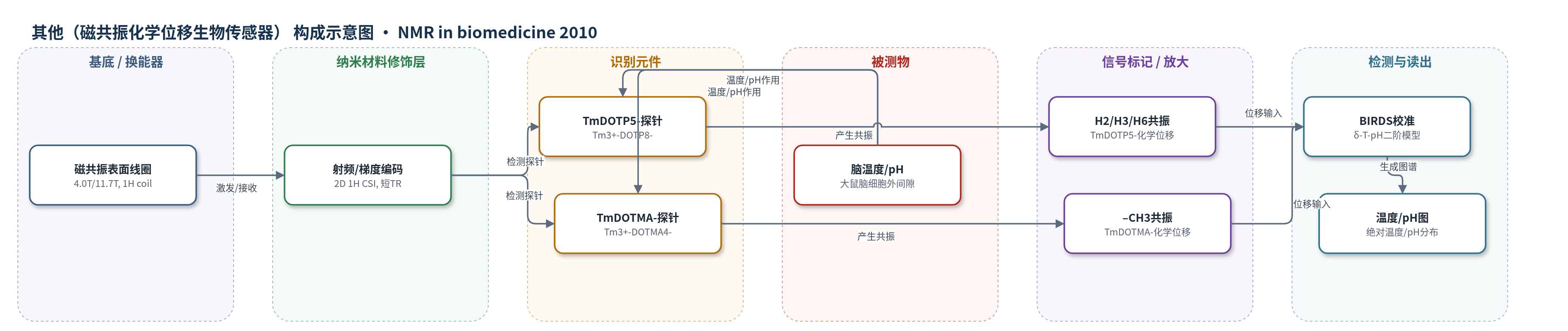
点击图片查看大图 · 依据论文自动绘制
传感器类型
其他(磁共振化学位移生物传感器)
检测对象
脑温度(brain temperature)、pH(pH);样品基质:大鼠脑细胞外间隙/血液(in vivo)及体外玻璃管模型
检测原理
BIRDS利用顺磁镧系配合物中质子化学位移对温度和pH的依赖进行生物传感。静脉注射TmDOTP5-或TmDOTMA-后,探针进入脑细胞外间隙/血液;局部温度或pH改变会改变Tm3+配合物中可观测质子的化学位移。TmDOTP5-的H2、H3和H6共振对温度与pH具有不同灵敏度,因此多个共振提供冗余信息,可联立解算温度和pH;TmDOTMA-的–CH3共振基本不受pH影响,主要随温度变化,温度灵敏度约0.7 ppm/°C,且信噪比高于TmDOTP5-的H6。高速2D 1H CSI在排除水信号的前提下采集各共振化学位移,再代入二阶校准模型δ=A+B·T+C·pH+D·T^2+E·pH^2+F·T·pH(TmDOTMA-简化为δ–T二次式)计算温度/pH。信号随被测参数变化表现为化学位移偏移,而非浓度变化。
检测灵敏度
温度灵敏度: TmDOTP5- H2 -0.6 ± 0.1 ppm/°C (4.0T)、-0.6 ± 0.1 ppm/°C (11.7T);H3 -0.5 ± 0.1 ppm/°C (4.0T/11.7T);H6 1.1 ± 0.1 ppm/°C (4.0T)、1.0 ± 0.1 ppm/°C (11.7T);TmDOTMA- –CH3 0.7 ± 0.1 ppm/°C (4.0T/11.7T);R = 0.99998(TmDOTMA-计算温度与热电偶测量温度线性拟合)
效应效果
体外模型中,TmDOTP5-可同时测温度/pH:45°C水浴平均温度为37.7±0.3°C和37.2±0.3°C,pH为7.39±0.04和7.02±0.06;35°C时为30.6±0.3°C和30.0±0.3°C,pH为7.39±0.04和7.03±0.06。TmDOTMA-仅响应温度:45°C为38.6±0.2°C和38.9±0.2°C,35°C为31.4±0.1°C和31.7±0.2°C。体内皮层平均温度为34.6±0.4°C(TmDOTP5-)和34.8±0.4°C(TmDOTMA-),深/浅层差约0.6°C。TmDOTMA- –CH3信噪比约为TmDOTP5- H6的5倍,SNR约15/25时温度标准差为0.008/0.002°C;一小时平均温度标准差为0.21/0.15°C。作者认为BIRDS灵敏度(1.0/0.7 ppm/°C)高于水基MRI法(0.01 ppm/°C),适用于啮齿动物功能研究。
传感器的构成
- 换能器/检测平台:4.0 T或11.7 T磁共振系统配1H表面线圈射频探头(1.0/1.4 cm),用于激发和接收质子化学位移信号
- 传感探针/识别元件:TmDOTP5-(Tm3+与DOTP8-配合物)或TmDOTMA-(Tm3+与DOTMA4-配合物),静脉注射后分布于脑细胞外间隙/血液,其质子化学位移响应温度和pH
- 信号标记/编码元件:TmDOTP5-的H2/H3/H6质子共振或TmDOTMA-的–CH3质子共振,作为温度/pH编码信号,无需额外标记物
- 样品基质/生物环境:大鼠脑细胞外间隙与血液(in vivo),或含4 mM探针、10% D2O、pH 7.0/7.4的体外玻璃管模型
- 读出/计算模块:高速2D 1H CSI序列与BIRDS多参数校准模型,将化学位移转换为温度/pH图
中文摘要
顺磁镧系离子与环状螯合物配合物的质子化学位移对生理温度和pH敏感。本文展示利用Tm3+与DOTMA4-形成的TmDOTMA-配合物在大鼠脑中进行绝对温度成像,并与基于DOTP8-的TmDOTP5-生物传感器比较。体外和体内结果表明,排除水信号的冗余位移偏差生物传感器成像(BIRDS)可提供精度良好的温度图。TmDOTP5-产生三个对温度和pH差异敏感的主要质子共振,可同时评估温度和pH;TmDOTMA-具有占主导的pH不敏感–CH3质子共振,可获得更高信噪比的温度评估。在4.0 T和11.7 T下,这些共振的温度/pH灵敏度基本一致,低场仅轻微损失信噪比。由于弛豫时间极短,需要高速化学位移成像(CSI)检测。重复体内CSI扫描显示稳定性优良。总体提示BIRDS可在低场或高场可靠用于啮齿动物功能研究。
英文摘要
Chemical shifts of complexes between paramagnetic lanthanide ions and macrocyclic chelates are sensitive to physiological variations (of temperature and/or pH). Here we demonstrate utility of a complex between thulium ion (Tm(3+)) and the macrocyclic chelate 1,4,7,10-tetramethyl 1,4,7,10-tetraazacyclododecane-1,4,7,10-tetraacetate (or DOTMA(4-)) for absolute temperature mapping in rat brain. The feasibility of TmDOTMA(-) is compared with that of another Tm(3+)-containing biosensor which is based on the macrocyclic chelate 1,4,7,10-tetraazacyclododecane- 1,4,7,10-tetrakis(methylene phosphonate) (or DOTP(8-)). In general, the in vitro and in vivo results suggest that Biosensor Imaging of Redundant Deviation in Shifts (BIRDS) which originate from these agents (but exclude water) can provide temperature maps with good accuracy. While TmDOTP(5-) emanates three major distinct proton resonances which are differentially sensitive to temperature and pH, TmDOTMA(-) has a dominant pH-insensitive proton resonance from a -CH(3) group to allow higher signal-to-noise ratio (SNR) temperature assessment. Temperature (and pH) sensitivities of these resonances are practically identical at low (4.0T) and high (11.7T) magnetic fields and at nominal repetition times only marginal SNR loss is expected at the lower field. Since these resonances have extremely short relaxation times, high-speed chemical shift imaging (CSI) is needed to detect them. Repeated in vivo CSI scans with BIRDS demonstrate excellent measurement stability. Overall, results with TmDOTP(5-) and TmDOTMA(-) suggest that BIRDS can be reliably applied, either at low or high magnetic fields, for functional studies in rodents.