组成图示
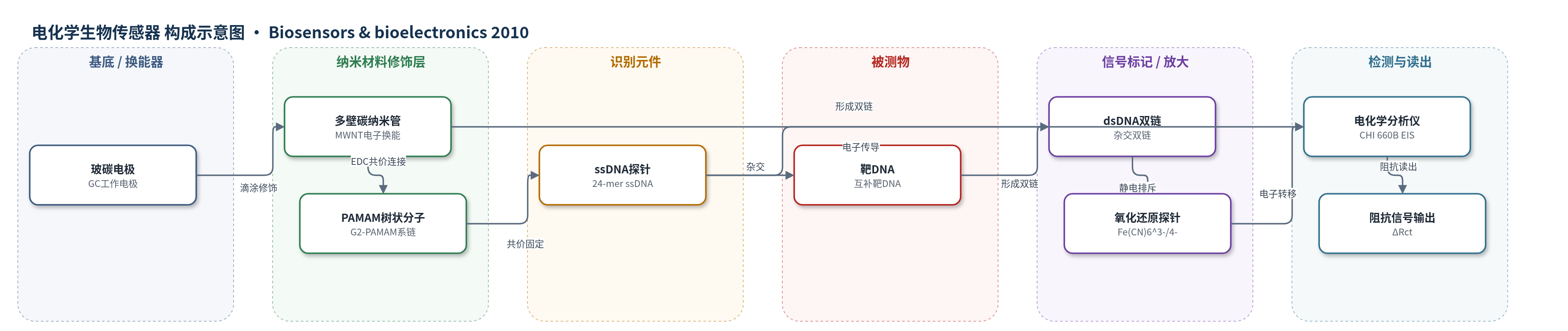
点击图片查看大图 · 依据论文自动绘制
传感器类型
电化学生物传感器
检测对象
靶DNA(target DNA,互补寡核苷酸);样品基质:0.30 M PBS杂交缓冲液
检测原理
传感器以MWNT/GC为导电换能器,G2-PAMAM通过EDC共价连接在MWNT表面,其末端氨基再经EDC共价固定ssDNA探针。当溶液中的互补靶DNA与表面ssDNA探针杂交形成dsDNA时,电极/电解质界面负电荷密度增加,dsDNA骨架磷酸基团与Fe(CN)6^3-/4-阴离子氧化还原探针之间静电排斥增强,阻碍氧化还原探针接近电极表面并降低电子转移速率,使EIS半圆直径对应的电荷转移电阻Rct增大。ΔRct随靶DNA浓度增加而增大,并与浓度对数呈线性关系。G2-PAMAM的多氨基结构提高探针表面密度,MWNT的高导电性和大比面积增强电子传导,共同实现无标记阻抗放大检测。
检测灵敏度
LOD: 0.1 pM (S/N = 3);线性范围: 0.5–500 pM(ΔRct与靶DNA浓度对数线性);灵敏度斜率: 652.3(ΔRct = 652.3 log C − 872.9,C单位fM);相关系数: ρ = 0.9976
效应效果
该传感器对互补靶DNA响应显著,对无靶缓冲液和非互补DNA的ΔRct变化可忽略,表明选择性良好。同一电极对同一浓度互补DNA重复5次杂交的RSD约为8.6%。传感器在PBS缓冲液中保存至少7天后阻抗信号基本不变,稳定性良好。用0.1 M NaOH处理120 s后,传感器信号可基本恢复,可重复使用。其检出限0.1 pM与多数电化学DNA传感器相当,并低于作者此前仅用CNT或G4-PAMAM/Au的电化学DNA传感器。作者认为该方法简单、灵敏、可靠,具有实际应用潜力。
传感器的构成
- 基底/工作电极:玻碳电极(GC),作为工作电极基底与电子传导支撑
- 纳米材料修饰层:纯化多壁碳纳米管(MWNTs,含羧基),滴涂于GC表面,增大电极活性面积并提供电子换能
- 树状分子系链层:第二代聚酰胺胺树状分子(G2-PAMAM,含30个氨基),经EDC与MWNT羧基共价连接,提供大量氨基用于固定探针DNA
- 识别元件:24-mer单链DNA探针(ssDNA probe),经EDC共价固定于G2-PAMAM氨基上,用于与靶DNA杂交
- 信号标记物:Fe(CN)6^3-/4-氧化还原探针(10 mM,1:1),用于EIS监测界面电荷转移电阻
- 检测读出:电化学分析仪(CHI 660B)进行EIS,读取ΔRct
- 清洗/再生处理:0.1% SDS、0.3 M PBS、蒸馏水去除非特异吸附;0.1 M NaOH处理120 s实现再生
中文摘要
本研究报道了一种新型阻抗法DNA生物传感器,将第二代聚酰胺胺树状分子(G2-PAMAM)共价功能化到纯化多壁碳纳米管(MWNT)电子换能器上,作为表面限制探针DNA的系链。G2-PAMAM/MWNT复合材料既用于固定单链DNA(ssDNA)探针,又作为电子换能器构建传感器。当表面ssDNA探针与溶液中的靶DNA杂交并在电极表面形成双链DNA(dsDNA)时,电极/电解质界面负电荷发生变化,使电极对Fe(CN)6^3-/4-氧化还原电对的界面电荷转移电阻改变,该变化用于阻抗法DNA检测。G2-PAMAM提供大量氨基,增加探针DNA表面结合量,从而提高对靶DNA的灵敏度。在实验条件下,界面电荷转移电阻变化与靶DNA浓度对数在0.5–500 pM范围内线性,检出限为0.1 pM(S/N=3)。该传感器具有优异的分析性能,具有实际应用潜力。
英文摘要
This study demonstrates a new impedimetric DNA biosensor with second-generation poly(amidoamine) dendrimer (G2-PAMAM) covalently functionalized onto multi-walled carbon nanotube (MWNT) electronic transducers as the tether for surface confinement of probe DNA. G2-PAMAM dendrimer was covalently functionalized onto purified MWNTs and the as-formed G2-PAMAM-functionalized MWNT composite (i.e., G2-PAMAM/MWNT) was used both as the support to confine the single-stranded DNA (ssDNA) probe and as the electronic transducer to form the DNA biosensors. Upon the occurrence of hybridization events between surface-confined ssDNA probe with target DNA in solution to form a double-stranded DNA (dsDNA) at electrode surface, the negative charge in the electrode/electrolyte interface and, as such, the interfacial charge-transfer resistance of the electrodes towards the Fe(CN)(6)(3-/4-) redox couple were changed. Such a change was used for the impedimetric DNA biosensing. The use of G2-PAMAM dendrimer attached onto MWNT electronic transducer as the tether for probe DNA provides a large number of amino groups to increase the surface binding of probe DNA, results in the increase the sensitivity of the impedimetric biosensor for the target DNA. Under the conditions employed here, the change in the interfacial charge-transfer resistance was linear with the logarithm of the concentration of the target DNA within a concentration range from 0.5 to 500 pM with a detection limit of 0.1 pM (S/N=3). The excellent analytical properties of the impedimetric DNA biosensors developed here substantially makes them potentially useful for practical applications.