组成图示
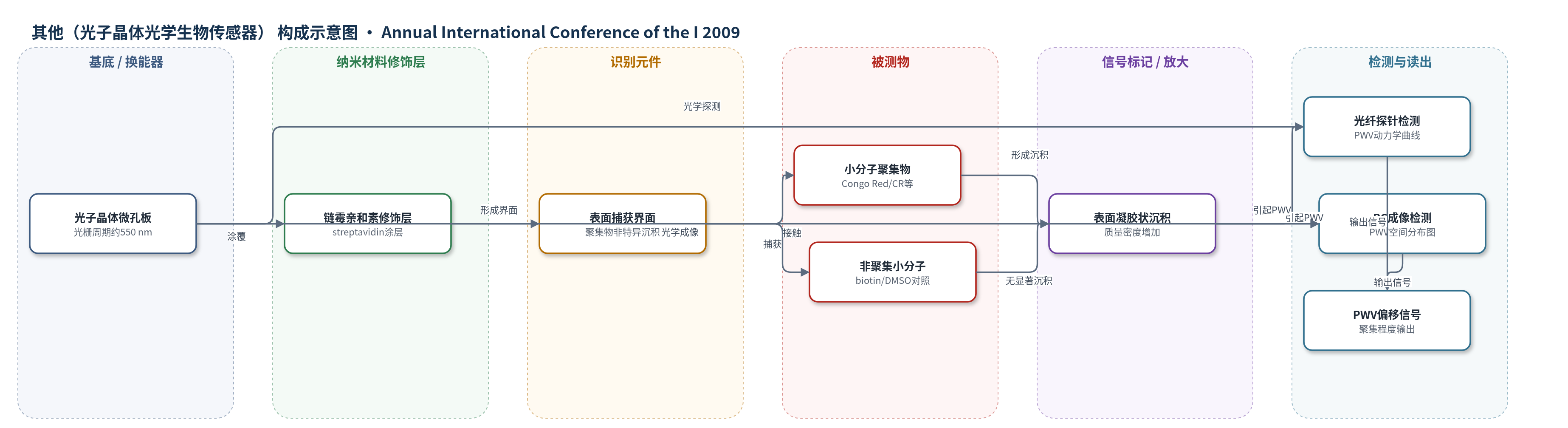
点击图片查看大图 · 依据论文自动绘制
传感器类型
其他(光子晶体光学生物传感器)
检测对象
小分子聚集物(small molecule aggregates,含刚果红 Congo Red/CR 等聚集剂)、非聚集小分子(nonaggregators,如生物素 biotin、DMSO 对照),样品基质为 PBS 缓冲液/DMSO 溶液(384 孔微孔板)
检测原理
小分子化合物在溶液中若形成多聚体或聚集物,会非特异性地吸附并沉积到链霉亲和素修饰的光子晶体表面,形成不规则凝胶状厚膜,填充光栅沟槽。该沉积增加表面质量密度和局部有效折射率,使光子晶体光学响应波长(PWV)发生红移。由于沉积物经三次缓冲液洗涤后仍保留,信号并非松散沉淀或溶液体相折射率变化所致。聚集物越多,表面沉积质量越大,PWV 偏移越大,因此可通过 PWV 随时间变化或空间分布定量识别聚集化合物。该方法无标记,直接测量吸附材料质量密度,并可在 384 孔微孔板中高通量实施。
检测灵敏度
原文未报告 LOD、线性范围、灵敏度斜率或相关系数。
效应效果
PC 生物传感器在 22 个测试化合物中,对 9 个化合物和阳性对照刚果红(CR)显示聚集信号,对 11 个化合物及 DMSO、生物素、缓冲液阴性对照无信号。SEM 证实化合物 8、19 表面存在凝胶状沉积,化合物 1、2 和 DMSO 表面清洁;PC 成像显示聚集物均匀覆盖整个传感器表面,洗涤三次后信号保留,说明沉积稳定且非体相折射率效应。与 α-胰蛋白酶比色法总体一致,但比色法受化合物颜色和沉淀干扰,且需浓度系列;DLS 对非球形聚集物误差大、标准差大,阴性对照约 100 nm,单样需 30–60 min,不适合高通量。作者认为 PC 微孔板方法简单、无标记、可直接定量表面沉积质量密度,并兼容自动液体处理。
传感器的构成
- 基底/换能器:光子晶体微孔板(PC biosensor microplate),表面具有光栅结构(grating,周期约550 nm),提供无标记光学换能。
- 识别/修饰层:链霉亲和素(streptavidin)涂层,修饰 PC 表面并作为识别/捕获界面,用于样品接触与聚集物沉积。
- 样品层:小分子化合物溶液(small molecule compounds,含刚果红 Congo Red/CR、生物素 biotin、DMSO、PBS 等),在 384 孔微孔板孔内与表面接触。
- 信号标记/放大:无标记(label-free),聚集物在表面形成凝胶状沉积(gel-like deposits),增加表面质量密度并引起光子晶体波长偏移(PWV shift)。
- 读出装置:光纤探针动力学检测仪器(fiber probe kinetic instrument)与 PC 成像检测仪器(PC imaging instrument),记录 PWV 随时间变化或空间分布。
- 对照/清洗:PBS 缓冲液(PBS)和 DMSO 溶剂对照,洗涤三次去除未结合物。
中文摘要
高通量筛选是药物发现中识别先导化合物的重要手段,但小分子库中相当比例的化合物具有聚集行为,常因非特异性结合靶蛋白而在多种筛选实验中产生假阳性。因此,高效识别并剔除筛选库中的聚集化合物可简化筛选流程。本文报道利用光子晶体(PC)光学生物传感器微孔板技术识别和定量小分子聚集。作者测试了一组已知聚集剂、非聚集剂及疑似聚集化合物,并将 PC 生物传感器测量结果与动态光散射(DLS)、α-胰蛋白酶比色法和扫描电子显微镜(SEM)进行比较。PC 生物传感器对聚集的测量经 SEM 直接观察证实,并与 α-胰蛋白酶法总体一致。作为无标记检测方法,PC 生物传感器聚集检测易于实施,可直接定量吸附到换能器表面材料的质量密度;微孔板格式还可兼容药物筛选中常用的高通量自动液体处理方法。
英文摘要
Small molecules identified through high-throughput screens are an essential element in pharmaceutical discovery programs. It is now recognized that a substantial fraction of small molecules exhibit aggregating behavior leading to false positive results in many screening assays, typically due to nonspecific attachment to target proteins. Therefore, the ability to efficiently identify compounds within a screening library that aggregate can streamline the screening process by eliminating unsuitable molecules from further consideration. In this work we show that photonic crystal (PC) optical biosensor microplate technology can be utilized to identify and quantify small molecule aggregation. A group of aggregators and nonaggregators were tested using the PC technology, and measurements were compared with those gathered by three alternative methods: dynamic light scattering (DLS), an alpha-chymotrypsin colorimetric assay, and scanning electron microscopy (SEM). The PC biosensor measurements of aggregation were confirmed by visual observation using SEM, and were in general agreement with the alpha-chymotrypsin assay. As a label-free detection method, the PC biosensor aggregation assay is simple to implement and provides a quantitative direct measurement of the mass density of material adsorbed to the transducer surface, while the microplate-based sensor format enables compatibility with high-throughput automated liquid handling methods used in pharmaceutical screening.