组成图示
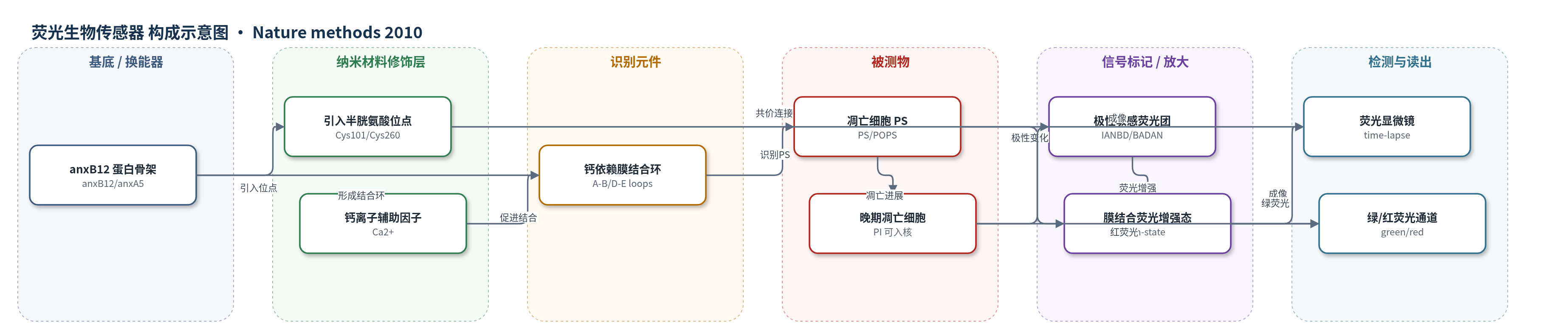
点击图片查看大图 · 依据论文自动绘制
传感器类型
荧光生物传感器
检测对象
磷脂酰丝氨酸(phosphatidylserine, PS)外翻、凋亡/退变细胞活力;样品基质:细胞培养液(COS-7 细胞、DRG 神经元)及大鼠坐骨神经组织。
检测原理
pSIVA 以 annexin B12/A5 为识别蛋白,在 Ca2+ 存在下特异性结合凋亡细胞质膜外叶暴露的磷脂酰丝氨酸(PS)。荧光团 IANBD 或 BADAN 通过引入的半胱氨酸连接在膜结合环上;游离于水相时处于极性环境,荧光较弱(off 态)。当 annexin 结合 PS 膜后,荧光团进入脂质双分子层的非极性环境,发生荧光增强和蓝移(on 态)。IANBD 标记的双位点 pSIVAm 在 500–550 nm 区间膜结合态荧光约增强 45 倍,BADAN 双标记在 420–470 nm 区间约增强 50 倍。荧光强度随 PS 暴露面积/凋亡细胞数量增加而升高,PS 回翻后信号可逆下降,经荧光显微镜时间序列读出。
检测灵敏度
原文未报告 LOD、线性范围、灵敏度斜率或相关系数。
效应效果
pSIVAm 对凋亡细胞具有选择性:正常 COS-7 细胞和含 NGF 的 DRG 神经元基本无荧光,背景不可检测;加入 pSIVAm 不影响细胞生长。NGF 剥夺诱导的神经元退变中,pSIVAm 荧光随 PS 暴露逐渐增强,PI 阳性出现前约 1 h 可见 PS 暴露;在 NGF 撤除后 7–15 h 内回补 NGF 可挽救神经元,荧光下降,表明结合可逆。体内大鼠坐骨神经离断后,pSIVAm 仅标记损伤远端轴突,对侧未损伤神经无信号。与 FITC 标记 anxA5 相比,pSIVAm 背景更低、信噪比更高,适用于活细胞和体内时间序列成像。
传感器的构成
- 识别蛋白层:annexin B12(anxB12)/annexin A5(anxA5),钙依赖结合磷脂酰丝氨酸(PS),构成识别元件
- 极性敏感荧光团层:IANBD 或 BADAN,经引入半胱氨酸共价连接,膜结合后荧光增强
- 双标记增强探针:pSIVAm(anxB12 Cys101,Cys260-IANBD),双荧光团提高信号强度
- 结合辅助因子:Ca2+,介导 annexin 与带负电 PS 膜结合
- 阴性对照探针:anxB12 Cys4-IANBD/BADAN,标记凹面水相位点,验证荧光变化源于膜结合
- 读出装置:荧光显微镜/时间序列显微镜(Axiovert 200、AxioCam MRm/Cascade:1K),检测绿/蓝荧光
中文摘要
细胞凋亡是许多生物学研究的核心问题,但缺乏能够以无毒、非侵入方式连续监测凋亡或细胞活力的方法。本文报道了一种适用于活细胞成像的工具,可在不扰动细胞环境的情况下实时可视化凋亡变化。作者设计了一种极性敏感的 annexin 基生物传感器(pSIVA),其具有可切换的荧光状态,仅当结合凋亡细胞时产生信号。利用 pSIVA 进行活细胞成像,观察到体外和体内大鼠神经元退变过程中单个神经元内动态的局部变化。此外,pSIVA 结合具有可逆性,并明确界定了神经元可被挽救的关键时间窗。作者预期 pSIVA 可广泛应用于研究凋亡过程的时间空间事件、可逆性以及培养细胞的整体活力。
英文摘要
Apoptosis is of central importance to many areas of biological research, but there is a lack of methods that permit continuous monitoring of apoptosis or cell viability in a nontoxic and noninvasive manner. Here we report the development of a tool applicable to live-cell imaging that facilitates the visualization of real-time apoptotic changes without perturbing the cellular environment. We designed a polarity-sensitive annexin-based biosensor (pSIVA) with switchable fluorescence states, which allows detection only when bound to apoptotic cells. Using pSIVA with live-cell imaging, we observed dynamic local changes in individual rat neurons during degeneration in vitro and in vivo. Furthermore, we observed that pSIVA binding was reversible and clearly defined the critical period for neurons to be rescued. We anticipate pSIVA can be widely applied to address questions concerning spatiotemporal events in apoptotic processes, its reversibility and the general viability of cells in culture.