组成图示
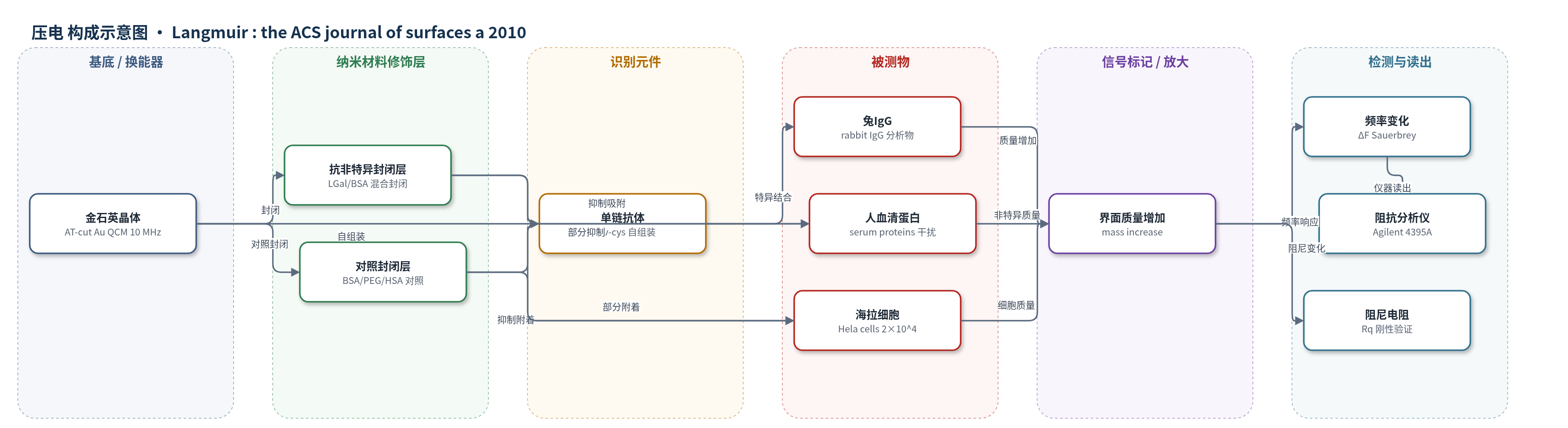
点击图片查看大图 · 依据论文自动绘制
传感器类型
压电(QCM)生物传感器
检测对象
兔IgG(rabbit IgG)、人血清蛋白(human serum proteins)、Hela细胞(Hela cells);样品基质:人血清(0.2%–100%)、PBS、Hela细胞悬液
检测原理
scFv-cys 通过 Au-S 自组装固定于金石英晶体表面,LGal/BSA 封闭未占据金位点,形成抗非特异吸附界面。兔IgG与scFv发生特异性识别并结合,使界面质量增加;QCM 依据 Sauerbrey 方程将质量变化转换为共振频率下降,1 Hz 约对应 1 ng 质量变化。人血清蛋白和Hela细胞若发生非特异吸附也会增加质量并降低频率,但 LGal/BSA 通过水化层/空间排斥抑制其吸附,从而降低背景。CV/EIS 以 Fe(CN)6^3-/4- 为氧化还原探针监测界面电子转移,验证封闭层不阻碍 IgG 结合。信号随兔IgG浓度增加而增大。
检测灵敏度
1 Hz对应1 ng(原文:1 Hz corresponds to a mass increase of 1 ng for the 10 MHz quartz crystal)
效应效果
LGal/BSA 封闭表面在 0.2%–1% 人血清中几乎完全抑制非特异蛋白吸附,优于 BSA 和 PEG-thiol;在 50% 人血清中仍保持高效兔IgG结合,100%血清中信号略降但仍显著高于 BSA 封闭表面在50%血清中的响应。表面暴露人血清超过10 h,基线稳定,说明抗血清干扰和稳定性好。对 2×10^4 Hela 细胞,LGal/BSA 表面频率变化很小,而 PEG 表面出现明显质量增加,显示抗细胞附着。阻尼电阻变化 |ΔRq|/Rq <1.5%,表明吸附层刚性,Sauerbrey 方程适用。作者认为该封闭体系可用于未稀释血清免疫传感、实时动力学测量及植入/抗生物膜材料。
传感器的构成
- 基底/换能器:AT-cut Au 石英晶体(10 MHz,面积0.23 cm²)或 Au 板电极,提供压电换能与金自组装表面
- 识别元件:scFv-cys 单链抗体(0.3 mg/mL,PBS,4°C 过夜)自组装于金表面,特异性结合兔 IgG
- 抗非特异封闭层:LGal/BSA 混合物(10 mg/mL lipoic galactose + 100 mg/mL BSA,1:1 v/v,3 h)封闭未占据金表面,抑制血清蛋白和细胞非特异吸附
- 对照封闭层:BSA(100 mg/mL)、PEG-thiol(1:1 v/v)、HSA(100 mg/mL)或单一 lipoic carbohydrates(10 mg/mL)用于比较
- 电化学探针:5 mM K3Fe(CN)6/K4Fe(CN)6 于 0.1 M KCl,用于 CV/EIS 监测界面电子转移
- 样品基质:人血清(0.2%–100%)、PBS 及 Hela 细胞悬液(2×10^4 cells),用于非特异吸附与特异结合测试
中文摘要
本研究将碳水化合物衍生的硫辛酸衍生物作为抗蛋白和抗细胞生物材料进行考察。采用石英晶体微天平(QCM)评价六类碳水化合物降低人血清和Hela细胞非特异性吸附的能力。结果表明,碳水化合物结构对抵抗非特异性结合具有重要作用。具体而言,抗非特异性吸附能力按硫辛酸岩藻糖 < 硫辛酸甘露糖 < 硫辛酸N-乙酰氨基葡萄糖 < 硫辛酸葡萄糖 < 硫辛酸唾液酸 < 硫辛酸半乳糖递增,其中硫辛酸半乳糖衍生物抗非特异性吸附能力最强。此外,硫辛酸半乳糖与牛血清白蛋白(BSA)的组合在降低未稀释人血清吸附和Hela细胞附着方面最有效,同时允许特异性结合。多项对照实验表明,硫辛酸半乳糖与BSA混合物的抗非特异性吸附能力与已知最佳降低非特异性吸附体系相当。
英文摘要
The carbohydrate-derived lipoic acid derivatives were studied as protein and cell resistant biomaterials. Six types of carbohydrates were examined for their abilities to reduce nonspecific adsorption of human serum and Hela cell using quartz crystal microbalance. Our data suggested that the structures of carbohydrates play an important role in resisting nonspecific binding. Specifically, the resistance was found to increase in the order lipoic fucose < lipoic mannose < lipoic N-acetyl glucosamine < lipoic glucose < lipoic sialic acid < lipoic galactose, where lipoic galactose derivative resisted most nonspecific adsorption. Furthermore, the combination of lipoic galactose and BSA was the most effective in reducing the adsorption of even undiluted human serum and the attachment of Hela cells while allowing specific binding. Several control experiments have demonstrated that the resistant-ability of mixed lipoic galactose and BSA was comparable to the best known system for decreasing nonspecific adsorption.