组成图示
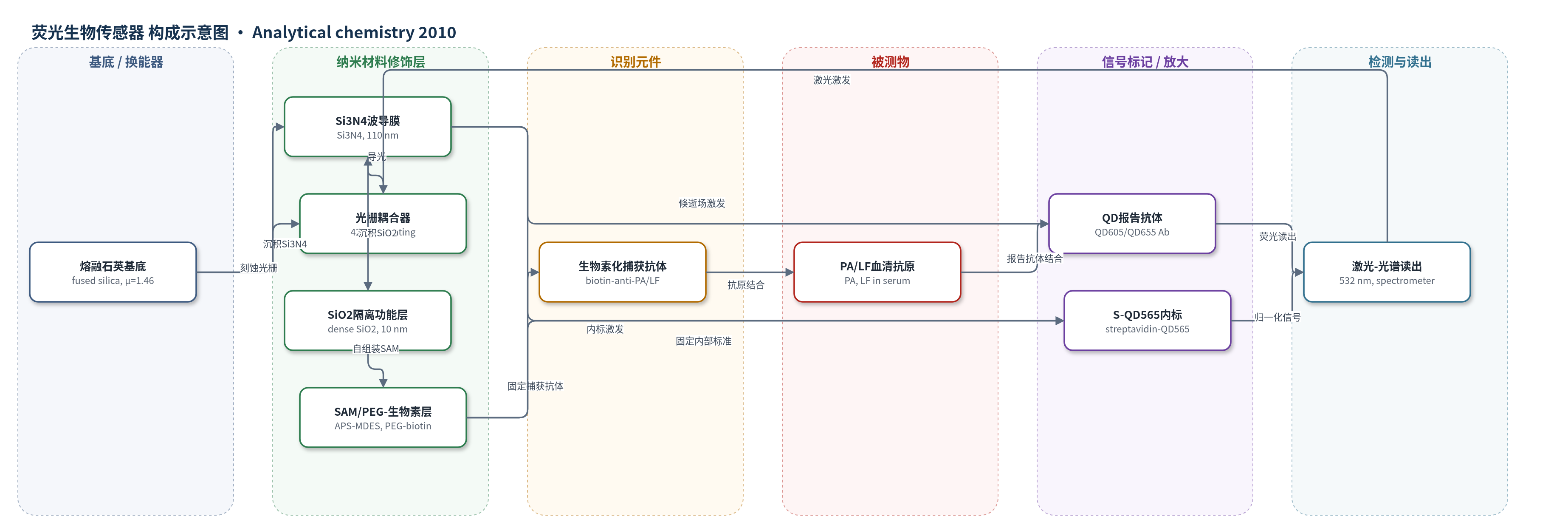
点击图片查看大图 · 依据论文自动绘制
传感器类型
荧光生物传感器
检测对象
炭疽杆菌保护性抗原(protective antigen,PA)、炭疽杆菌致死因子(lethal factor,LF);样品基质:血清(serum)
检测原理
传感器表面经氨基硅烷自组装单分子层和 PEG-生物素层功能化,生物素化捕获抗体通过生物素-亲和素化学固定。血清中的 PA 或 LF 与对应捕获抗体结合后,再加入分别标记 QD605 和 QD655 的报告抗体,形成夹心复合物。532 nm 激光经全息光栅耦合进入 Si3N4 平面波导,倏逝场在表面 200–400 nm 内衰减,只激发结合在表面的量子点,而溶液中游离 QD 和血清自发荧光不被检测,实现空间过滤。QD605 与 QD655 在单波长激发下产生不同发射峰,由光谱仪分辨,实现多重定量;S-QD565 作为内标用于归一化。抗原浓度升高使表面 QD 数量增加,荧光强度上升,约 >100 pM 后趋于饱和。
检测灵敏度
LOD: 1 pM each (PA and LF in serum)
效应效果
该传感器在血清中表现出低非特异结合和良好选择性:1 pM 抗原下 LF 信号/非特异结合比为 3.9,PA 为 1.75;波导背景约 100 RFU。与相同抗体的板法相比,波导平台 LOD 由 100 pM 降至 1 pM,且可在 15 min 内完成检测。多通道波导 12 个传感单元无荧光串扰,三通道四重复同时检测三个样品,与单通道数据高度一致。使用 S-QD565 内标归一化后,PA 的 CV 由 29.09% 降至 16.6%,LF 由 27.9% 降至 17.05%,显著改善批内/批间重复性。1 pM S-QD565 在 440 µW 激发下连续 20 次测量无显著光漂白。作者认为该平台可扩展至多种病原体或肿瘤标志物,用于复杂临床样品中的快速、定量、多重检测。
传感器的构成
- 基底:熔融石英光学抛光基底(fused silica,μ=1.46),承载波导与光栅。
- 波导层:氮化硅高折射率膜(Si3N4,110 nm ±5 nm),形成平面光学波导并产生倏逝场。
- 光栅耦合器:折射全息光栅耦合器(period 420 nm,532 nm/+10°),将激光耦合进波导。
- 隔离保护层:致密二氧化硅层(dense SiO2,≥1100 nm)覆盖光栅区,隔离倏逝场并保护光栅。
- 传感功能层:10 nm 二氧化硅膜(SiO2)沉积于 Si3N4 传感区,提供可功能化表面。
- 自组装单分子层:(3-aminopropyl)methyldiethoxysilane 自组装单分子层(SAM)与羧基端聚乙二醇链(PEG,0.1–10 mol% 生物素-PEG,表面生物素化 0.1%),抗非特异结合并提供生物素位点。
- 识别元件:生物素化抗 PA 捕获抗体(biotin-anti-PA)与生物素化抗 LF 捕获抗体(biotin-anti-LF),经生物素-亲和素化学固定,捕获目标抗原。
- 信号标记/内部标准:抗 PA-QD605 与抗 LF-QD655 报告抗体(anti-PA-QD605、anti-LF-QD655)及链霉亲和素-QD565 内标(S-QD565),提供荧光报告与归一化。
中文摘要
单一生物标志物难以准确预测疾病,理想生物检测技术应能定量、可重复、灵敏地检测有限标志物组合。本文报道基于平面光学波导的生物传感器平台,利用半导体量子点作为荧光报告物,对炭疽杆菌致死毒素的保护性抗原(PA)和致死因子(LF)进行多重检测。该平台可扩展至多种生物标志物,实现比传统免疫分析更快的定量、灵敏、多重检测。检测在复杂生物样品(如血清)中灵敏(各标志物检出限1 pM)、特异(非特异性结合低)且快速(15 min)。为改善测量重复性并提高通量,作者设计多通道波导,可同时以四重复检测三个样品中的标志物。论文给出多通道波导的设计、制备与开发,并展示其与单通道数据高度一致,可同时对三个样品中的炭疽致死毒素进行有效、可重复测量。
英文摘要
No single biomarker can accurately predict disease. An ideal biodetection technology should be capable of the quantitative, reproducible, and sensitive detection of a limited suite of such molecules. To this end, we have developed a multiplex biomarker assay for protective antigen and lethal factor of the Bacillus anthracis lethal toxin using semiconductor quantum dots as the fluorescence reporters on our waveguide-based biosensor platform. The platform is extendable to a wide array of biomarkers, facilitating rapid, quantitative, sensitive, and multiplex detection, better than achievable by conventional immunoassay. Our assay allows for the sensitive (limit of detection 1 pM each), specific (minimal nonspecific binding), and rapid (15 min) detection of these biomarkers in complex biological samples (e.g., serum). To address the issue of reproducibility in measurement and to increase our sample throughput, we have incorporated multichannel waveguides capable of simultaneous multiplex detection of biomarkers in three samples in quadruplicate. In this paper, we present the design, fabrication, and development of multichannel waveguides for the simultaneous detection of lethal factor and protective antigen in serum. Evaluation of the multichannel waveguide shows an excellent concordance with single-channel data and effective, simultaneous, and reproducible measurement of lethal toxins in three samples.