组成图示
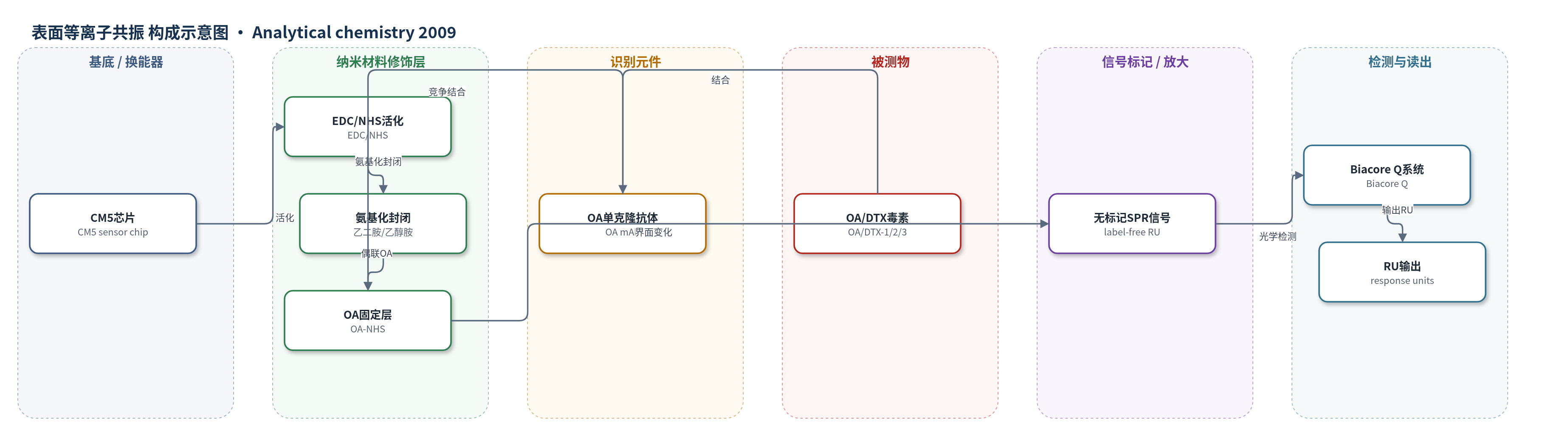
点击图片查看大图 · 依据论文自动绘制
传感器类型
表面等离子共振(SPR)生物传感器
检测对象
石房蛤酸(okadaic acid, OA)、膝沟藻毒素-1(dinophysistoxin-1, DTX-1)、膝沟藻毒素-2(dinophysistoxin-2, DTX-2)、膝沟藻毒素-3(dinophysistoxin-3, DTX-3);样品基质:贝类/贻贝组织提取物(shellfish/mussel matrix)
检测原理
该传感器采用SPR抑制免疫分析原理。CM5芯片经EDC/NHS活化、乙二胺氨基化和乙醇胺封闭后,共价固定OA-NHS衍生物,形成竞争捕获表面。样品中OA/DTX毒素与OA单克隆抗体结合,形成抗体-毒素复合物,从而减少可自由结合芯片固定OA的抗体量。将样品与抗体混合后注入芯片,游离抗体与固定OA结合引起界面质量/折射率变化,SPR系统以响应单位(RU)记录。毒素浓度越高,结合到芯片的抗体越少,RU响应越低,通过标准基质校准曲线定量。抗体对DTX-1和DTX-2的交叉反应与其毒性当量相近,使方法无需水解即可给出OA当量结果。
检测灵敏度
LOD: 31 µg/kg;工作范围/线性范围: 31-174 µg/kg;R^2 = 0.99 (CRM-DSP-Mus-b);R^2 = 0.97 (naturally contaminated mussel samples)
效应效果
方法对gymnodimine、yessotoxin、pectenotoxin和azaspiracid(250 µg/kg)无交叉反应。OA加标贻贝批内/批间平均CV和SD为7.9和10.1;80、160、200 µg/kg下CV为8.5、6.2、5.0。DTX-1回收率77%,DTX-2约60%,DTX-3在160 µg/kg下回收率75%且无需水解。芯片可稳定使用1000循环。与LC/MS/MS相比,CRM相关R²=0.99(y=1.25x),天然污染贻贝R²=0.97(y=0.86x)。行动限120 µg/kg,工作范围31–174 µg/kg,无假阴性,可替代小鼠生物试验用于DSP毒素快速筛查。
传感器的构成
- 基底/换能器:CM5传感器芯片(CM5 sensor chip),金表面羧甲基化,提供SPR信号换能基础
- 活化层:EDC/NHS活化羧基,形成NHS酯,用于共价偶联
- 氨基化/封闭层:1 M乙二胺(ethylene diamine)引入氨基,1 M乙醇胺盐酸盐(ethanolamine)封闭游离NHS酯
- 固定捕获层:OA-NHS衍生物共价偶联于芯片表面,作为竞争捕获分子
- 识别元件:OA单克隆抗体(OA mAb),工作稀释1/280,识别OA/DTX毒素
- 信号标记物:无标记(label-free),mAb结合引起SPR响应单位(RU)变化
- 读出系统:Biacore Q光学SPR生物传感器系统及Biacore Q软件,记录RU响应
中文摘要
本研究开发并完成了单实验室验证,建立了一种用于快速检测贝类基质中石房蛤酸(OA)及其结构相关毒素的光学生物传感器免疫分析方法。该方法采用一种单克隆抗体,其结合OA组毒素的顺序与其毒性一致,从而形成伪功能性检测体系。对OA定量检测的单实验室验证结果显示,方法行动限为120 µg/kg,检出限为31 µg/kg,工作范围为31–174 µg/kg;标准基质校准曲线中点为80 µg/kg,为现行法规限值的二分之一。阴性贻贝样品加标OA的批内和批间研究平均变异系数和标准差分别为7.9和10.1。方法还验证了同时检测并定量DTX-1、DTX-2和DTX-3的能力,且检测DTX-3无需碱水解。与液相色谱-串联质谱法相比,使用认证参考物质、实验室参考物质和天然污染贻贝样品均获得良好相关性(R²=0.99和0.97)。该新方法可作为替代动物试验的DSP毒素快速筛查手段。
英文摘要
A rapid analytical optical biosensor-based immunoassay was developed and validated for the detection of okadaic acid (OA) and its structurally related toxins from shellfish matrix. The assay utilizes a monoclonal antibody which binds to the OA group of toxins in order of their toxicities, resulting in a pseudofunctional assay. Single-laboratory validation of the assay for quantitative detection of OA determined that it has an action limit of 120 microg/kg, a limit of detection of 31 microg/kg, and a working range of 31-174 microg/kg. The midpoint on the standard matrix calibration curve is 80 microg/kg, half the current regulatory limit. Inter- and intra-assay studies of negative mussel samples spiked with various OA concentrations produced average coefficient of variation (CV) and standard deviation (SD) values of 7.9 and 10.1, respectively. The assay was also validated to confirm the ability to accurately codetect and quantify dinophysistoxin-1 (DTX-1), DTX-2, and DTX-3 from shellfish matrix. Alkaline hydrolysis was not required for the detection of DTX-3 from matrix. Excellent correlations with the data generated by the biosensor method and liquid chromatography/tandem mass spectrometry (LC/MS/MS) were obtained using a certified reference material (R(2) = 0.99), laboratory reference material, and naturally contaminated mussel samples (R(2) = 0.97). This new procedure could be used as a rapid screening procedure replacing animal-based tests for DSP toxins.