组成图示
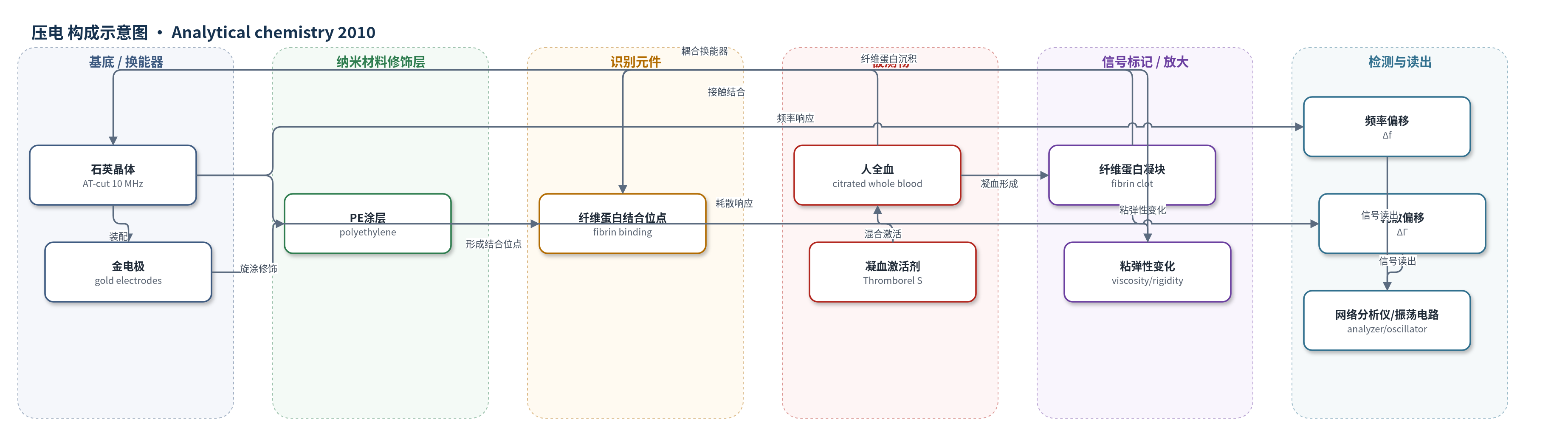
点击图片查看大图 · 依据论文自动绘制
传感器类型
压电(QCM)生物传感器
检测对象
凝血酶原时间(prothrombin time, PT);样品基质:枸橼酸抗凝人全血(Tris缓冲液稀释)
检测原理
枸橼酸抗凝人全血与Thromborel S混合后,其中的钙离子和组织因子激活外源性凝血途径:组织因子激活因子VII,进而激活因子X;活化因子X与因子Va、钙离子和磷脂形成凝血酶原酶复合物,将凝血酶原转化为凝血酶。凝血酶切割纤维蛋白原生成纤维蛋白单体并聚合为纤维。纤维蛋白在PE涂层表面锚定并沉积,同时液体粘度上升;后期凝块回缩使界面刚性增加。压电石英晶体受粘弹性负载后,谐振频率下降、耗散增加。作者取频率曲线局部极大(df/dt=0且d2f/dt2<0)作为凝血点tQCM,从而得到PT。稀释度越高,粘度变化越小,Δf和ΔΓ幅度越低。
检测灵敏度
原文未报告 LOD、线性范围、灵敏度斜率或相关系数。
效应效果
QCM测得的PT与商用机械凝血仪(Biomatic 2000、MC4plus)结果高度一致,Bland-Altman分析显示所有数据点位于均值±2SD范围内,且两种方法无系统性偏高或偏低。全血稀释度1:2至1:5时,凝血时间约20–60 s,频率偏移约100–400 Hz;稀释越高,粘度变化越小,标准差增大。自制振荡电路与网络分析仪结果相近,说明低成本读出可行。加入1.0 IU/mL肝素后PT延长,4 IU/mL肝素时无凝血发生;加入300 µg/mL polybrene可拮抗肝素并使PT恢复。作者认为该方法适合全血肝素状态监测,并可扩展至aPTT和纤溶检测,用于体外循环在线诊断。
传感器的构成
- 换能器基底:AT-cut 10 MHz 石英晶体,压电换能器,产生剪切波并响应质量/粘度变化
- 电极层:平行平面金电极,施加交流电压驱动石英并读出谐振
- 表面修饰层:聚乙烯(PE)薄膜,旋涂1% PE/十氢萘,提供凝血锚点并减少非特异吸附
- 识别/结合界面:PE涂层表面经全血预处理形成纤维蛋白结合位点,凝血时纤维蛋白纤维锚定/沉积
- 被测物/反应层:枸橼酸抗凝人全血,37°C下与Thromborel S混合后形成纤维蛋白凝块
- 信号读出:网络分析仪或自制振荡电路,监测频率偏移Δf和耗散偏移ΔΓ并确定凝血点tQCM
中文摘要
本文报道了一种基于石英晶体微天平(QCM)生物传感器测定人全血样品凝血酶原时间(PT)的新方法。在心血管治疗和手术中,血液接触人工表面时需要快速监测凝血与纤溶状态。研究采用10 MHz AT切石英晶体,其表面涂覆薄聚乙烯(PE)层,并用全血预处理以减少非特异吸附并提供凝血锚点。凝血激活剂Thromborel S加入枸橼酸抗凝全血后,纤维蛋白形成使液体粘度和界面刚性变化,导致石英谐振频率下降和耗散增加。作者同时使用网络分析仪和自制振荡电路进行驱动与读出,发现两种方法均可准确测定PT,并与机械凝血仪结果高度一致。实验还展示了肝素延长PT以及polybrene(多聚溴)拮抗肝素的作用。结果表明,QCM可用于全血PT测定和肝素治疗监测,并因微型化潜力和数字信号适合集成到体外循环血液回路中进行在线凝血诊断。
英文摘要
Monitoring of blood coagulation and fibrinolysis is an important issue in treatment of patients with cardiovascular problems and in surgery when blood gets into contact with artificial surfaces. In this work a new method for measuring the coagulation time (prothrombin time, PT) of human whole-blood samples based on a quartz crystal microbalance (QCM) biosensor is presented. The 10 MHz sensors used in this work respond with a frequency shift to changes in viscosity during blood clot formation. For driving and for readout of the quartz, both a network analyzer and an oscillator circuit were utilized. The sensor surfaces were specifically coated with a thin polyethylene layer. We found that both frequency analysis methods are suitable to measure exact prothrombin times in a very good conformity with a mechanical coagulometer as a reference. The anticoagulant effect of heparin on the prothrombin time was exemplarily shown as well as the reverse effect of the heparin antagonist polybrene. The change of the viscoelastic properties during blood coagulation, reflected by the ratio of frequency and dissipation shifts, is discussed for different dilutions of the whole-blood samples. In conclusion, QCM is a distinguished biosensor technique to determine prothrombin time and to monitor heparin therapy in whole-blood samples. Due to the excellent potential of miniaturization and the availability of direct digital signals, the method is predestinated for incorporation and integration into other devices and is thus opening the field of application for inline coagulation diagnostic in extracorporeal blood circuits.