组成图示
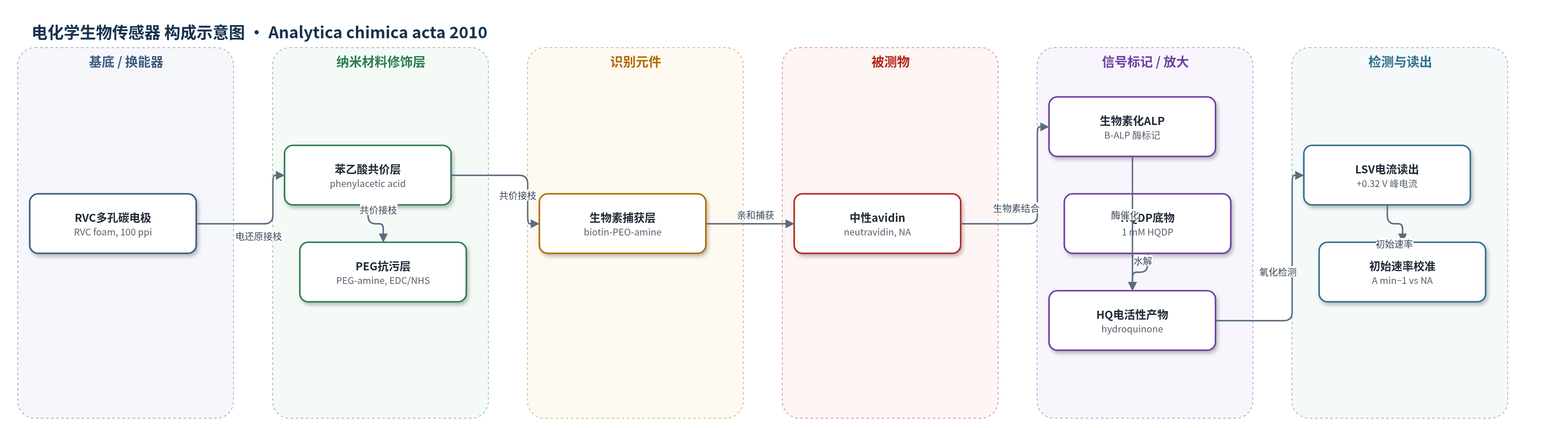
点击图片查看大图 · 依据论文自动绘制
传感器类型
电化学生物传感器
检测对象
中性avidin(neutravidin, NA);样品基质:Tris 缓冲液(pH 8)
检测原理
该传感器以多孔RVC为基底,孔内表面先经4-氨基苯乙酸重氮盐电还原形成苯乙酸共价层,再通过EDC/NHS将PEG-amine和biotin-PEO-amine共价接枝。PEG层通过空间位阻和水化作用抑制蛋白非特异性吸附,biotin-PEO-amine作为识别元件特异性捕获溶液中的中性avidin(NA)。捕获的NA进一步结合生物素化碱性磷酸酶(B-ALP),形成夹心结构。加入底物HQDP后,表面B-ALP催化HQDP水解生成电活性产物HQ;HQ在RVC孔道内积累并被LSV氧化,峰电流随时间增加。由于初始HQ生成速率与表面B-ALP量成正比,而B-ALP量随NA浓度增加,因此初始速率可定量NA。RVC多孔结构限制扩散损失,提高信号积累。
检测灵敏度
LOD: 52 ± 2 ng mL−1;绝对检测限: 5.2 ± 0.2 ng(100 µL 样品);线性范围: 1–20 µg mL−1;斜率: 2.13 ± 0.09 × 10⁻⁷ A min−1 µg−1 mL−1;R^2 = 0.993
效应效果
作者比较九种RVC修饰方案,发现type VI(苯乙酸/PEG-biotin-PEO-amine)NSB最低且SB较高。无NA空白初始速率仅8×10−8 A min−1,说明B-ALP主要经NA结合。中性avidin校准曲线R^2=0.993,LOD为52±2 ng/mL,100 µL样品绝对检测限5.2±0.2 ng。作者认为其接近近期电化学avidin方法,低于比色竞争抑制法和夹心法。RVC多孔结构利于信号积累,但重现性受孔分布和接触电阻影响,建议用电阻<50 Ω电极。
传感器的构成
- 基底/换能器电极:网状玻璃碳(RVC, 100 ppi)多孔碳泡沫,金线接触,提供高比表面孔道并作为电化学换能器
- 共价锚定层:4-氨基苯乙酸重氮盐电还原形成的苯乙酸(phenylacetic acid)层,提供羧基并降低疏水/负电抑制NSB
- 抗污封闭层:胺基聚乙二醇(PEG-amine, M.W. ~5000 Da)经EDC/NHS与羧基共价连接,形成PEG刷抑制蛋白吸附
- 识别元件:生物素-聚乙二醇胺(biotin-PEO-amine, M.W. 374.50)经EDC/NHS共价连接,作为生物素捕获配体结合中性avidin
- 信号标记物:生物素化碱性磷酸酶(B-ALP)与捕获的中性avidin结合,作为酶标记
- 底物/信号产物:二磷酸氢醌(HQDP)被ALP水解生成氢醌(HQ),作为电活性信号分子
- 信号读出:线性扫描伏安法(LSV)在+0.32 V检测HQ氧化峰电流,并以初始速率定量
中文摘要
本文报道了多种用于抑制网状玻璃碳(RVC)电极表面非特异性结合(NSB)的修饰策略,以改善电化学生物传感器在临床和环境分析中的适用性。作者以中性avidin(NA)、中性avidin-碱性磷酸酶偶联物(NA-ALP)和生物素化碱性磷酸酶(B-ALP)为模型蛋白,利用碱性磷酸酶底物二磷酸氢醌(HQDP)在RVC孔内被催化生成电活性产物氢醌(HQ),并通过线性扫描伏安法(LSV)测定HQ初始生成速率,评估不同修饰电极上NSB与特异性结合(SB)程度。结果表明,苯乙酸和聚乙二醇(PEG)功能化电极表现出较低的NSB;当修饰方案中包含生物素捕获配体时,可获得较高的SB。基于非特异性结合最低的RVC电极,作者建立了中性avidin夹心生物检测法,在100 µL样品体积下,中性avidin的浓度检测限为52 ± 2 ng/mL,绝对检测限为5.2 ± 0.2 ng。
英文摘要
Non-specific binding (NSB) of high-molecular-weight proteins onto electrode surfaces can complicate the application of electroanalytical techniques to clinical and environmental research, particularly in biosensor applications. We present herein various strategies to modify the surface of reticulated vitreous carbon (RVC) electrodes to suppress non-specific binding of biomolecules onto its surface. Non-specific binding and specific binding (SB) of two enzyme conjugates, neutravidin-alkaline phosphatase (NA-ALP) and biotinylated alkaline phosphatase (B-ALP), and also neutravidin itself, were studied using hydroquinone diphosphate (HQDP) as an enzyme substrate for ALP inside the pores of RVC electrodes that had been subjected to various modification schemes. The extent of NSB and SB of these biomolecules inside RVC pores was assessed by measuring the initial rate of generation of an electroactive product, hydroquinone (HQ), of the enzyme-catalyzed reaction, using linear scan voltammetry (LSV) for HQ detection. Electrodes functionalized with phenylacetic acid and poly(ethylene glycol) (PEG) showed low NSB and high SB (when biotin capture ligands were included in the modification scheme) in comparison with unmodified electrodes and RVC electrodes modified in other ways. A simple sandwich bioassay for neutravidin was performed on the RVC electrode with the lowest NSB. A concentration detection limit of 52+/-2 ng mL(-1) and an absolute detection limit of 5.2+/-0.2 ng were achieved for neutravidin when this assay was performed using a 100 microL sample size.