组成图示
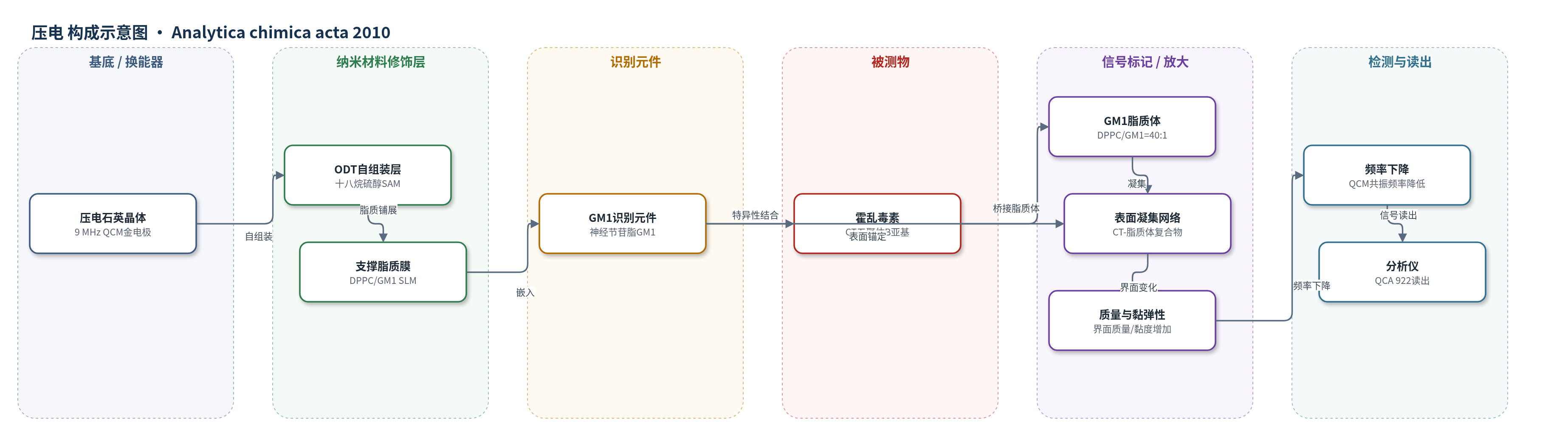
点击图片查看大图 · 依据论文自动绘制
传感器类型
压电(QCM)生物传感器
检测对象
霍乱毒素(cholera toxin, CT);样品基质:PBS缓冲液、CT阴性全血清(10倍稀释)
检测原理
金电极经十八烷硫醇(ODT)自组装单分子层修饰后,DPPC/GM1脂质体自发铺展形成含GM1的支撑脂质膜。CT的五个B亚基可特异性结合GM1。当CT加入含GM1脂质体的PBS中时,CT同时结合电极表面GM1和脂质体表面GM1,使脂质体在电极表面发生特异性凝集,形成CT-脂质体网络复合物。该网络带来大量质量负载,并显著改变界面密度与黏弹性。QCM在液相中频率变化由质量效应和黏弹性效应共同决定,凝集网络使两者叠加,产生比单纯表面结合更大的频率下降。CT浓度越高,凝集网络越大,频率下降或初始响应速率越大,表面凝集策略实现信号放大。
检测灵敏度
LOD: 50 ng mL−1(稳态频率法);LOD: 25 ng mL−1(初始速率法);线性范围: 0.1 μg mL−1–1 μg mL−1(稳态频率法);线性范围: 0.1 μg mL−1–5 μg mL−1(初始速率法);灵敏度斜率: 653.7 Hz/(μg mL−1)(稳态频率法);灵敏度斜率: 1.4 Hz s−1/(μg mL−1)(初始速率法);R^2 = 0.99(稳态频率法);R^2 = 0.99(初始速率法)
效应效果
该传感器对常见干扰蛋白和血清成分抗非特异吸附能力良好:1 μg/mL CT响应为738(39) Hz,而50 μg/mL BSA、HSA、人IgG、IgE、溶菌酶、凝血酶及10倍稀释CT阴性全血清响应分别为55(6)、40(5)、19(4)、60(7)、43(5)、39(4)、35(5) Hz,选择性较高。传感器可再生50次以上且灵敏度无明显损失;50次再生后对1 μg/mL CT的频率响应RSD为4.1%,20个独立制备传感器RSD为6.2%。ODT自组装表面可空气保存3个月以上。作者认为适合CT快速筛查和临床诊断,也可推广至抗体、适配体等蛋白检测。
传感器的构成
- 基底/换能器:9 MHz 压电石英晶体(QCM)金电极,提供压电换能与频率读出
- 自组装单分子层:十八烷硫醇(ODT)SAM,形成疏水界面并支撑脂质膜铺展
- 支撑脂质膜:DPPC/GM1 脂质体自发铺展形成的支撑脂质膜(SLM),提供生物相容界面
- 识别元件:单唾液酸神经节苷脂(GM1),嵌入 SLM,特异性结合 CT
- 凝集放大元件:GM1 功能化脂质体(DPPC/GM1=40:1),与 CT 形成表面凝集网络
- 被测物:霍乱毒素(CT),桥接电极表面 GM1 与脂质体 GM1
- 信号读出:石英晶体分析仪(QCA 922),监测共振频率下降
中文摘要
本文报道了一种基于神经节苷脂(GM1)功能化脂质体表面凝集的新型压电生物传感器,用于霍乱毒素(CT)检测。为实现电极表面的CT特异性凝集,金电极先自组装长链烷硫醇单分子层,再通过GM1功能化脂质体自发铺展形成GM1功能化支撑脂质膜。当存在CT时,检测介质中掺有GM1的脂质体通过CT同时结合电极表面GM1和脂质体界面GM1,在电极表面快速特异性凝集,导致压电晶体质量负载显著增加,并引起界面密度和黏度明显升高,从而使压电晶体共振频率下降。表面凝集反应中质量负载与界面黏弹性变化的协同作用,使该压电生物传感器对CT产生显著信号放大,检测限可低至25 ng/mL。这是首次基于GM1修饰脂质体特异性表面凝集实现CT检测。该支撑脂质膜传感界面易于制备并可再生,使其特别适用于蛋白质的简便、可重复和高灵敏测定。
英文摘要
A novel piezoelelctric biosensor has been developed for cholera toxin (CT) detection based on the analyte-mediated surface-agglutination of ganglioside (GM1)-functionalized liposomes. To achieve a CT-specific agglutination at the surface, the gold electrode is modified by a GM1-functionalized supported lipid membrane via spontaneous spread of the liposomes on a self-assembled monolayer of a long-chain alkanethiol. In the presence of CT, the GM1-incorporated liposomes in assay medium will rapidly specifically agglutinate at the electrode surface through the binding of CT to GM1 on the electrode surface and the liposome interface. This results in an enormous mass loading on the piezoelelctric crystal as well as a significant increase of density and viscosity at the interface, thereby generating a decrease in frequency of the piezoelelctric crystal. The combination of mass loading with interfacial change in the surface-agglutination reaction allows the developed piezoelelctric biosensor to show substantial signal amplification in response to the analyte CT. The detection limit can be achieved as low as 25 ng mL(-1) CT. This is the first demonstration on CT detection based on specific surface-agglutination of GM1-modified liposomes. The supported lipid layer based sensing interface can be prepared readily and renewably, making the developed technique especially useful for simple, reusable and sensitive determination of proteins.