组成图示
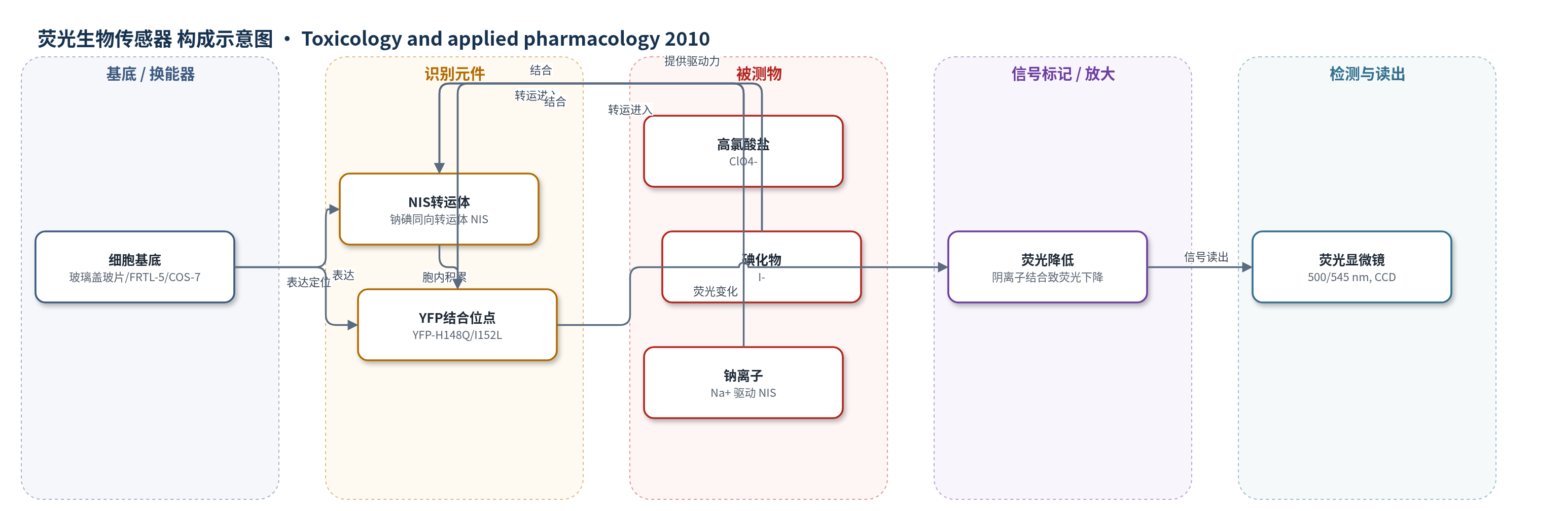
点击图片查看大图 · 依据论文自动绘制
传感器类型
荧光生物传感器
检测对象
高氯酸盐(perchlorate, ClO4-)、碘化物(iodide, I-);样品基质:FRTL-5 甲状腺细胞及 NIS 表达 COS-7 细胞的胞内环境。
检测原理
该传感器基于 NIS 介导的阴离子转运与 YFP-H148Q/I152L 的阴离子响应。细胞膜上的 NIS 利用 Na+ 电化学梯度将胞外 ClO4- 或 I- 转运入胞,使胞内游离阴离子浓度随暴露浓度和时间升高。胞内表达的 YFP-H148Q/I152L 具有靠近三肽发色团的阴离子结合位点,ClO4- 或 I- 结合后引起发色团质子化,导致荧光强度下降。荧光变化与胞内阴离子浓度按 [X]=Ka(Fmax-F)/(F-Fmin) 关系定量,其中 Ka 由体外或原位校准获得。实时荧光显微镜在 500/545 nm 下记录荧光,经背景扣除和光漂白校正后得到胞内浓度。高氯酸盐还可竞争性占据 NIS,抑制 I- 摄取,从而减弱碘化物诱导的荧光下降。
检测灵敏度
LOD: 50 μM perchlorate, 85 μM iodide(胞内,对应 ±2.1% 荧光变化)
效应效果
该传感器对 NIS 依赖的 ClO4-/I- 摄取具有选择性:无 NIS 的 COS-7 细胞响应低于 2%,且 FRTL-5 细胞中 ClO4- 诱导的荧光变化依赖 Na+,不受胞内 pH 或 Cl- 变化影响。响应可逆,重复加药可重现。定量显示胞内 ClO4- 积累比 I- 低约 10 倍,稳态胞内外比可达 75–80 倍;ClO4- 摄取半时 0.59 min,I- 为 1.18 min;Km 分别为 4.6 μM 和 34.8 μM,Vmax 分别为 6.8 μM/s 和 39.5 μM/s。ClO4- 抑制 I- 摄取的 IC50 为 1.6 μM(初始速率)和 1.1 μM(稳态),30 μM 时完全抑制且可逆。相比电生理、放射性示踪和 IC-MS/MS,该方法可实时监测游离胞内浓度,但 ClO4- 仅引起约 10–12% 荧光下降,亚毫摩尔灵敏度有限。
传感器的构成
- 细胞基底:玻璃盖玻片(glass coverslip)与 FRTL-5/COS-7 细胞,承载 YFP 表达、NIS 定位和实时成像。
- 转运识别元件:钠碘同向转运体(NIS),介导 ClO4-/I- 依赖 Na+ 进入细胞。
- 荧光报告元件:YFP-H148Q/I152L,胞内表达,结合阴离子后荧光降低。
- 阴离子结合位点:YFP-H148Q/I152L 中靠近三肽发色团的独特结合位点,结合 ClO4-/I- 引起发色团质子化。
- 原位校准元件:离子载体 nigericin、valinomycin 和 tributyltin,平衡胞内外阴离子与 pH 用于校准。
- 信号读出:倒置荧光显微镜(Zeiss Axiovert 200)、YFP 滤片(500/545 nm)、CCD 相机与 Metafluor 软件,实时记录荧光强度。
中文摘要
高氯酸盐是一种环境污染物,可通过与钠碘同向转运体(NIS)相互作用损害甲状腺功能。NIS 是甲状腺摄取碘化物的转运体,高氯酸盐既是碘化物转运的竞争性抑制剂,也可被 NIS 转运。本研究评估黄色荧光蛋白变体 YFP-H148Q/I152L 作为可遗传编码生物传感器,用于实时荧光显微镜监测细胞内高氯酸盐浓度。重组 YFP-H148Q/I152L 的荧光可被高氯酸盐和碘化物抑制,亲和力分别为 1.2 mM 和 1.6 mM。在 FRTL-5 甲状腺细胞和表达 NIS 的 COS-7 细胞中,高氯酸盐可抑制 YFP 荧光,但在缺乏 NIS 的 COS-7 细胞中无作用。FRTL-5 细胞中荧光变化依赖 Na+,与 NIS 活性一致。高氯酸盐摄取使细胞内浓度比碘化物低约 10 倍,并表现为更高亲和力(Km 4.6 μM 对 34.8 μM)和更低最大速度(Vmax 6.8 μM/s 对 39.5 μM/s)。高氯酸盐还可阻止碘化物诱导的荧光变化,半抑制浓度为 1.1–1.6 μM。结果表明,YFP-H148Q/I152L 可检测甲状腺及其他 NIS 表达细胞中高氯酸盐的积累,并揭示 NIS 转运高氯酸盐与碘化物的动力学差异。
英文摘要
Perchlorate is an environmental contaminant that impairs thyroid function by interacting with the sodium iodide symporter (NIS), the transporter responsible for iodide uptake in the thyroid gland. Perchlorate is well known as a competitive inhibitor of iodide transport by NIS, and recent evidence demonstrates that NIS can also transport perchlorate. In this study, we evaluated the yellow fluorescent protein (YFP) variant YFP-H148Q/I152L, as a genetically encodable biosensor of intracellular perchlorate concentration monitored by real-time fluorescence microscopy. Fluorescence of recombinant YFP-H148Q/I152L was suppressed by perchlorate and iodide with similar affinities of 1.2 mM and 1.6 mM, respectively. Perchlorate suppressed YFP-H148Q/I152L fluorescence in FRTL-5 thyroid cells and NIS-expressing COS-7 cells, but had no effect on COS-7 cells lacking NIS. Fluorescence changes in FRTL-5 cells were Na+-dependent, consistent with the Na+-dependence of NIS activity. Perchlorate uptake in FRTL-5 cells resulted in 10-fold lower intracellular concentrations than iodide uptake, and was characterized by a higher affinity (K(m) 4.6 microM for perchlorate and 34.8 muM for iodide) and lower maximal velocity (V(max) 6.8 microM/s for perchlorate and 39.5 microM/s for iodide). Perchlorate also prevented iodide-induced changes in YFP-H148Q/I152L fluorescence in FRTL-5 cells, with half-maximal inhibition occurring at 1.1-1.6 muM. In conclusion, YFP-H148Q/I152L detects perchlorate accumulation by thyroid and other NIS-expressing cells, and reveals differences in the kinetics of perchlorate versus iodide transport by NIS.