组成图示
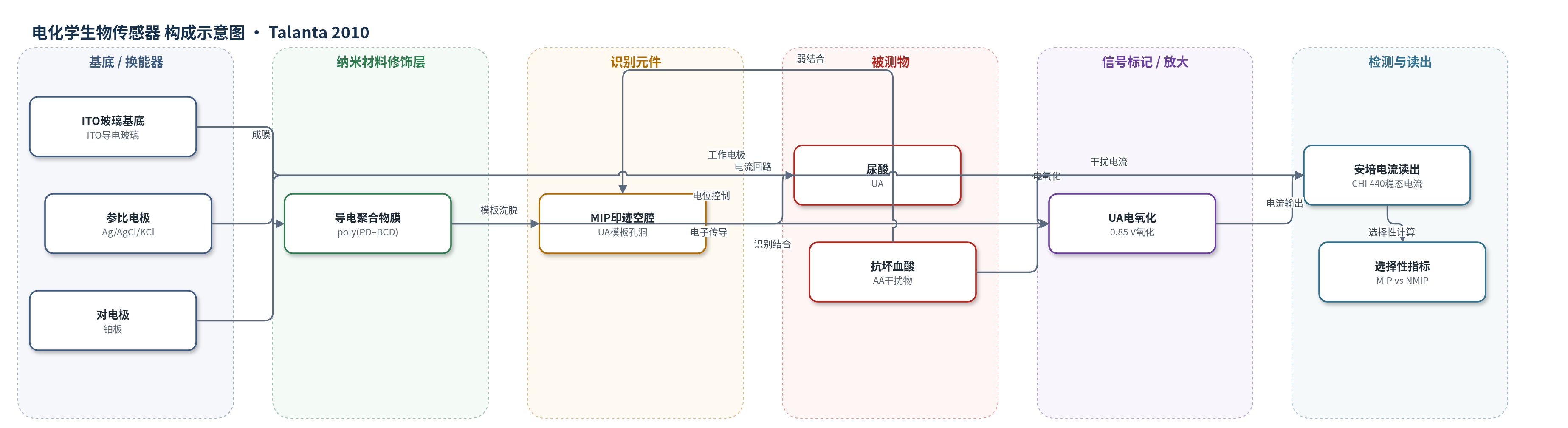
点击图片查看大图 · 依据论文自动绘制
传感器类型
电化学生物传感器
检测对象
尿酸(uric acid, UA);样品基质:人血清模拟样品(含抗坏血酸 AA)
检测原理
该传感器以 ITO 为工作电极基底,在其表面制备 poly(PD–BCD) 分子印迹聚合物薄膜。制备时以尿酸(UA)为模板,UA 与聚合物中的酮基、苯环氢等通过氢键和范德华作用形成互补结构;洗脱模板后留下几何匹配的空腔和扩散通道。检测时,溶液中的 UA 选择性进入 MIP 表面空腔并被识别富集,随后在 0.85 V 固定电位下发生电氧化,产生与 UA 浓度成正比的稳态安培电流。导电聚合物膜承担电子传导功能,印迹空腔提高 UA 的表面识别和吸附,使 MIP 电流高于 NMIP。该体系无酶、无外源标记,信号放大主要来自印迹位点对 UA 的选择性吸附和导电聚合物电子传导;膜厚过大会埋藏模板、减少表面位点并阻碍电子传导,因此 0.6 wt% 最佳。
检测灵敏度
LOD: 0.3 μM (S/N = 3);线性范围: 0–1.125 mM;灵敏度: MIP 24.72 μA mM−1 cm−2,NMIP 6.63 μA mM−1 cm−2;R^2 > 0.995
效应效果
MIP 电极对 UA 的印迹效率约为 3.73,灵敏度较 NMIP 提高约 3 倍。在模拟人血清条件下,0.04 mM 抗坏血酸(AA)的电流响应小于 0.4 mM UA 与 0.04 mM AA 共存总电流的 7%;MIP 电极对 UA/AA 的选择性为 28.76,明显高于 NMIP 的 8.85。NMIP 电极在 UA+AA 共存时电流比单独 UA 高约 48%,说明 AA 干扰更明显。MIP 电极在 1 mM UA 的 PBS/KCl 溶液中连续操作 40 次,平均电流密度为 20.6 ± 0.6 μA cm−2,无明显灵敏度下降,表明其可重复使用且稳定。作者认为该 MIP 电极可作为人血清中 UA 的电化学生物传感器,尤其适合在 AA 存在下选择性检测 UA。
传感器的构成
- 基底/换能器电极:ITO 玻璃(indium–tin oxide, ITO),导电工作电极基底;边缘用环氧胶带限定 1.0 cm × 1.0 cm,铜胶带(Cu tape)作汇流条
- 成膜溶剂:1-甲基-2-吡咯烷酮(NMP),溶解 poly(PD–BCD) 与 UA,成膜后程序升温去除
- 模板分子:尿酸(UA),1.5 mM,与 poly(PD–BCD) 形成印迹空腔,成膜后用水洗脱
- 修饰/识别层:poly(PD–BCD) 分子印迹聚合物薄膜(MIP),胺-酰亚胺型导电聚合物,提供 UA 识别空腔和电子传导通道
- 识别元件:MIP 表面孔洞/氢键位点,由 UA 模板洗脱后形成,选择性识别 UA
- 信号标记物:无外源标记物,UA 本身电活性,在 MIP 位点发生电氧化产生电流
- 电解液/电极体系:0.02 M PBS(pH 7.4)+ 0.1 M KCl 支持电解质;Ag/AgCl/饱和 KCl 参比电极和铂板对电极
- 信号读出:CHI 440 恒电位仪/恒电流仪,安培法在 0.85 V 测稳态电流密度
中文摘要
本文报道了一种新型胺-酰亚胺型导电聚合物 poly(PD–BCD) 分子印迹聚合物薄膜电化学生物传感器,用于尿酸(UA)检测。以 ITO 玻璃为基底,在不含功能单体的条件下,以 UA 为模板分子,将 poly(PD–BCD) 与 UA 在 NMP 中混合后滴涂成膜并程序升温去除溶剂,再洗脱模板形成印迹空腔。通过改变聚合物含量(0.3–0.9 wt%)调节膜厚,发现 0.6 wt% 时印迹效率和灵敏度最佳。MIP 电极对 UA 的灵敏度较相同方法制备的非印迹聚合物(NMIP)电极提高 3 倍以上。两种电极在 0–1.125 mM 范围内稳态电流与 UA 浓度呈线性关系,0.6 wt% MIP 和 NMIP 电极灵敏度分别为 24.72 和 6.63 μA mM−1 cm−2,MIP 检出限为 0.3 μM(S/N=3)。在模拟人血清样品中,MIP 电极可在抗坏血酸(AA)存在下选择性检测 UA,选择性分别为 28.76 和 8.85。循环伏安、线性扫描伏安、安培法和扫描电镜结果支持上述结论。
英文摘要
A novel amine-imide type conducting polymer, denoted as poly(PD-BCD), was molecularly imprinted on an indium-tin oxide (ITO) glass, with uric acid (UA) as the template and without any functional monomer. Intending to improve the imprinting efficiency, the polymer content was varied from 0.3 to 0.9wt% during the preparation of the molecularly imprinted polymer (MIP), thereby varying the thickness of the polymer film; the content of UA as the template was maintained to be the same for all the films. The sensitivities of the thus prepared MIP electrodes were calculated to be more than 3-fold, compared to those of the corresponding non-MIP (NMIP) electrodes, which were obtained through the same method, however, without adding UA during their preparation. A polymer content of 0.6wt% rendered the best performing MIP electrode, as judged by the imprinting efficiency and sensitivity of the electrode for UA. A linear relationship between steady-state currents and UA concentrations from 0 to 1.125mM was obtained for both types of the sensors. The sensitivities of the MIP and the NMIP electrodes made with 0.6wt% of polymer were calculated to be 24.72 and 6.63microAmM(-1)cm(-2), respectively. The limit of detection (LOD) for this MIP was found to be 0.3microM at a signal to noise ratio (S/N) of 3. This MIP electrode was used as a biosensor for the detection of UA in the presence of ascorbic acid (AA) in a sample containing these species in the same concentrations as those in a human serum. The selectivity of MIP electrode is higher than that of NMIP electrode, and the values are 28.76 and 8.85, respectively. The results are substantiated by using cyclic voltammetry (CV), linear sweep voltammetry, amperometry, and scanning electron microscopy.