组成图示
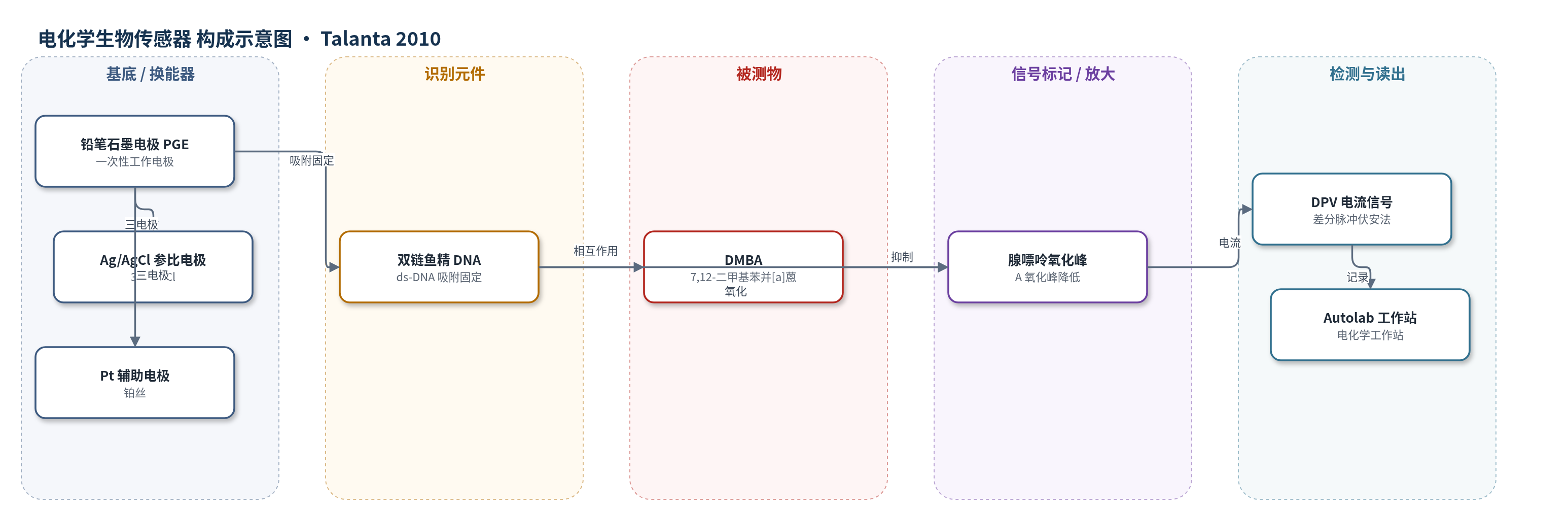
点击图片查看大图 · 依据论文自动绘制
传感器类型
电化学生物传感器
检测对象
7,12-二甲基苯并[a]蒽(DMBA);样品基质:水溶液、加标人尿、磷酸盐缓冲液(DNA 相互作用体系)
检测原理
该电化学 DNA 生物传感器以一次性铅笔石墨电极(PGE)为工作电极,先将双链鱼精 DNA(ds-DNA)在磷酸盐缓冲液(pH 7.4)中吸附固定于电极表面。DMBA 与表面 DNA 发生嵌入或共价加合物形成,改变腺嘌呤(A)的电子转移环境,使 A 的氧化峰电流降低。差分脉冲伏安法(DPV)在约 +1.20 V 处检测 A 氧化峰,DMBA 浓度越高,峰电流下降越明显;在 0–1 μg/mL 范围内呈线性,回归方程为 ip (μA) = −0.294 C (μg/mL) + 0.465。方法无外源标记,依靠 DNA 自身氧化信号和 300 s 相互作用实现检测;直接 AdSV 中 DMBA 也可在 +0.60 V 吸附富集后于 +1.15 V 氧化,峰电流随浓度增加。
检测灵敏度
水溶液 AdSV: LOD: 0.194 nM (49.7 ng L−1);线性范围: 2–10 nM;斜率: 0.217 μA/nM;回归方程: ip (μA) = 0.217 C (nM) −0.134;相关系数: 0.992。加标人尿: LOD: 0.04 μM;线性范围: 0.2–0.8 μM;斜率: 2.39 μA/μM;回归方程: ip (μA) = 2.39 C (μM) + 0.025;相关系数: 0.999。DNA 生物传感器: LOD: 11.8 ng mL−1 (ca. 46 nM)(表面固定)和 11.9 ng mL−1 (ca. 46 nM)(溶液相);线性范围: 0–1 μg mL−1;斜率: −0.294 μA/(μg/mL);回归方程: ip (μA) = −0.294 C (μg mL−1) + 0.465;相关系数: 0.999。
效应效果
水溶液 AdSV 在 6 nM 下 10 次重复 RSD 为 5.1%;加标人尿 3 次测量平均 RSD 为 2.9%,线性 0.2–0.8 μM,LOD 0.04 μM。尿样经乙腈沉淀、离心和介质交换后无明显电活性干扰,但信号低于纯水溶液。DMBA 的 DMSO 储备液暗处冰箱保存两周无明显变化。DNA 生物传感器无 DMBA 时平均峰高 374 nA、RSD 3.74%;表面相互作用后 166 nA、RSD 4.86%,溶液相 159 nA、RSD 13.46%;0.5–1 μg/mL 内 RSD≤8%。作者认为方法简单、快速、低成本,水溶液 LOD 0.194 nM 与色谱法相当,可用于环境水样筛查,尿样灵敏度需与 HPLC 联用提高。
传感器的构成
- 换能器电极:一次性铅笔石墨电极(PGE),作为工作电极,提供电子转导与伏安信号输出
- 电极活化:在支持电解质中施加 +1.4 V/60 s(或 +1.6 V/90 s)预处理,提高表面稳定性与灵敏度
- 识别元件:双链鱼精 DNA(ds-DNA),以吸附方式固定在 PGE 表面,作为 DNA 相互作用识别元件
- 支持电解质:0.05 M 磷酸盐缓冲液(phosphate buffer)含 0.02 M NaCl,pH 7.4,维持生理离子环境
- 信号标记物:无外源标记,利用 ds-DNA 腺嘌呤(A)自身氧化峰作为内源信号
- 三电极体系:Ag/AgCl(3 M NaCl)参考电极与 Pt 丝辅助电极,配合 PGE 完成伏安测量
- 信号读出:Autolab type III 电化学工作站,采用差分脉冲伏安法(DPV)/方波伏安法(SWV)记录电流
中文摘要
7,12-二甲基苯并[a]蒽(DMBA)是一种强致癌多环芳烃。本文首先用循环伏安法在玻璃碳电极和铅笔石墨电极上研究了非水介质(DMSO/LiClO4)中 DMBA 的氧化行为,发现其在高正电位发生不可逆两步氧化,并在较低电位形成还原/再氧化波。随后重点研究一次性铅笔石墨电极上吸附剥离伏安法结合介质交换在水溶液(pH 3.0–9.0)中的测定。方波剥离模式下,在醋酸缓冲液 pH 4.8、+1.15 V(vs. Ag/AgCl)处获得清晰峰,预富集电位 +0.60 V、时间 360 s,线性范围 2–10 nM,检出限 0.194 nM(49.7 ng/L),并用于加标人尿分析。最后基于腺嘌呤氧化信号降低,用差分脉冲伏安法检测 DMBA 与鱼精双链 DNA 的相互作用,300 s 相互作用后检出限约 46 nM,表明该电化学 DNA 生物传感器可用于快速、低成本检测 DMBA–DNA 相互作用。
英文摘要
7,12-Dimethylbenz[a]anthracene (DMBA), is a widely studied polycyclic aromatic hydrocarbon that has long been recognized as a very potent carcinogen. Initially, the electrochemical oxidation of DMBA at the glassy carbon and pencil graphite electrodes in non-aqueous media (dimethylsulphoxide with lithium perchlorate) was studied by cyclic voltammetry. DMBA was irreversibly oxidized in two steps at high positive potentials, resulting in the ill-resolved formation of a couple with a reduction and re-oxidation wave at much lower potentials. Special attention was given to the use of adsorptive stripping voltammetry together with a medium exchange procedure on disposable pencil graphite electrode in aqueous solutions over the pH range of 3.0-9.0. The response was characterized with respect to pH of the supporting electrolyte, pre-concentration time and accumulation potential. Using square-wave stripping mode, the compound yielded a well-defined voltammetric response in acetate buffer, pH 4.8 at +1.15V (vs. Ag/AgCl) (a pre-concentration step being carried out at a fixed potential of +0.60V for 360s). The process could be used to determine DMBA concentrations in the range 2-10nM, with an extremely low detection limit of 0.194nM (49.7ngL(-1)). The applicability to assay of spiked human urine samples was also illustrated. Finally, the interaction of DMBA with fish sperm double-stranded DNA based on decreasing of the oxidation signal of adenine base was studied electrochemically by using differential pulse voltammetry with a pencil graphite electrode at the surface and also in solution. The favorable signal-to-noise characteristics of biosensor resulted in low detection limit (ca. 46nM) following a 300-s interaction. These results displayed that the electrochemical DNA-based biosensor could be used for the sensitive, rapid, simple and cost effective detection of DMBA-DNA interaction.