组成图示
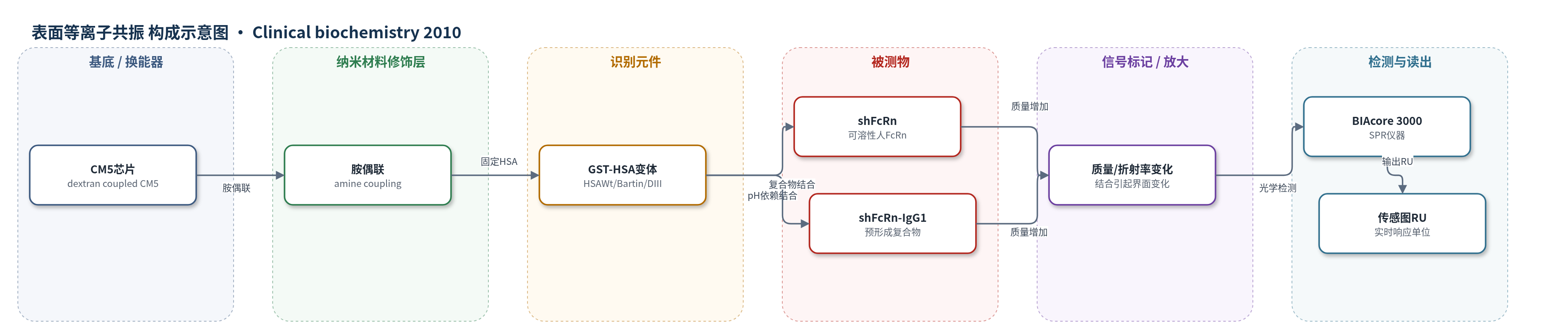
点击图片查看大图 · 依据论文自动绘制
传感器类型
表面等离子共振(SPR)生物传感器
检测对象
可溶性人新生儿 Fc 受体(soluble human FcRn, shFcRn)、shFcRn-人 IgG1 复合物;样品基质:重组蛋白缓冲液(磷酸盐缓冲液 pH 6.0/7.4、HBS/EP pH 7.4)。
检测原理
CM5 芯片表面通过胺偶联共价固定 GST 标记 HSA 变体,形成配体层。可溶性人 FcRn(shFcRn)在酸性 pH 6.0 下与 HSA 的 III 结构域(DIII)结合,在生理 pH 7.4 下结合显著减弱或不结合;shFcRn-人 IgG1 复合物也可结合 HSAWt,说明 FcRn 上 IgG 与白蛋白结合位点相互独立。结合事件使芯片表面质量/折射率增加,改变表面等离子体共振条件,BIAcore 3000 实时记录响应单位(RU)传感图。结合量随 shFcRn 浓度和亲和力变化,解离后信号回落。该方法无需标记或酶放大,直接以质量变化反映 pH 依赖结合;HSABartin 因缺失 DIII 无结合,HSADIII 保留结合。
检测灵敏度
—
效应效果
本研究用 ELISA 与 SPR 验证 FcRn 结合。ELISA 中 shFcRn 以 5–0.04 μg/mL 梯度捕获,HSA 变体 5 μg/mL,HRP 二抗 1:4000,TMB 显色 45 min,450 nm 读数;HSAWt 在 pH 6.0 结合强于 pH 7.4,HSABartin 无结合,HSADIII 信号略高,因其分子量约为 HSAWt 一半。SPR 中 HSAWt 固定量 1560 RU,HSABartin 2200 RU,100 nM shFcRn 在 pH 6.0 可逆结合,pH 7.4 无结合;shFcRn-IgG1 复合物仍可结合 HSAWt。作者认为 SPR 快速、实时、无需检测试剂,可用于临床白蛋白变体、化学修饰及白蛋白融合药物的 FcRn 筛选。
传感器的构成
- 基底/换能器:CM5 传感器芯片(dextran coupled CM5 sensor chip),提供表面等离子共振(SPR)换能表面。
- 固定/修饰层:胺偶联化学(amine coupling),将 GST 标记 HSA 变体共价固定于芯片表面。
- 识别/配体层:GST 标记人血清白蛋白变体(GST-HSAWt、GST-HSABartin、GST-HSADIII),作为 FcRn 结合配体。
- 分析物层:可溶性人 FcRn(shFcRn)或 shFcRn-人 IgG1 复合物,在 pH 6.0/7.4 下与固定 HSA 结合。
- 信号层:结合引起的表面质量/折射率变化,无需外源标记物。
- 读出层:BIAcore 3000 SPR 仪器,实时记录响应单位(RU)传感图。
中文摘要
新生儿 Fc 受体(FcRn)通过 pH 依赖结合挽救 IgG 和白蛋白免于降解,维持其血清水平。无白蛋白血症是一种罕见常染色体隐性遗传病,患者循环中白蛋白缺失或极低,相关白蛋白变体可能因 FcRn 结合改变而影响半衰期、分布和转运能力。本研究建立简便的克隆、表达和纯化策略,获得重组谷胱甘肽 S-转移酶(GST)标记人血清白蛋白(HSA)变体,并采用酶联免疫吸附测定(ELISA)和实时表面等离子共振(SPR)生物传感器系统评估其 pH 依赖 FcRn 结合特性。结果显示,纯化 GST 标记白蛋白变体中,类似临床剪接突变 Bartin 的截短 HSA 变体(HSABartin)与野生型 HSAWt 及仅含羧基末端 III 结构域(HSADIII)相比,未检测到 pH 依赖 FcRn 结合。该策略可快速筛选临床截短、突变或修饰 HSA 变体的 FcRn 结合特性,并证明 HSABartin 不与 FcRn 相互作用,从分子层面解释其低血清水平;同时 HSA DIII 单独仍保留 FcRn 结合能力。
英文摘要
BACKGROUND: : The major histocompatibility class I-related neonatal Fc receptor, FcRn, salvages both IgG and albumin from degradation and thus contributes to maintain high serum levels of these proteins. Analbuminemia is a rare autosomal recessive disorder characterized by clinically observed allelic albumin variants that are absent or found in very low concentrations in the blood circulation. Such variants may have altered FcRn binding properties that affect their half-life, biodistribution and thereby transport ability.
METHODS: : We established an easy cloning, expression and purification strategy to obtain recombinant GST-tagged human serum albumin (HSA) variants for evaluation of pH dependent FcRn binding properties using an enzyme-linked immunosorbent assay (ELISA) and a real time surface plasmon resonance (SPR) biosensor system.
RESULTS: : The strategy yielded purified GST-tagged albumin variants. A recombinant truncated HSA variant similar to a clinically observed splice mutant denoted Bartin, here abrogated HSA(Bartin), showed no detectable pH dependent FcRn binding compared to a fully functional albumin wild type variant, HSA(Wt), and a truncated HSA variant consisting of only the carboxy terminal domain III (HSA(DIII)).
CONCLUSIONS: : The approach described can be used to rapidly screen clinically observed truncated or otherwise mutant or modified HSA variants regarding their pH dependent FcRn binding properties. Here, we demonstrate that a recombinant truncated HSA variant, HSA(Bartin), does not interact with FcRn, which gives a molecular explanation for the low serum levels. In addition, DIII of HSA alone was shown to retain its FcRn binding property.