组成图示
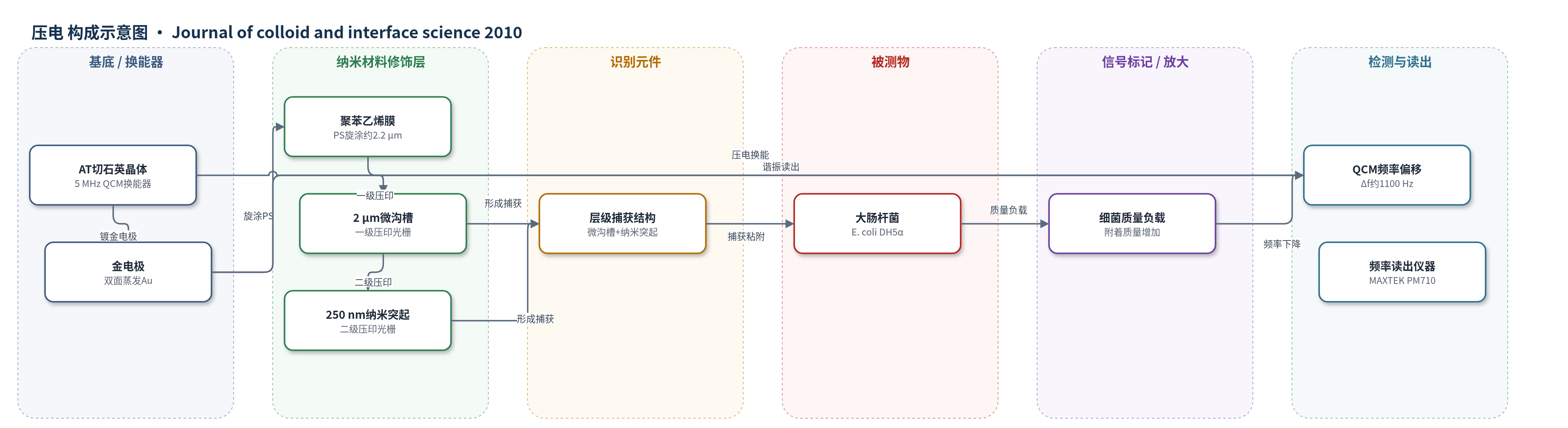
点击图片查看大图 · 依据论文自动绘制
传感器类型
压电(QCM)生物传感器
检测对象
大肠杆菌(Escherichia coli, E. coli),样品基质为 LB 肉汤细菌悬液(1×10^4 CFU/mL)
检测原理
该传感器采用物理捕获而非特异性生物识别。AT切石英晶体表面镀金后旋涂聚苯乙烯膜,并通过顺序纳米压印形成2 μm微沟槽与250 nm纳米突起的层级结构。将晶体浸入大肠杆菌LB悬液孵育时,细菌一方面被微沟槽机械捕获,另一方面通过鞭毛、菌毛等表面附属物粘附在纳米突起上;层级结构增大接触面积,使细菌在PBS冲洗后仍保留。附着细菌质量增加改变石英晶体谐振界面质量负载,使谐振频率下降。按Sauerbrey方程,频率偏移与吸附质量近似成正比,因此大肠杆菌浓度越高,附着质量越大,频率偏移越大。该方法无化学放大,主要依靠微纳拓扑结构增强捕获。
检测灵敏度
原文未报告 LOD、线性范围、灵敏度斜率或 R^2;在 1×10^4 CFU/mL 大肠杆菌悬液中,层级压印表面频率偏移约 1100 Hz,比无层级结构高 1–2 个数量级。
效应效果
在1×10^4 CFU/mL大肠杆菌悬液中,层级压印表面QCM频率偏移约1134和1127 Hz,裸片仅69 Hz,单层2 μm和250 nm分别为629和326 Hz;换算质量负载约19.97和19.84 μg/cm²,约为单层结构的2和4倍。LB肉汤对照仅180 Hz,说明培养基干扰可忽略;原文未报告RSD、稳定性或回收率。由于未用抗体,存在非特异性结合,作者建议未来引入抗体提高特异性。与文献中10^4–10^9 CFU/mL下20–350 Hz的QCM信号相比,本工作在更低浓度下获得约1100 Hz信号,表明灵敏度提升,可用于饮水和食品中大肠杆菌检测。
传感器的构成
- 换能器基底:AT切石英晶体(AT-cut quartz crystal),5 MHz谐振频率,面积0.316 cm²,提供压电换能。
- 电极层:双面蒸发金(Au)电极,作为QCM谐振电极与信号读出界面。
- 聚合物修饰层:聚苯乙烯(PS,Mw=45,000 g/mol)旋涂膜,约2.2 μm厚,作为可压印基底。
- 微结构层:2 μm光栅(1:1占空比、2 μm深)一级压印,形成微沟槽与微突起。
- 纳米结构层:250 nm光栅(1:1占空比、250 nm深)二级压印,形成纳米突起与纳米沟槽。
- 捕获/识别层:未使用抗体或适配体,依靠层级微沟槽捕获和纳米突起粘附固定大肠杆菌。
中文摘要
大肠杆菌检测对保障人类健康和公共安全具有重要意义。多数检测方法的关键步骤是使大肠杆菌细胞附着到生物传感器基底或换能器表面,因此基底产生的化学或物理增强效应有助于提高细菌检测灵敏度。本研究利用层级压印表面结构,在石英晶体微天平(QCM)的聚苯乙烯涂层谐振晶体上制备微纳层级结构。将晶体在降低浓度(1×10^4 CFU/mL)的大肠杆菌悬液中孵育后,其谐振频率偏移比无层级结构样品高1–2个数量级。该增强效应归因于基底表面积增大以及细菌固定方式的改变。扫描电子显微镜显示,层级基底既能将大肠杆菌捕获在微沟槽中,又能使其粘附在纳米突起上;而单层压印结构主要使细胞位于沟槽内或突起上方,不能同时实现两种固定方式。结果表明,层级聚合物表面可显著增强大肠杆菌附着,为细菌生物传感器灵敏度提升提供新策略。
英文摘要
Escherichia coli (E. coli) detection is important for ensuring human health and public security. One critical step in most detection methods is to have the E. coli cells attach to the substrate or transducer of a biosensor before they can be detected and/or identified. In this context, a chemical or physical enhancement effect arising from the substrate will help to achieve a high sensitivity of bacterial detection. This work makes use of hierarchically imprinted surface structures to demonstrate such effect using quartz crystal microbalance (QCM). Specifically, hierarchical structures are imprinted on polystyrene coated resonance crystals of QCM; such crystals, after incubation in an E. coli suspension of reduced concentration (1x10(4) colony forming units/mL), exhibit improved resonance frequency shifts, which are 1-2 orders of magnitude higher than those without the hierarchical structures. The enhancement effect is attributed to the enlarged surface area of the substrate and the way it immobilizes the bacteria. As revealed by scanning electron microscopy, the hierarchical substrates immobilize the E. coli cells by both trapping them in the micro-trenches and having them adhere to the nano-protrusions, while the single-level imprinted structures accommodate the cells mainly in the trenches or over the protrusions, instead of both.