组成图示
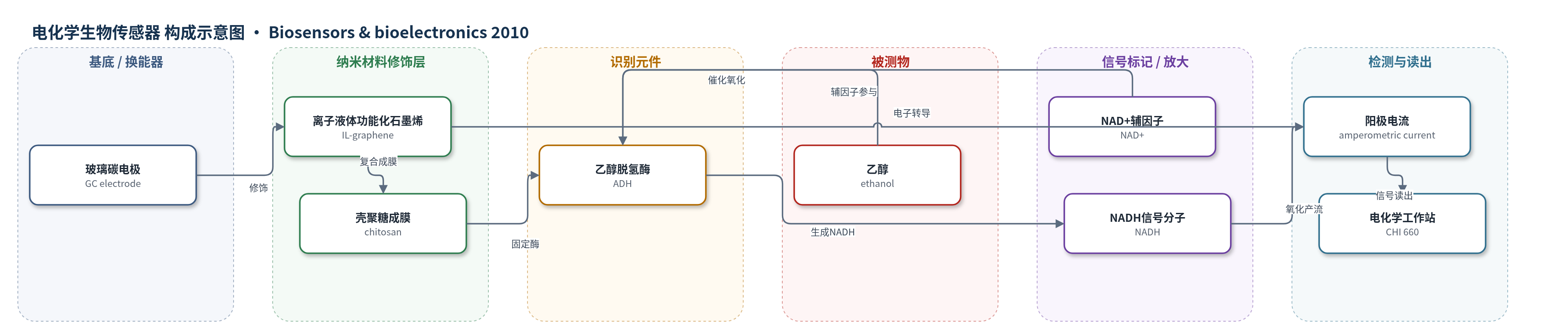
点击图片查看大图 · 依据论文自动绘制
传感器类型
电化学生物传感器
检测对象
NADH(β-NADH,PBS缓冲液)、乙醇(ethanol,PBS缓冲液及啤酒/葡萄酒实际样品)
检测原理
该传感器以玻璃碳电极为基底,IL-graphene/壳聚糖复合膜固定ADH。乙醇进入膜内后,在ADH催化下发生氧化,NAD+作为辅因子接受氢生成NADH。生成的NADH在修饰电极表面发生电化学氧化,电子经IL-graphene的高导电界面传递至GC电极,形成阳极电流。IL功能化石墨烯通过恢复石墨烯电子共轭、提高离子导电性和生物相容性,显著降低NADH氧化过电位并减少表面污损,使信号随乙醇浓度线性增强。安培法在固定电位下记录电流,电流大小与乙醇浓度成正比。
检测灵敏度
NADH:线性范围: 0.25–2 mM;灵敏度: 37.43 μA mM−1 cm−2;R^2 = 0.999。乙醇:LOD: 5.0 μM;线性范围: 25–200 μM;灵敏度: 6.91 nA μM−1 cm−2。
效应效果
该电极在AA存在下仍可选择性检测NADH,AA与NADH氧化峰分离约300 mV。NADH安培响应稳定,1 mM NADH中10、30、60 min后电流分别保持95.4%、90%和86%。乙醇传感器响应时间约20 s,对100 μM乙醇连续6次测量RSD为4.2%;4 ℃保存5天和15天后分别保留92.3%和82.8%初始响应。实际样品中啤酒和葡萄酒乙醇测定值分别为3.3±0.9%和37±1.2%(V/V),与供应商认证值3.6%和38%一致。作者认为该传感器成本低、制备简便、灵敏快速,适用于实际样品乙醇分析。
传感器的构成
- 基底/换能器电极:玻璃碳电极(GC electrode),抛光后作为工作电极,提供电子转导基底
- 纳米材料修饰层:离子液体功能化石墨烯(IL-graphene),由氧化石墨烯(GO)与1-(3-氨基丙基)-3-甲基咪唑溴化物(IL-NH2)反应并经NaBH4还原制备,降低NADH氧化过电位并促进电子转移
- 聚合物固定层:壳聚糖(chitosan),与IL-graphene混合成膜,固定纳米材料和酶,提供生物相容性
- 识别元件:乙醇脱氢酶(ADH),催化乙醇氧化并生成NADH
- 辅因子:β-NAD+(NAD+),作为ADH辅因子接受氢生成NADH
- 信号分子:NADH,酶反应产物,在电极表面氧化产生阳极电流
- 检测介质:磷酸盐缓冲液(PBS,0.05 M,pH 7.4),乙醇检测体系含5 mg mL−1 NAD+
- 信号读出:电化学工作站(CHI 660)配合铂丝辅助电极和Ag|AgCl参比电极,进行安培法/循环伏安法检测
中文摘要
本文首次报道了基于离子液体功能化石墨烯(IL-graphene)修饰电极的低电位NADH电化学检测及乙醇生物传感。IL-graphene/壳聚糖修饰电极使NADH氧化过电位显著降低约440 mV,氧化起始电位约为0 V(vs. Ag|AgCl),并在1 mM NADH溶液中表现出更稳定的安培响应:10 min和30 min后分别保留95.4%和90%初始活性,而裸玻璃碳电极仅保留68%和46%。该电极对NADH在0.25–2 mM范围内线性良好,灵敏度为37.43 μA mM−1 cm−2。IL-graphene可促进NADH与电极间的电子转移,为脱氢酶型安培生物传感器提供了新型生物相容平台。以乙醇脱氢酶(ADH)为模型酶,通过简单浇铸法构建ADH/IL-graphene/壳聚糖修饰电极,实现对乙醇快速、高灵敏的安培检测,检出限为5 μM。该传感器用于实际样品中乙醇测定,结果与供应商认证值一致,显示其应用潜力。
英文摘要
It is firstly reported that low-potential NADH detection and biosensing for ethanol are achieved at an ionic liquid-functionalized graphene (IL-graphene) modified electrode. A substantial decrease (440 mV) in the overvoltage of the NADH oxidation was observed using IL-graphene/chitosan coating, with oxidation starting at ca. 0 V (vs. Ag|AgCl). And the NADH amperometric response at such a modified electrode is more stable (95.4% and 90% of the initial activity remaining after 10 min and 30 min at 1 mM NADH solution) than that at bare electrode (68% and 46%). Furthermore, the IL-graphene/chitosan-modified electrode exhibited a good linearity from 0.25 to 2 mM and high sensitivity of 37.43 microA mM(-1)cm(-2). The ability of IL-graphene to promote the electron transfer between NADH and the electrode exhibited a novel and promising biocompatible platform for development of dehydrogenase-based amperometric biosensors. With alcohol dehydrogenase (ADH) as a model, the ADH/IL-graphene/chitosan-modified electrode was constructed through a simple casting method. The resulting biosensor showed rapid and highly sensitive amperometric response to ethanol with a low detection limit (5 microM). Moreover, the proposed biosensor has been used to determine ethanol in real samples and the results were in good agreement with those certified by the supplier.