组成图示
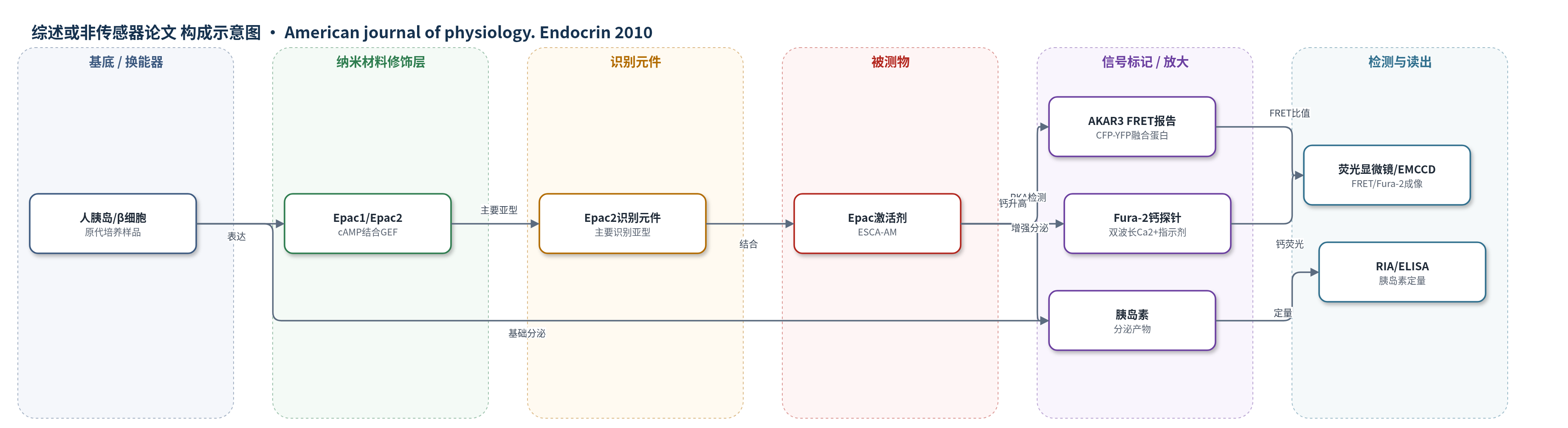
点击图片查看大图 · 依据论文自动绘制
传感器类型
综述或非传感器论文
检测对象
胰岛素(insulin,人胰岛灌流/静态孵育上清)、细胞内钙离子([Ca2+]i,人胰岛/β细胞活细胞成像)、PKA 活性(PKA activity,人胰岛裂解液/活细胞 AKAR3 FRET)
检测原理
8-pCPT-2′-O-Me-cAMP-AM 为脂溶性前药,进入人胰岛β细胞后被胞质酯酶水解为活性 Epac 选择性 cAMP 类似物,主要激活 Epac2 并上调 Rap1。该信号增强葡萄糖依赖的 KATP 通道关闭,使膜去极化,电压依赖钙通道开放,钙内流增加;同时促进钙诱导钙释放(CICR),使 [Ca2+]i 升高,触发胰岛素颗粒胞吐。AKAR3 作为 PKA 报告生物传感器,PKA 磷酸化其底物基序后引起 CFP-YFP FRET 比值变化;Fura-2 双波长荧光比值反映 [Ca2+]i;分泌到灌流液或孵育上清中的胰岛素用 RIA/ELISA 定量。1–10 μM 剂量范围内促泌和钙信号呈浓度依赖,PKA 抑制剂可阻断增强效应。
检测灵敏度
原文未报告 LOD、线性范围、灵敏度斜率或相关系数。
效应效果
10 μM 8-pCPT-2′-O-Me-cAMP-AM 在灌流体系中使第一相和第二相葡萄糖刺激胰岛素分泌分别增强 1.54 倍和 2.01 倍;静态孵育中 10 mM 葡萄糖本身刺激 2.7 倍,该化合物再增强约 1.5 倍,1–10 μM 呈剂量依赖。PKA 选择性类似物 Bt2-cAMP-AM 和 6-Bnz-cAMP-AM 有类似促泌作用。H-89(10 μM)或 Rp-8-CPT-cAMPS(200 μM)几乎消除其增强作用,并使基础分泌从 24.6 降至 21.6 或 18.5 ng·mL−1·30 min−1。β细胞去极化平均 37±5 mV,CICR 幅度 1640±665 nM,Epac2 mRNA 为 Epac1 的 29.9 倍。
传感器的构成
- 非传感器说明:无固定传感器结构(本文为人胰岛细胞生理研究)
- 样品基质:人胰岛/人胰岛β细胞(原代培养,提供检测对象与分泌产物)
- 识别/响应元件:Epac1/Epac2(cAMP 结合鸟苷交换因子,响应 8-pCPT-2′-O-Me-cAMP-AM)
- PKA 报告元件:AKAR3 FRET 生物传感器(CFP-YFP 融合蛋白,病毒转导表达,用于 PKA 活性成像)
- 钙指示剂:Fura-2 AM(双波长荧光探针,用于 [Ca2+]i 成像)
- 分泌产物:胰岛素(insulin,由胰岛分泌,进入灌流液/孵育上清)
- 定量读出:RIA/ELISA(放射免疫分析或酶联免疫吸附测定,定量胰岛素)
中文摘要
本研究评估了可激活 Epac1 和 Epac2 的 cAMP 类似物乙酸甲酯 8-pCPT-2′-O-Me-cAMP-AM 在人朗格汉斯胰岛中的胰岛素促泌作用。RT-QPCR 显示人胰岛主要表达 Epac2,同时可检测到 Epac1。在胰岛灌流条件下,10 μM 8-pCPT-2′-O-Me-cAMP-AM 可增强 10 mM 葡萄糖刺激的第一相和第二相胰岛素分泌,但不影响 3 mM 葡萄糖下的基础分泌。该促泌作用伴随 β 细胞去极化和胞内钙浓度升高,反映钙内流与胞内钙动员。作为 Epac 选择性 cAMP 类似物,10 μM 化合物未刺激 PKA 底物 CREB 和 Kemptide 磷酸化,也不能激活病毒转导表达的人胰岛细胞 AKAR3 PKA 生物传感器。然而,PKA 抑制剂 H-89 或阻断 PKA 激活的 cAMP 拮抗剂 Rp-8-CPT-cAMPS 几乎完全消除其对葡萄糖刺激胰岛素分泌的增强作用。结论认为,人胰岛胰岛素分泌存在一种葡萄糖依赖且受 Epac 调控的允许性 PKA 活性,可能作用于钙依赖胞吐的颗粒募集、准备和/或后准备步骤。
英文摘要
Potential insulin secretagogue properties of an acetoxymethyl ester of a cAMP analog (8-pCPT-2'-O-Me-cAMP-AM) that activates the guanine nucleotide exchange factors Epac1 and Epac2 were assessed using isolated human islets of Langerhans. RT-QPCR demonstrated that the predominant variant of Epac expressed in human islets was Epac2, although Epac1 was detectable. Under conditions of islet perifusion, 8-pCPT-2'-O-Me-cAMP-AM (10 microM) potentiated first- and second-phase 10 mM glucose-stimulated insulin secretion (GSIS) while failing to influence insulin secretion measured in the presence of 3 mM glucose. The insulin secretagogue action of 8-pCPT-2'-O-Me-cAMP-AM was associated with depolarization and an increase of [Ca(2+)](i) that reflected both Ca(2+) influx and intracellular Ca(2+) mobilization in islet beta-cells. As expected for an Epac-selective cAMP analog, 8-pCPT-2'-O-Me-cAMP-AM (10 microM) failed to stimulate phosphorylation of PKA substrates CREB and Kemptide in human islets. Furthermore, 8-pCPT-2'-O-Me-cAMP-AM (10 microM) had no significant ability to activate AKAR3, a PKA-regulated biosensor expressed in human islet cells by viral transduction. Unexpectedly, treatment of human islets with an inhibitor of PKA activity (H-89) or treatment with a cAMP antagonist that blocks PKA activation (Rp-8-CPT-cAMPS) nearly abolished the action of 8-pCPT-2'-O-Me-cAMP-AM to potentiate GSIS. It is concluded that there exists a permissive role for PKA activity in support of human islet insulin secretion that is both glucose dependent and Epac regulated. This permissive action of PKA may be operative at the insulin secretory granule recruitment, priming, and/or postpriming steps of Ca(2+)-dependent exocytosis.